
Powerful X5.8 solar flare erupts from Region 3664 during G5 – Extreme geomagnetic storm
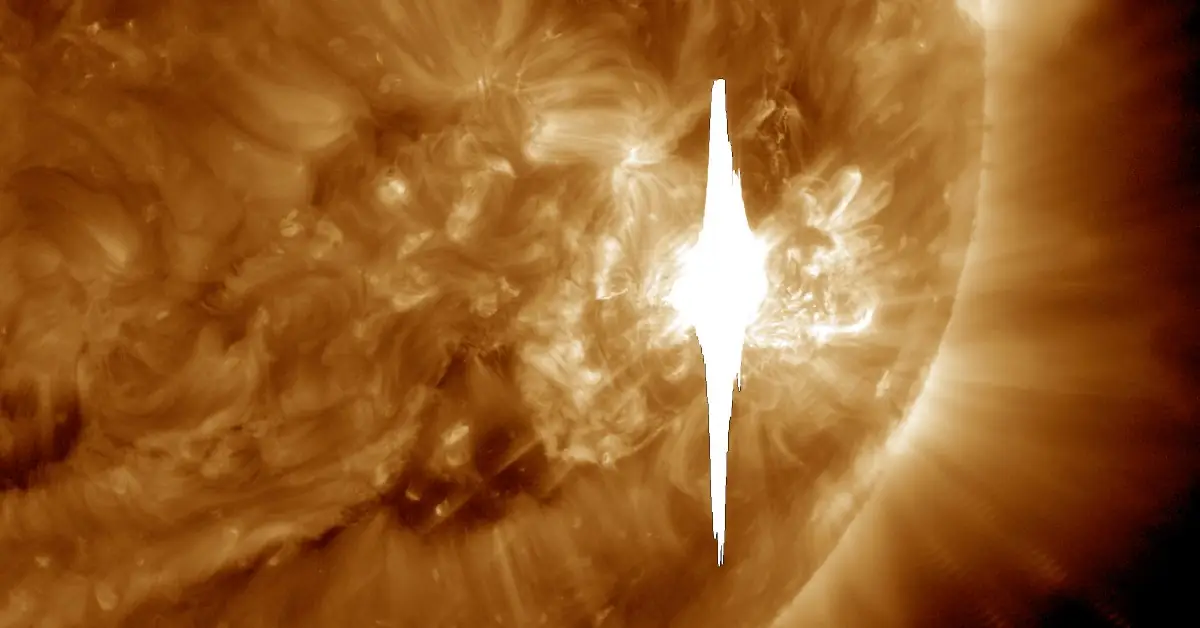
Featured image: X5.8 solar flare on May 11, 2024. Credit: NASA SDO/AIA 211
A major solar flare measuring X5.8 erupted from Active Region 3664 at 01:23 UTC on May 11, 2024. The event started at 01:10 and ended at 01:39 UTC. It took place during G5 – Extreme geomagnetic storm, producing another Earth-directed coronal mass ejection (CME).
Today’s X5.8 is the second strongest solar flare of the current solar cycle — Solar Cycle 25 — after X6.3 on February 22, 2024. It is also the 11th X-class flare since X1.3 on May 5, 2024.
A Type IV and II radio emissions (estimated velocity of 564 km/s), were associated with the flare event, suggesting a strong coronal mass ejection (CME) was produced.
Additionally, a 10cm Radio Burst (tenflare) lasting 23 minutes and with a peak flux of 800 sfu was associated with this event, indicating that the electromagnetic burst associated with a solar flare at the 10cm wavelength was double or greater than the initial 10cm radio background. This can be indicative of significant radio noise in association with a solar flare. The noise is generally short-lived but can cause interference for sensitive receivers including radar, GPS, and satellite communications.
Radio frequencies were forecast to be most degraded over east Asia, Australia, New Zealand, and the Pacific Ocean all the way to Alaska, U.S., and Canada at the time of the flare.


An associated fast, halo CME produced by this flare is expected to merge with the preceding in-transit CMEs and arrive at Earth by 12:00 UTC on May 12, SWPC forecasters said.


The total number of Earth-directed CMEs since May 6 is now more than 7. This is complicating analysis and making any CME impact forecast hard to make.

Increased solar activity in May 2024
The Sun has been extremely active since the beginning of the month, producing 83 M-class and 11 X-class flares from May 1 to 11.
The strongest thus far was today’s X5.8, followed by X4.5 on May 6, and X3.9 on May 10.
| Max class | Time (UTC) |
|---|---|
| X5.8 | 05/11, 01:23 |
| M3.8 | 05/10, 21:08 |
| M1.9 | 05/10, 20:03 |
| M1.1 | 05/10, 19:53 |
| M2.0 | 05/10, 19:05 |
| M1.7 | 05/10, 18:48 |
| M1.1 | 05/10, 18:32 |
| M5.9 | 05/10, 14:11 |
| M2.2 | 05/10, 10:14 |
| X3.9 | 05/10, 06:54 |
| M1.3 | 05/10, 06:24 |
| M1.4 | 05/10, 03:29 |
| M1.3 | 05/10, 00:13 |
| M1.5 | 05/9, 23:51 |
| M1.2 | 05/9, 23:08 |
| M2.6 | 05/9, 22:41 |
| M1.0 | 05/9, 22:15 |
| M1.0 | 05/9, 21:21 |
| X1.1 | 05/9, 17:44 |
| M3.7 | 05/9, 13:23 |
| M2.9 | 05/9, 12:12 |
| M3.1 | 05/9, 11:56 |
| X2.2 | 05/9, 09:13 |
| M2.1 | 05/9, 08:40 |
| M2.4 | 05/9, 06:27 |
| M2.3 | 05/9, 06:13 |
| M1.7 | 05/9, 04:49 |
| M4.5 | 05/9, 03:32 |
| M4.0 | 05/9, 03:17 |
| X1.0 | 05/8, 21:40 |
| M1.7 | 05/8, 20:34 |
| M2.0 | 05/8, 19:21 |
| M2.9 | 05/8, 18:36 |
| M7.9 | 05/8, 17:53 |
| M8.6 | 05/8, 12:04 |
| M4.1 | 05/8, 11:22 |
| M2.1 | 05/8, 09:48 |
| M1.8 | 05/8, 09:37 |
| M4.5 | 05/8, 07:41 |
| M7.1 | 05/8, 06:53 |
| X1.0 | 05/8, 05:09 |
| M3.5 | 05/8, 04:30 |
| M1.9 | 05/8, 03:42 |
| M1.8 | 05/8, 03:27 |
| M3.4 | 05/8, 02:27 |
| X1.0 | 05/8, 01:41 |
| M8.2 | 05/7, 16:30 |
| M1.0 | 05/7, 13:35 |
| M1.0 | 05/7, 13:25 |
| M1.5 | 05/7, 12:54 |
| M2.4 | 05/7, 11:50 |
| M1.3 | 05/7, 08:23 |
| M5.1 | 05/7, 06:16 |
| M2.6 | 05/7, 00:58 |
| M4.3 | 05/6, 22:27 |
| M1.2 | 05/6, 21:48 |
| M1.5 | 05/6, 09:59 |
| X4.5 | 05/6, 06:35 |
| M1.3 | 05/6, 05:28 |
| M1.6 | 05/6, 01:06 |
| M1.3 | 05/5, 19:52 |
| M1.0 | 05/5, 18:40 |
| M1.3 | 05/5, 17:01 |
| M2.2 | 05/5, 15:38 |
| M1.3 | 05/5, 14:47 |
| X1.2 | 05/5, 11:54 |
| M7.4 | 05/5, 10:00 |
| M2.3 | 05/5, 09:38 |
| M1.3 | 05/5, 08:19 |
| X1.3 | 05/5, 06:01 |
| M8.4 | 05/5, 01:27 |
| M9.0 | 05/4, 23:48 |
| M3.2 | 05/4, 22:37 |
| M1.3 | 05/4, 18:20 |
| M1.5 | 05/4, 07:07 |
| M9.1 | 05/4, 06:19 |
| M1.6 | 05/4, 00:36 |
| M2.4 | 05/3, 23:30 |
| M1.0 | 05/3, 23:16 |
| M1.2 | 05/3, 22:47 |
| M4.4 | 05/3, 08:11 |
| X1.6 | 05/3, 02:22 |
| M2.7 | 05/3, 00:15 |
| M2.7 | 05/2, 20:57 |
| M1.0 | 05/2, 02:17 |
| M1.8 | 05/1, 22:31 |
| M1.9 | 05/1, 14:44 |
| M1.8 | 05/1, 14:32 |

Solar radiation storm
This increased solar activity started reflecting in proton flux levels on May 9. S1 – Minor solar radiation storm threshold was reached at around 13:30 UTC on May 10.
The levels peaked at S2 – Moderate at 16:40, dropped below S1 at 01:20 UTC on May 11, then sharply rose back to S1 after today’s X5.8 and are now approaching S2 levels again.

G5 – Extreme geomagnetic storm
Today’s X5.8 solar flare took place during G5 – Extreme geomagnetic storm, likely caused by three CMEs produced on May 8 and 9 merged into one (Cannibal CME).


The CME impact was registered at 16:56 UTC on May 10, rapidly increasing geomagnetic field levels from unsettled to G4 – Severe by 17:44 and to G5 – Extreme by 23:34 UTC — something we haven’t seen in nearly 21 years.
Aurora sightings were reported as far south as Florida, U.S, and the Mediterranean Sea. Amazing aurora images were also captured in Tasmania and New Zealand. You can see a selection of them in the article below:
Halloween Storms of 2003
The last time Earth had a G5 – Extreme geomagnetic storm was in October 2003 — dubbed the Halloween Storms of 2003. These storms resulted in power outages in Sweden and damaged transformers in South Africa. Surprisingly, they occurred 2 to 3 years after solar maximum.
The Halloween storms refer to a series of significant solar events occurring from mid-October to early November 2003, with the peak intensity on October 28 – 29.
The storms included the largest solar flare ever recorded by the GOES system, which was initially estimated as X28 but later modeled as strong as X45 due to the saturation of the GOES detectors.
These storms impacted satellite-based systems and communications, and aircraft were instructed to avoid high altitudes near polar regions. Sweden experienced a one-hour power outage due to solar activity. Aurorae were observed as far south as Texas and in European countries around the Mediterranean. Despite South Africa’s low geomagnetic latitude, 12 transformers were damaged and required replacement.
The solar activity caused a temporary failure of the SOHO satellite and damaged the Advanced Composition Explorer (ACE). Several other spacecraft experienced issues or downtime, with some intentionally placed in safe mode to protect sensitive equipment. Astronauts aboard the International Space Station took shelter in the more shielded sections of the Russian Orbital Segment to avoid the heightened radiation levels.
The CME was later detected by spacecraft across the solar system, including Mars Odyssey orbiting Mars, Ulysses near Jupiter, and Cassini on its way to Saturn. In April 2004, Voyager 2 detected the emissions as they reached the spacecraft.
These events took place during Solar Cycle 23, three years after its peak in 2000, which was marked by another significant solar event known as the Bastille Day event.
Forecast
Solar activity is expected to persist at high to very high levels through May 13, with M-class (95%) and X-class flares (75%) expected, due primarily to the flare potential of Region 3664 — magnetic configuration beta-gamma-delta.
According to the SWPC forecasters, periods of G3 – Strong to G4 -Severe geomagnetic storms are expected on May 11 due to continued CME activity.
Periods of G1 – Minor to G2 – Moderate storming are likely on May 12 due to the anticipated arrival of at least two more halo CMEs associated with activity from Region 3664 on May 9 and 10, in addition to the onset of coronal hole high speed stream (CH HSS) influences.
Detailed explanations of the effects produced by G4 – Severe and G5 – Extreme can be seen below:


As Region 3664 approaches the western limb, the likelihood of a strong solar radiation storm increases. Current trends suggest we can expect simultaneous geomagnetic and solar radiation storms in the coming days.
You can follow space weather in near-real-time at SWX and follow us on X where we post all C+ solar flares and SWPC Alerts, Watches and Warnings.

I'm a dedicated researcher, journalist, and editor at The Watchers. With over 20 years of experience in the media industry, I specialize in hard science news, focusing on extreme weather, seismic and volcanic activity, space weather, and astronomy, including near-Earth objects and planetary defense strategies. You can reach me at teo /at/ watchers.news.

Jamal.
Calm down.
Everything you are thinking
was thought long before.
Just enjoy the ride.
When it comes to solar physics, the people of the world will recognize, sooner or later that I deserve a higher prize than a Nobel Prize. That is because not only that I can predict solar cycle, but also there are no mysteries under my proposed solar model. Furthermore, and most importantly, replicating the primary energy source of the Sun is possible only if you take SHRAIR SOLAR MODEL in your consideration
Whe it comes to the physics of the Sun, sooner or later the people will recognize that I deserve prize higher than the Nobel Prize. That is because not only that predict solar cycle, but more importantly, there are no solar mysteries with my proposed solar and on the top of all that, the primary energy source of the Sun can only be achieved based on SHRAIR SOLAR MODEL