
Mekong River drops to lowest level in 100 years

Image credit: SCMP
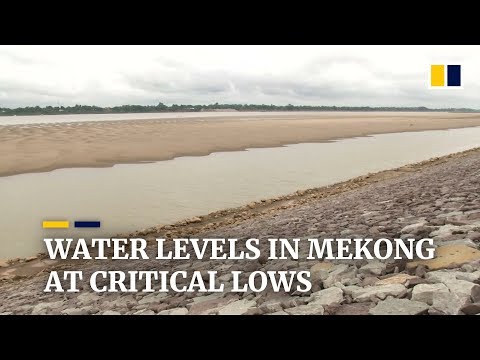
Southeast Asia’s Mekong River, one of the longest rivers in the world, has dropped to its lowest level in 100 years due to severe drought, sand-mining, and upstream dam developments, causing threats to the food supply and livelihood of nearby inhabitants.
Monsoon rains, which were expected to come late May, turned to extremely hot weather, triggering drought. The crisis was worsened by hydropower dams restricting waters.
The river’s current state could be a potential disaster especially to the millions of residents in the region who are depending on the water for daily needs.
The Mekong River flows through six neighboring countries namely China, Myanmar, Thailand, Laos, Cambodia, and Vietnam.
"This is the worst ecological disaster in the history of the Mekong region," Thai natural resources expert Chainarong Setthachua said.
Tonle Sap, Cambodia’s inland lake and the heart of Mekong, reportedly dropped severely, resulting in one floating village drying up. Some parts of the lake became shallow waters as well. Natives living near Tonle Sap were in disbelief that the drought happened two months into the rainy season.
Xayaburi Dam in Laos, located 30 km (19 miles) east of Sainyabuli town in Northern Laos, blocked the mainstream of the Mekong River, posing threats to the ecology in the region.
In China, around seven dams block seasonal water flows as well. U.S. Secretary of State Mike Pompeo expressed his disappointment over the action, saying that China was taking control of the Mekong River by building dams that affect one of Southeast Asia’s most important water sources.
Experts warned that although it has started raining and the water levels are now slowly recovering, the drought could still result in potential risks that may be worse than the drought in 2016 which spawned forest fires near Tonle Sap.

Published in the last 24 hours
- Northern lights are possible at high latitudes on November 17 and 18 as NOAA forecasts minor (G1) geomagnetic storms from coronal hole wind
- In February 2022, SpaceX launched 49 Starlink satellites into a solar storm so mild that forecasters rated it minor, and within days 38 of them had fallen back and burned up, because the storm had swollen the thin air they were flying through Epicenter
- On a Friday night in October 1992, a fireball over the eastern US was filmed by fans at high school football games before it punched through the trunk of a teenager’s $400 Chevy Malibu in Peekskill, New York, and she sold the wrecked car for $10,000 Epicenter
- Green Lake, Hawaii's largest freshwater lake, was gone by the afternoon of June 2, 2018, after lava from Kilauea filled its basin. The water was about 20 feet deep, not the 200 feet often claimed. Epicenter
