
Powerful eruption at Sinabung volcano, ash to 16.7 km (55 000 feet), Indonesia

Featured image: Mount Sinabung erupting on June 9, 2019. Credit: PVMBG
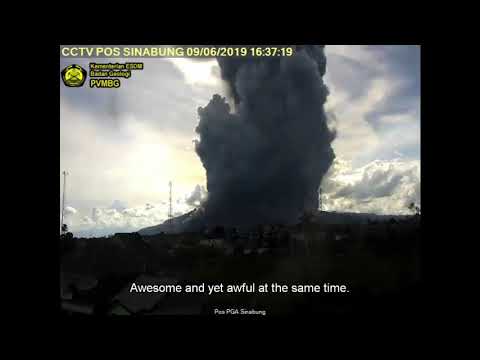
A new high-level eruption started at Indonesian Mount Sinabung around 09:28 UTC on June 9, 2019. The Aviation Color Code is Red.
According to the Darwin VAAC, volcanic ash is rising up to 16.7 km (55 000 feet) above sea level at 10:05 UTC, moving west. "Webcam imagery indicates ash-rich eruption. Volcanic ash height and movement based on multispectral satellite imagery and EC model guidance."


 The Aviation Color Code is Red.
Pyroclastic flows descended southeast and south of the crater up to 3.4 km (2.1 miles) and 3 km (1.8 miles), respectively.
There are no reports of damages or casualty.
Sinabung Eruption 190609#Sinabung #eruption@janinekrippner @OysteinLAnderse pic.twitter.com/Ma1brhdu2x
— Richard Payne (@thearpee) June 9, 2019
#sinabung #volcano #2019 pic.twitter.com/irnKrY9vh8
— GemukTapiKosong (@GloriArdiyanta) June 9, 2019
Erupsi #sinabung kelihatan sampe ke pancur batu.
#prayforsinabung #erupsisinabung pic.twitter.com/RW2hpJSOR8— New Fat Calorie (@Ianpelawi) June 9, 2019
Erupsi #Sinabung Minggu 09 Juni 2019 pkl. 16:28 WIB dengan tinggi kolom abu -/+ 7000 m di atas puncak. Kolom abu teramati berwarna hitam dengan intensitas tebal ke arah Selatan. Erupsi ini terekam di seismograf dengan amplitudo maksimum 120 mm dan durasi 557 detik pic.twitter.com/h3Ar6BqIyS
— Andri Supriadi (@abahakung01) June 9, 2019
#sinabung pic.twitter.com/Oxj4lbXakH
— Tegerta (@Tegerta1) June 9, 2019
Geological summary
Gunung Sinabung is a Pleistocene-to-Holocene stratovolcano with many lava flows on its flanks. The migration of summit vents along a N-S line gives the summit crater complex an elongated form. The youngest crater of this conical, 2 460-m-high (8 070 feet) andesitic-to-dacitic volcano is at the southern end of the four overlapping summit craters.
An unconfirmed eruption was noted in 1881, and solfataric activity was seen at the summit and upper flanks in 1912.
No confirmed historical eruptions were recorded prior to explosive eruptions during August – September 2010 that produced ash plumes to 5 km (16 404 feet) above the summit. (GVP)

Teo Blašković founded The Watchers in 2011 and edited it until 2026, covering seismic and volcanic activity, extreme weather, space weather and near-Earth objects. Articles on this page are his archive.
Published in the last 24 hours
- High Risk of excessive rainfall covers Florida’s Space Coast as St. Johns River near Cocoa reaches 5.67 m
- Four small asteroids will pass close to Earth from November 21 to 23
- Cyclone Akvan weakens after landfall near Gopalpur; more than 300 000 evacuated in Odisha, India
- A broad low over southeastern Florida and the northwestern Bahamas has a 30 percent chance of subtropical or tropical development within 48 hours and a 50 percent chance within 7 days, the National Hurricane Center says
