
New pyroclastic flow at Fuego, death toll jumps to 109, nearly 200 missing, Guatemala

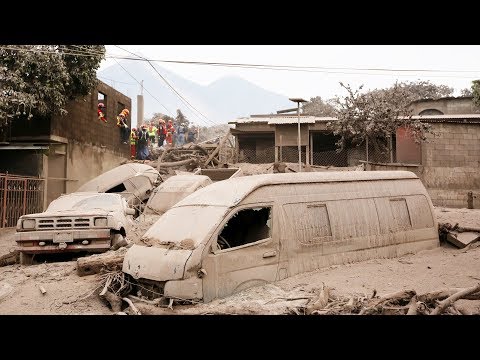
Image credit: Rescue workers escaping new pyroclastic flow descending down Guatemala's Fuego volcano on June 5, 2018.
A new pyroclastic flow descended down the southeastern flank of Guatemala's Fuego volcano on June 5, 2018. Ash plume rose to approximately 6 km (20 000 feet) above sea level. The death toll from Fuego's eruption on June 3 reached 75 late June 5, with 192 people still missing.
The flow followed the same path as the one on Sunday, June 3, during Fuego's worst eruption in decades and Guatemala's deadliest since 1902 when an eruption of Santa Maria volcano killed thousands of people.
Sunday's eruption came without warning just before midday (local time), sending deadly pyroclastic flows more than 10 km (6.2 miles) downslope and destroying entire villages. The same mixture of very hot gas and fast-moving volcanic material (pyroclastic flow) destroyed Italian city of Pompeii after the eruption of Mount Vesuvius in 79 AD. Pyroclastic flows can reach speeds of up to 700 km/h (430 mph) while its gases can reach temperatures of about 1 000 °C (1 830 °F).
More than 1.7 million people were affected by the eruption on Sunday, more than were 3 000 evacuated, at least 75 killed and nearly 200 left missing, as of Wednesday morning, June 6.
Rescue teams working in the rural community of San Miguel Los Lotes said they encountered 8 to 10 m (26 to 33 feet) high mounds of volcanic ash, adding that the most common cause of death was asphyxia, followed by burns.
"The houses became ovens, and the village a crematorium. There are no survivors," a volunteer firefighter, Francisco Flores, told The Guardian.
"There is so much ash it’s like a massive beach but with trees and rocks thrown in, it’s terrible up there," he said.



Update
June 8
The death toll from Fuego’s most violent eruption in four decades has been gradually rising and now stands at 109, the Guatemala’s disaster and forensic agency Inacif said earlier on Thursday, June 7.

Teo Blašković founded The Watchers in 2011 and edited it until 2026, covering seismic and volcanic activity, extreme weather, space weather and near-Earth objects. Articles on this page are his archive.
Published in the last 24 hours
- The storms drenching California this week are fed by a river in the sky, a band of water vapor that can carry up to 15 times the flow of the Mississippi River, and this winter’s near-record El Niño could keep aiming more of them at the West Coast
- Malawi continues Bris AI weather forecasting tests ahead of operational integration Epicenter
- Right about now, Voyager 1 is crossing a line no human-made object has ever reached, a full light-day from Earth, which means a message NASA sends tonight won't arrive until tomorrow night, and the spacecraft's answer won't make it home until the night after that
- G1 geomagnetic storm watch remains in effect as NOAA forecasts Kp 4.67 late on November 17 and early on November 18
