
Explosions at Shinmoedake volcano, first pyroclastic flow, Japan
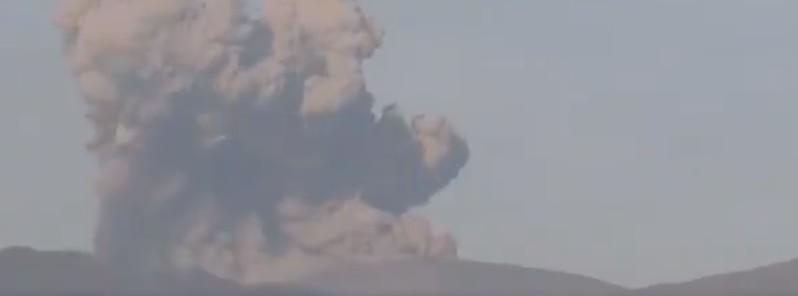
Featured image: Shinmoedake volcano eruption on March 25, 2018. Credit: Volcano Time Lapse
Explosive eruptions and Kyushu's Shinmoedake volcano on Sunday, March 25, 2018, sent plumes of gas and ash 4.8 km (16 000 feet) above sea level and created first pyroclastic flow since the volcano started erupting at the beginning of the month.
Explosive eruptions at the volcano were recorded at 07:35 and 08:45 JST on March 25, according to the Japan Meteorological Agency.
The pyroclastic flow was produced during the second eruption, as well as a co-pyroclastic plume, and was confirmed over a distance of about 800 m (2 624 feet) west of the crater. The flow did not approach any residential area, the agency said.
Dos nuevos pulsos eruptivos del Volcán #Shinmoedake en Japón
Marzo 25/2018
#eruption du #MountShinmoedake
Créditos: Volcano Time Lapse vía @YouTube pic.twitter.com/sEP0SWteLj— Geól. Sergio Almazán (@chematierra) March 25, 2018
Tornadoes of dust have also been observed, remobilizing the ashes deposited on overheated soil.
What an awesome aerial shot of that big ash twister earlier at #Shinmoedake captured by NHK #Japan #volcano #新燃岳 pic.twitter.com/oN7z3Wmwf4
— James Reynolds (@EarthUncutTV) March 25, 2018
The JMA maintains the alert level for the volcano at 3, meaning people should stay away from the mountain.
Local residents are urged to be cautious about pyroclastic flows within an area of 2 km (1.2 miles) from the crater as well as for large flying rocks within 3 km (1.8 miles) of the crater.
#Kirishima #shinmoedake volcano eruption as seen by our #Sentinel2 on 23March pic.twitter.com/ikXP4w0uQt
— Copernicus EU (@CopernicusEU) March 25, 2018
Shinmoedake volcano started erupting at 20:34 UTC on October 10, 2017 after 6 years of quiescence. The volcano soon quieted down and was building up energy until March 1, 2018 when it started erupting again.
Geological summary
Kirishimayama is a large group of more than 20 Quaternary volcanoes located north of Kagoshima Bay. The late-Pleistocene to Holocene dominantly andesitic group consists of stratovolcanoes, pyroclastic cones, maars, and underlying shield volcanoes located over an area of 20 x 30 km (12.4 – 18.6 miles).
The larger stratovolcanoes are scattered throughout the field, with the centrally located, 1700-m-high (5 577 feet) Karakunidake being the highest.
Onamiike and Miike, the two largest maars, are located SW of Karakunidake and at its far eastern end, respectively. Holocene eruptions have been concentrated along an E-W line of vents from Miike to Ohachi, and at Shinmoedake to the NE. Frequent small-to-moderate explosive eruptions have been recorded since the 8th century. (GVP)

I'm a dedicated researcher, journalist, and editor at The Watchers. With over 20 years of experience in the media industry, I specialize in hard science news, focusing on extreme weather, seismic and volcanic activity, space weather, and astronomy, including near-Earth objects and planetary defense strategies. You can reach me at teo /at/ watchers.news.

Commenting rules and guidelines
We value the thoughts and opinions of our readers and welcome healthy discussions on our website. In order to maintain a respectful and positive community, we ask that all commenters follow these rules.