
Asteroid 2016 QA2 makes exceptionally close Earth flyby hours after discovery
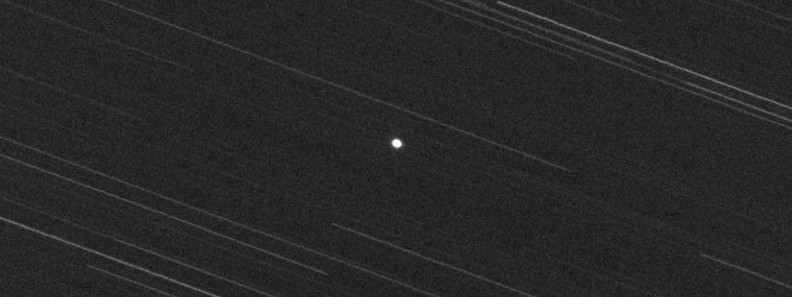
Featured image: Asteroid 2016 QA2 at 00:55 UTC on August 28, 2016. Credit: Virtual Telescope Project.
Asteroid 2016 QA2 made an exceptionally close flyby of our planet at 01:24 UTC on August 28, 2016, just hours after it was discovered. Its estimated size is 34 meters (111.5 feet), between 16 and 52 meters (52 – 170 feet). This is about twice as big as the asteroid that exploded over Chelyabinsk, Russia in February 2013, injuring over 1 000 people.
At the time of closest approach to our planet, asteroid 2016 QA2 was about 0.22 LD (84 480 km / 52 493 miles) from the surface.
It was discovered by the SONEAR Observatory at Oliveira, Brazil on August 27, as the 24th asteroid in orbit near Earth discovered by SONEAR.

Asteroid 2016 QA2 orbital diagram – August 28, 2016. Credit: SONEAR Observatory
Astronomer Gianluca Masi of the Virtual Telescope Project captured a sequence of 2016 QA2 images. The video is 113X faster than the real motion:
asteroid #2016QA2 had an extremely close but safe encounter with #Earth earlier today. We did this stunning movie. pic.twitter.com/bPvA6k54iv
— Virtual Telescope (@VirtualTelescop) August 28, 2016
Asteroid 2016 QA2 appears to be an Aten asteroid. This is a group of near-Earth asteroids, named after the first of the group 2062 Aten, discovered by Eleanor F. Helin on January 7, 1967. Aten asteroids are defined by having a semi-major axis of less than one astronomical unit (AU), the distance from the Earth to the Sun. They also have an aphelion (furthest distance from the Sun) greater than 0.983 AU.
An Aten orbit need not be entirely contained within Earth's orbit, as nearly all known Aten asteroids have their aphelion greater than 1 AU although their semi-major axis is less than 1 AU. Observation of objects inferior to the Earth's orbit is difficult and this difficulty may be the cause of some sampling bias in the apparent preponderance of eccentric Atens.
Aten asteroids account for only about 6% of the known near-Earth asteroid population.

Image credit Virtual Telescope Project
The image above is a 60-seconds exposure, remotely taken with PlaneWave 17″+Paramount ME+SBIG STL-6303E robotic unit available at Virtual Telescope. The robotic mount tracked the extremely fast (1500″/minute) apparent motion of the asteroid, so stars are trailing. The asteroid is perfectly tracked: it is the bright, sharp dot in the center.
"This is with no doubts a super result, showing the amazing capabilities of the Virtual Telescope in tracking extremely demanding asteroids," VT said.
Asteroids the size of 2016 QA2 can pose a significant threat to a town or city.

The Watchers team and our contributors bring the latest on extreme weather, earthquakes, volcanic eruptions, space weather, and all things science. We're all about making sense of the natural world and keeping you informed on what’s happening. Got a tip or a question? Hit us up using the form at newstips!
Published in the last 24 hours
- Asteroid 2026 WJ to pass Earth at 1.7 lunar distances at 04:20 UTC on November 22, with 2026 WD following at 4.4 lunar distances on November 23
- High Risk of excessive rainfall covers Florida’s Space Coast as St. Johns River near Cocoa reaches 5.67 m
- Cyclone Akvan crossed the north Andhra Pradesh and south Odisha coasts close to Gopalpur on November 20 with 70-80 km/h winds gusting to 90, and has weakened into a deep depression
- A broad low over southeastern Florida and the northwestern Bahamas has a 30 percent chance of subtropical or tropical development within 48 hours and a 50 percent chance within 7 days, the National Hurricane Center says

We saw something Saturday night about 9:30PM EST traveling slowly from west to east in northeast Ohio. Could we possibly have been watching this asteroid?
That’s kinda scary!