
Penumbral lunar eclipse on March 23, 2016

Image credit: NASA / LRO
Observers located in the extreme eastern Asia, eastern Australia, the Pacific Ocean and the west coast of North America including Alaska will get to see a penumbral lunar eclipse on March 23, 2016, the first of three lunar eclipses in 2016.
The eclipse will reach its greatest point at 11:48 UTC. However, it will be nearly indistinct from a regular full moon so more interesting event in the night sky will be a very bright Jupiter, right next to the Moon in its full phase.
Jupiter will be very bright at -2.5 magnitude and the Moon will be extremely bright at -12.4 magnitude. The pair made their closest approach, passing within 1°57' of each other, at 02:48 UTC on March 22.

A penumbral lunar eclipse occurs when the Moon passes through the Earth's partial shadow, or penumbra. During this eclipse, the Moon will darken slightly but not completely. Image credit: Fred Espenak
This penumbral lunar eclipse comes 2.1 days before the Moon reaches apogee, in the constellation Virgo.
It belongs to Saros 142 and is number 18 of 73 eclipses in the series. All eclipses in this series occur at the Moon’s ascending node. The Moon moves southward with respect to the node with each succeeding eclipse in the series and gamma decreases.
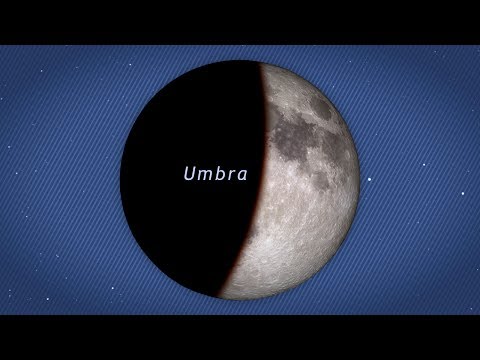
Over the nights following March 23, the Moon will rise around an hour later each day so as to become prominent later in the night. Within a few days, it will only be visible in the pre-dawn and early-morning sky.
By the time it reaches last quarter, a week after full moon, it will rise at around midnight and set at around noon.

The Watchers team and our contributors bring the latest on extreme weather, earthquakes, volcanic eruptions, space weather, and all things science. We're all about making sense of the natural world and keeping you informed on what’s happening. Got a tip or a question? Hit us up using the form at newstips!
Earlier reporting
Nothing on Watchers was published in the last 24 hours. These are older articles.
- On October 22, 2017, a single flash of lightning stretched 515 miles from eastern Texas to near Kansas City, a distance that takes eight hours to drive, and nobody realized how far it had gone until scientists went back through the satellite data years later Epicenter
- CPC posts a slight risk of heavy rain from the Gulf Coast to the Northeast urban corridor November 25-29, and a moderate risk of West Coast wind and Sierra snow on November 25
- Florida's east coast faces a moderate flash flood risk Wednesday through Friday, with 4 to 8 inches of rain forecast and the St. Johns River near Cocoa already in major flood at 17.13 feet
- Cyclone Akvan to make landfall between Nellore and Visakhapatnam around noon on November 20, IMD forecasts 120-130 km/h winds gusting to 145
