
Large pyroclastic flows recorded as Mount Sinabung erupts, Indonesia

Featured image: Pyroclastic flows produced at Sinabung volcano on February 26, 2016. Credit: RT
Indonesian Sinabung volcano erupted on February 26, 2016, sending thick smoke and ash up to 4.2 km (14 000 feet) a.s.l. and producing very large and impressive pyroclastic flows.
According to Agus Salihin, a volcanologist at the Sinabung observation post, yesterday's eruption was one of the biggest since early 2015.

Video courtesy RT
Photographer Endro Leva managed to take a few shots of abandoned homes burning after pyroclastic flows.
Mt #Sinabung feb26
Flujo piroclástico quema aldea abandonada #Simacem
Créditos #EndroLewa #EndiAwu
Vía @LeopoldAdam pic.twitter.com/mbAEbRhdts— Geól. Sergio Almazán (@chematierra) February 27, 2016
After being dormant for 400 years, Sinabung has been erupting continually since August 2010.
Update, February 28:
Ultra HD videos of the February 26th eruptions have been uploaded to YouTube today. One second of each video is equivalent to around 240 seconds in real time.
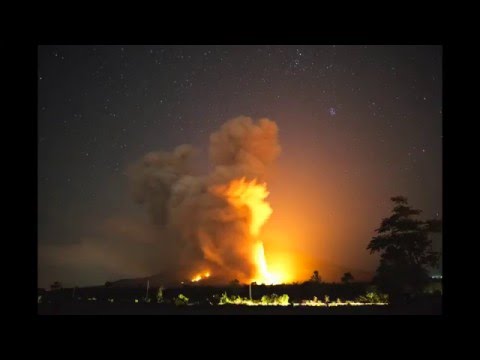

Videos courtesy of TS Zhang
Geological summary
Gunung Sinabung is a Pleistocene-to-Holocene stratovolcano with many lava flows on its flanks. The migration of summit vents along a N-S line gives the summit crater complex an elongated form. The youngest crater of this conical, 2460-m-high andesitic-to-dacitic volcano is at the southern end of the four overlapping summit craters.
An unconfirmed eruption was noted in 1881, and solfataric activity was seen at the summit and upper flanks in 1912. No confirmed historical eruptions were recorded prior to explosive eruptions during August-September 2010 that produced ash plumes to 5 km above the summit. (GVP)

Teo Blašković founded The Watchers in 2011 and edited it until 2026, covering seismic and volcanic activity, extreme weather, space weather and near-Earth objects. Articles on this page are his archive.
Published in the last 24 hours
- A Virginia park ranger was struck by lightning seven times and lived, even though three of the strikes set his hair on fire Epicenter
- The hole in the ozone layer over Antarctica was about twice the size of the US this year, and scientists say it would have been bigger still if ozone-eating chemicals were at their 2000 levels Epicenter
