
Comet 67P’s mysterious form
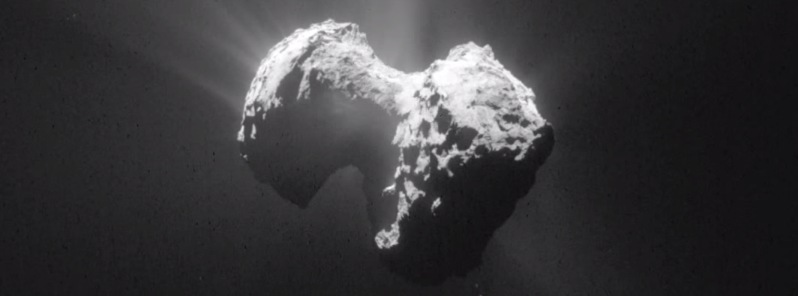
Image credit: ESA
The team behind The ThunderBolts Project has started a new series of reports that will discuss the latest scientific papers on the European Space Agency’s Rosetta mission to comet 67P.
In addition to countless unresolved puzzles facing comet scientists, they have discussed in previous 'Space News' episodes the problem of comet’s double-lobed shape.
Indeed, that particular form of a comet nucleus is apparently not unique; several other of the comets imaged to date have displayed similar forms. Multiple asteroids, including this one imaged on July 25th of this year, have displayed distinct peanut-like shapes, with a marked narrowing at the body’s neck. And recently, NASA’s New Horizons mission has revealed that the Plutonian moon Hydra also has a double-lobed form.
Why do so many of these different types of bodies in the solar system display this particular shape?

Video credit: The ThunderBolts project

The Watchers team and our contributors bring the latest on extreme weather, earthquakes, volcanic eruptions, space weather, and all things science. We're all about making sense of the natural world and keeping you informed on what’s happening. Got a tip or a question? Hit us up using the form at newstips!
Published in the last 24 hours
- Four small asteroids will pass close to Earth from November 21 to 23
- Male toads abandoned a pond in Italy five days before a deadly 2009 earthquake, while a scientist was counting them Epicenter
- An asteroid was spotted 19 hours before it exploded over Sudan in 2008, and students picked its pieces off the desert Epicenter
- A wave up to 3 m (10 feet) high rose out of Lake Michigan on a sunny June morning in 1954 and swept fishermen off Chicago’s piers, and when a second came 10 days later, warnings had cleared the shore Epicenter
