
DSCOVR reached its orbit around 1st Lagrange point
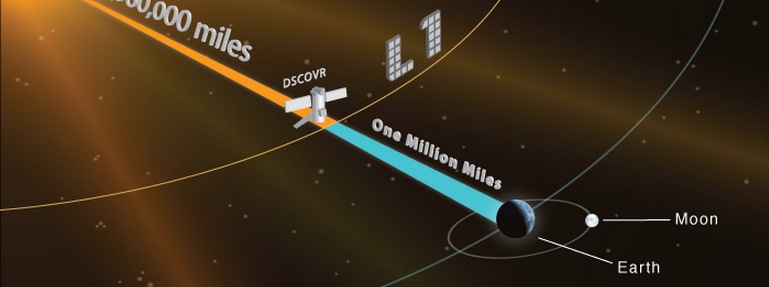
Image credit: NOAA/NESDIS
NOAA's Deep Space Climate Observatory (DSCOVR), launched on February 11, 2015, has reached its final destination on June 7 and entered orbit around the 1st Lagrange point (L1), the neutral gravity point between the Earth and Sun, approximately 1.5 million km (~1 million miles) from Earth.
After about 30 days, when final instrument checks are completed, DSCOVR will enable improved measurements of solar wind conditions to enhance NOAA’s ability to warn of potentially harmful solar activity.
In addition, DSCOVR's Earth-observing instruments will view the entire sunlit Earth from sunrise to sunset at an almost constant scattering angle between 165–178° and gather a range of measurements from ozone and aerosol amounts, to changes in Earth's radiation budget – the balance between incoming radiation (largely from the Sun) and that which is reflected from Earth. This balance affects our climate.
Data from DSCOVR, coupled with a new forecast model set to come online in 2016, will enable NOAA’s space weather forecasters to predict geomagnetic storm magnitude on a regional basis.

DSCOVR will eventually replace NASA’s Advanced Composition Explorer (ACE) research satellite as America’s primary warning system for solar magnetic storms headed towards Earth.

The Watchers team and our contributors bring the latest on extreme weather, earthquakes, volcanic eruptions, space weather, and all things science. We're all about making sense of the natural world and keeping you informed on what’s happening. Got a tip or a question? Hit us up using the form at newstips!
Published in the last 24 hours
- High Risk of excessive rainfall covers Florida’s Space Coast as St. Johns River near Cocoa reaches 5.67 m
- Asteroid 2026 WJ to pass Earth at 1.7 lunar distances at 04:20 UTC on November 22, with 2026 WD following at 4.4 lunar distances on November 23
- Cyclone Akvan weakens after landfall near Gopalpur; more than 300 000 evacuated in Odisha, India
- A broad low over southeastern Florida and the northwestern Bahamas has a 30 percent chance of subtropical or tropical development within 48 hours and a 50 percent chance within 7 days, the National Hurricane Center says
