
Geomagnetic storm reached G2 levels, amazing auroras photographed from ISS

Featured image: Aurora visible from ISS - August 19/20, 2014. Image credit: Reid Weisman
A Coronal Mass Ejection (CME) unleashed by solar filament eruption on August 15 started interacting with Earth's magnetic field around 07:00 UTC on August 19 causing, at first, only a minor instability.
As the Earth passed through the plasma cloud the effects increased and reached G2 – Moderate level threshold (Kp=6) at 23:01 UTC.
At these levels area of impact is primarily poleward of 55 degrees Geomagnetic Latitude. Power grid fluctuations can occur. High-latitude power systems may experience voltage alarms. Satellite orientation irregularities may occur; increased drag on low Earth-orbit satellites is possible. HF (high frequency) radio propagation can fade at higher latitudes. Aurora may be seen as low as New York to Wisconsin to Washington state.

Geomagnetic K-index of 6 threshold (G2 – Moderate storm) was reached at 23:01 UTC on August 19, 2014.
Astronaut Reid Wiseman, onboard International Space Station, captured the following images from his window:
Never in my wildest dreams did I imagine this. 10 minutes ago on the #ISS #aurora pic.twitter.com/PG25uTwm19
— Reid Wiseman (@astro_reid) August 19, 2014
Unbelievable. pic.twitter.com/NOgRQgwFqY
— Reid Wiseman (@astro_reid) August 19, 2014
Alerts issued by SWPC:
Space Weather Message Code: SUMSUD
Serial Number: 196
Issue Time: 2014 Aug 19 0713 UTC
SUMMARY: Geomagnetic Sudden Impulse
Observed: 2014 Aug 19 0700 UTC
Deviation: 12 nT
Station: BOU
***
Space Weather Message Code: ALTK04
Serial Number: 1720
Issue Time: 2014 Aug 19 2056 UTC
ALERT: Geomagnetic K-index of 4
Threshold Reached: 2014 Aug 19 2051 UTC
Synoptic Period: 1800-2100 UTC
Active Warning: Yes
Potential Impacts: Area of impact primarily poleward of 65 degrees Geomagnetic Latitude.
Induced Currents – Weak power grid fluctuations can occur.
Aurora – Aurora may be visible at high latitudes such as Canada and Alaska.
***
Space Weather Message Code: ALTK05
Serial Number: 748
Issue Time: 2014 Aug 19 2141 UTC
ALERT: Geomagnetic K-index of 5
Threshold Reached: 2014 Aug 19 2136 UTC
Synoptic Period: 2100-2400 UTC
Active Warning: Yes
NOAA Scale: G1 – Minor
Potential Impacts: Area of impact primarily poleward of 60 degrees Geomagnetic Latitude.
Induced Currents – Weak power grid fluctuations can occur.
Spacecraft – Minor impact on satellite operations possible.
Aurora – Aurora may be visible at high latitudes, i.e., northern tier of the U.S. such as northern Michigan and Maine.
***
Space Weather Message Code: ALTK06
Serial Number: 324
Issue Time: 2014 Aug 19 2306 UTC
ALERT: Geomagnetic K-index of 6
Threshold Reached: 2014 Aug 19 2301 UTC
Synoptic Period: 2100-2400 UTC
Active Warning: Yes
NOAA Scale: G2 – Moderate
Potential Impacts: Area of impact primarily poleward of 55 degrees Geomagnetic Latitude.
Induced Currents – Power grid fluctuations can occur. High-latitude power systems may experience voltage alarms.
Spacecraft – Satellite orientation irregularities may occur; increased drag on low Earth-orbit satellites is possible.
Radio – HF (high frequency) radio propagation can fade at higher latitudes.
Aurora – Aurora may be seen as low as New York to Wisconsin to Washington state.
***
The following video shows the filament eruption on August 15, the source of latest geomagnetic storms on Earth:
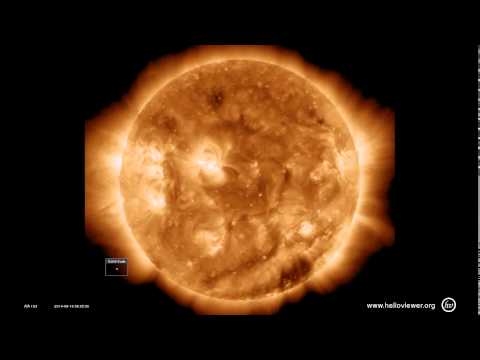
Solar filament eruption on August 15, 2014. Images by NASA SDO AIA 193 and 304

Teo Blašković founded The Watchers in 2011 and edited it until 2026, covering seismic and volcanic activity, extreme weather, space weather and near-Earth objects. Articles on this page are his archive.
Earlier reporting
Nothing on Watchers was published in the last 24 hours. These are older articles.
- G1 geomagnetic storm watch remains in effect as NOAA forecasts Kp 4.67 late on November 17 and early on November 18
- On October 22, 2017, a single flash of lightning stretched 515 miles from eastern Texas to near Kansas City, a distance that takes eight hours to drive, and nobody realized how far it had gone until scientists went back through the satellite data years later Epicenter
- CPC posts a slight risk of heavy rain from the Gulf Coast to the Northeast urban corridor November 25-29, and a moderate risk of West Coast wind and Sierra snow on November 25
- Florida's east coast faces a moderate flash flood risk Wednesday through Friday, with 4 to 8 inches of rain forecast and the St. Johns River near Cocoa already in major flood at 17.13 feet

Booyaakaa
I knew that the intense heat we felt yesterday was caused by this filament eruption, perhaps even the hottest day in this summer.