
“Neutron star” refutes its own existence

Featured image: An artist’s impression of an x-ray binary system. The matter that a neutron star (blue) sucks from a regular star (red) leads to the emission of intense x-ray beams. Image credit: NASA
A team of scientists studying the x-ray emissions of a so-called neutron star tell us that the existing theoretical models cannot explain what they are seeing. Astronomers say that neutron stars are very small yet massively dense objects that spin at incredibly fast speeds with rotation periods no more than hundreds of seconds and sometimes faster than a dentist drill.
However, according to new research, a so-called neutron star has been observed with a rotation period of 5.4 hours, an anomalously slow speed. The neutron star is also unusual in that it is pared to form a binary with a red giant and the magnetic field of the neutron star is incredibly strong. No one has ever seen a neutron star, and they are an inferred entity. Wal Thornhill weighs in with his thoughts regarding the Electric Universe model.
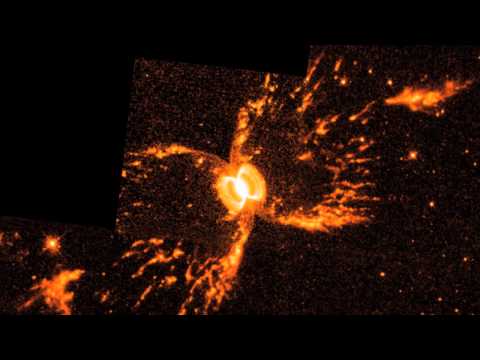
Video courtesy of Thunderbolts Project
Reference:

The Watchers team and our contributors bring the latest on extreme weather, earthquakes, volcanic eruptions, space weather, and all things science. We're all about making sense of the natural world and keeping you informed on what’s happening. Got a tip or a question? Hit us up using the form at newstips!
Published in the last 24 hours
- High Risk of excessive rainfall covers Florida’s Space Coast as St. Johns River near Cocoa reaches 5.67 m
- Asteroid 2026 WJ to pass Earth at 1.7 lunar distances at 04:20 UTC on November 22, with 2026 WD following at 4.4 lunar distances on November 23
- Cyclone Akvan crossed the north Andhra Pradesh and south Odisha coasts close to Gopalpur on November 20 with 70-80 km/h winds gusting to 90, and has weakened into a deep depression
- A broad low over southeastern Florida and the northwestern Bahamas has a 30 percent chance of subtropical or tropical development within 48 hours and a 50 percent chance within 7 days, the National Hurricane Center says
