
Shiveluch spews ash 10 km into the air, Kamchatka
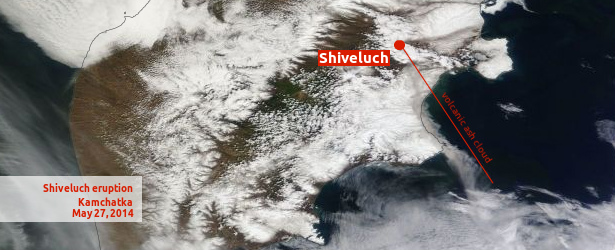
Image credit: NASA Terra / MODIS acquired May 27, 2014. Edit: The Watchers
Kamchatkan Shiveluch volcano had another strong eruption at 22:45 UTC on May 26, 2014 and spewed ash up to 10 km into the air, according to KVERT. Volcanic alert level is on orange.
Satellite data showed an ash cloud extended up to 850 km (520 miles) to the south from the volcano. However, it poses no hazard to nearby populated localities.
KVERT said a growth of the lava dome continues. Moderate ash explosions, fumarolic activity and incandescence of the dome summit and hot avalanches accompanies this process.
 At 04:15 UTC today, when latest KVERT notice was issued, volcanic eruption was still underway. At 02:56 UTC, the height of ash plume was estimated to 3 km a.s.l.
Previous strong eruption of Shiveluch occurred late on May 12, 2014, when volcanic ash was also estimated rising up to 10 km. This current eruptive phase of Shiveluch started on August 15, 1999.
Shiveluch webcams
#1: http://www.kscnet.ru/ivs/video/Sheveluch.html
#2: http://www.kscnet.ru/ivs/kvert/video_camera/Sheveluch2.html
#3: http://data.emsd.ru/videokry/svl.jpg
Geologic summary
The high, isolated massif of Shiveluch volcano (also spelled Sheveluch) rises above the lowlands NNE of the Kliuchevskaya volcano group. The 1300 cu km Shiveluch is one of Kamchatka's largest and most active volcanic structures. The summit of roughly 65,000-year-old Stary Shiveluch is truncated by a broad 9-km-wide late-Pleistocene caldera breached to the south. Many lava domes dot its outer flanks.
The Molodoy Shiveluch lava dome complex was constructed during the Holocene within the large horseshoe-shaped caldera; Holocene lava dome extrusion also took place on the flanks of Stary Shiveluch. At least 60 large eruptions of Shiveluch have occurred during the Holocene, making it the most vigorous andesitic volcano of the Kuril-Kamchatka arc. Widespread tephra layers from these eruptions have provided valuable time markers for dating volcanic events in Kamchatka. Frequent collapses of dome complexes, most recently in 1964, have produced debris avalanches whose deposits cover much of the floor of the breached caldera. (GVP)

I'm a dedicated researcher, journalist, and editor at The Watchers. With over 20 years of experience in the media industry, I specialize in hard science news, focusing on extreme weather, seismic and volcanic activity, space weather, and astronomy, including near-Earth objects and planetary defense strategies. You can reach me at teo /at/ watchers.news.


Commenting rules and guidelines
We value the thoughts and opinions of our readers and welcome healthy discussions on our website. In order to maintain a respectful and positive community, we ask that all commenters follow these rules.