
Low oxygen levels likely cause of mass fish die-off in Nevada, USA
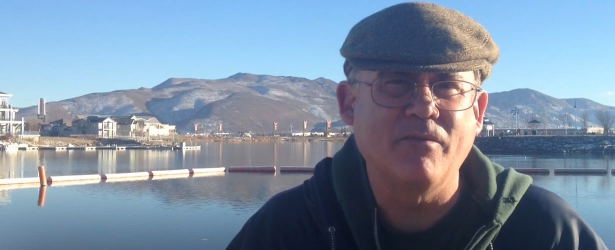
Image credit: Screenshot from Reno Gazette-Journal interview with Chris Healy.
Wildlife officials are trying to figure out the cause for mass die-off of fish in manmade lake Sparks Marina along U.S. Interstate 80 east of Reno. Nevada Department of Wildlife spokesman Chris Healy said that over the past month, an estimated 100 000 trout, bass and catfish have died in the marina. The die-off is apparently the result of a dramatic, unexplained drop in dissolved oxygen levels.
Healy said for The Associated Press that 'the 100 000 dead fish figure is something that is probably a pretty conservative guess,' and estimated they've stocked close to 1 million adult fish in the lake since they started in 1998. 'We don't know if any small fish have survived, but for all intents and purposes, the fishery doesn't exist anymore.'
"Scientists say a bitter cold snap could have caused oxygen-poor waters to rise from the old rock quarry's bottom to the surface, but they don't understand what sparked the massive die-off. Fish biologists confirmed low oxygen levels caused the death of an estimated 3 000 fish in one corner of the lake in mid-December, but Healy said they thought at the time that the event was localized and of limited impact. Since then, they've been unable to detect any live fish in the 77-acre lake. Numerous dead fish have been removed from the lake's shoreline, and Healy said it's likely the rest sank to the bottom."

For Reno Gazette-Journal, Healy said that oxygen levels at depths of 10 and 25 feet measured between 1.1 and 1.9 parts per million on Monday. 'Fish, particularly trout, require much higher levels of dissolved oxygen to survive, really between 5 and 6 parts per million.'

Teo Blašković founded The Watchers in 2011 and edited it until 2026, covering seismic and volcanic activity, extreme weather, space weather and near-Earth objects. Articles on this page are his archive.
Earlier reporting
Nothing on Watchers was published in the last 24 hours. These are older articles.
- On October 22, 2017, a single flash of lightning stretched 515 miles from eastern Texas to near Kansas City, a distance that takes eight hours to drive, and nobody realized how far it had gone until scientists went back through the satellite data years later Epicenter
- CPC posts a slight risk of heavy rain from the Gulf Coast to the Northeast urban corridor November 25-29, and a moderate risk of West Coast wind and Sierra snow on November 25
- Florida's east coast faces a moderate flash flood risk Wednesday through Friday, with 4 to 8 inches of rain forecast and the St. Johns River near Cocoa already in major flood at 17.13 feet
- Cyclone Akvan to make landfall between Nellore and Visakhapatnam around noon on November 20, IMD forecasts 120-130 km/h winds gusting to 145

Commenting rules and guidelines
We value the thoughts and opinions of our readers and welcome healthy discussions on our website. In order to maintain a respectful and positive community, we ask that all commenters follow these rules.