
Shiveluch erupts, sends ash up to 5 km, Kamchatka
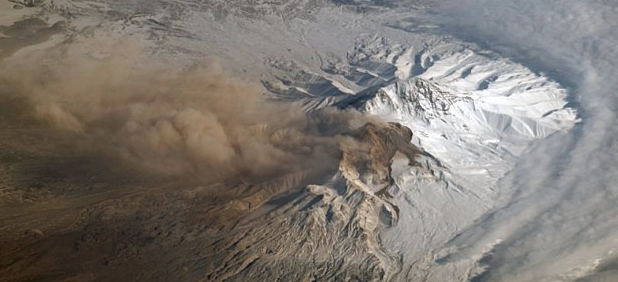
Image credit: And ash plume from Shiveluch was photographed by NASA astronauts aboard the International Space Station (ISS) around mid-morning on or around March 21, 2007. Ash eruptions had begun at Shiveluch in 1999 and were accompanied by long-term growth of a lava dome with occasional block-and-ash flows. Image courtesy of NASA, 2007 (photo ISS014-E-17165).
Local Emergencies Ministry department confirmed that Shiveluch volcano, Kamchatka, spewed ash to a height of up to 5 km (3 miles) on Monday, August 5, 2013. The cloud of ash moved in the eastern direction from the volcano bypassing residential areas at the distance of some 50 km.
VD reported that an explosion and/or dome collapse event occurred on August 2 at 19:36 UTC, with a likely ash plume rising to possibly up to 20,000 ft (estimated from seismic signals).
Although the current eruption poses no immediate threat to nearby settlements, ash fallouts could be dangerous to health, environment and air traffic.
Based on visual observations and analyses of satellite data, KVERT reported that during July 19 – 26 a viscous lava flow effused on the N flank of Shiveluch's lava dome, accompanied by hot avalanches, incandescence, and fumarolic activity. Satellite images detected a daily thermal anomaly. Based on analyses of satellite images, the Tokyo VAAC reported a possible eruption on July 27. Ash was detected in images the next day. The VAAC also noted that, according to the Kamchatka Branch of Geophysical Services (KBGS; Russian Academy of Sciences), ash plumes rose to altitudes of 6.1 – 6.4 km on July 27 and 29 (GVP).

Teo Blašković founded The Watchers in 2011 and edited it until 2026, covering seismic and volcanic activity, extreme weather, space weather and near-Earth objects. Articles on this page are his archive.
Published in the last 24 hours
- Lava fountains reached 1,900 feet (580 m) at Kīlauea Iki in 1959, the highest ever recorded at Kīlauea, as USGS forecasts episode 57 fountaining at Halemaʻumaʻu for November 22-26. Epicenter
- Novarupta in Alaska erupted about 3 cubic miles of magma in roughly 60 hours from 6 June 1912, 30 times Mount St. Helens in 1980, and strong northwesterly winds lifted that same loose ash on 16 November 2026, prompting an NWS SIGMET. Epicenter
- A fog linked to about 12 000 excess deaths in London in 1952 puzzled scientists for decades, until researchers reconstructed how coal smoke formed acidic haze Epicenter
- In 2012, cameras filming a thunderstorm in western China caught ball lightning by accident, and its 1.64-second glow carried iron, silicon, and calcium from the soil it rose out of Epicenter
