
Asteroid 1998 QE2 to become one of the best radar imaging targets of the year – Where to watch online
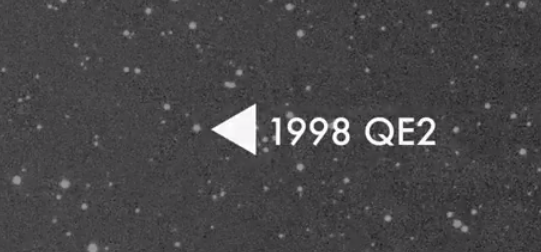
Image credit: NASA YT video screenshot.
Asteroid 1998 QE2 will fly past Earth at a safe distance of 5.8 million kilometers on May 31, 2013 at 20:59 UTC. The asteroid's size is estimated to be about 2.7 kilometers and this will be the closest it gets to Earth for at least the next two centuries.
The radar observations led by scientist Marina Brozovic of NASA's Jet Propulsion Laboratory revealed today that 1998 QE2 is a binary asteroid. About 16% of near-Earth asteroids are binary or even triple systems. The preliminary estimate for the size of the asteroid's satellite, or moon, is approximately 600 meters wide.
According to measurements by the Spitzer Space Telescope, 1998 QE2 reflects only 6% of the sunlight that falls on it, which makes it blacker than coal. "Consequently, it could have a composition similar to that of 101955 Bennu, the target of NASA's OSIRIS-REx mission," says Lance Benner of NASA's Jet Propulsion Laboratory.
Goldstone and Arecibo radars should be able to make detailed images of it and the radar maps should rival images of other asteroids obtained by spacecraft during flyby missions.
Although the closest approach is on May 31st, the best time to observe 1998 QE2 will be during the first week of June. At that time, its sunlit side will face Earth, making it an easy target for large backyard telescopes.
- If you want to spot it yourself – check AstroBob's How to zero in on asteroid 1998 QE2 during Friday’s flyby.
- From midnight – 02:00 UTC on May 31, 2013 Bill Cooke of the Meteoroid Environment Office at NASA's Marshall Space Flight Center in Huntsville will host an online chat at: http://www.nasa.gov/chat .
This is where you can watch in online:
- At 20:00 UTC, astrophysicist Gianluca Masi will have a webcast from the Virtual Telescope Project in Italy.
- Slooh Space Camera will track 1998 QE2 as it zooms by Earth on its close approach. The webcast will start at 20:30 UTC. Their Google+ event is here.

Learn more about asteroid 1998 QE2 here.

Teo Blašković founded The Watchers in 2011 and edited it until 2026, covering seismic and volcanic activity, extreme weather, space weather and near-Earth objects. Articles on this page are his archive.
Published in the last 24 hours
- Four small asteroids will pass close to Earth from November 21 to 23
- High Risk of excessive rainfall covers Florida’s Space Coast as St. Johns River near Cocoa reaches 5.67 m
- Cyclone Akvan weakens after landfall near Gopalpur; more than 300 000 evacuated in Odisha, India
- A broad low over southeastern Florida and the northwestern Bahamas has a 30 percent chance of subtropical or tropical development within 48 hours and a 50 percent chance within 7 days, the National Hurricane Center says
