
WMO dubbed last year as disturbing sign of climate change
Image credit: GreenPeace
The World Meteorological Organisation revealed in Statement on the Status of the Global Climate, that during the August to September 2012 melting season, the Arctic’s sea ice cover was just 3.4 million square kilometres (1.32 million square miles). That is equal to 18% less than record low set in 2007. Last year was the ninth warmest year since recorded history and the 27th consecutive year that the global land and ocean temperatures were above the 1961–1990 average.
The 2012 global land and ocean surface temperature during January–December 2012 is estimated to be 0.45°C (±0.11°C) above the 1961–1990 average of 14.0°C. The years 2001–2012 were all among the top 13 warmest years on record. Last year’s warming came despite a cooling La Nina at the beginning of the year.
Above-average temperatures were observed across most of the globe’s land surface areas, most notably North America, southern Europe, western Russia, parts of northern Africa and southern South America while cooler than average conditions were observed across Alaska, parts of northern and eastern Australia, and central Asia.
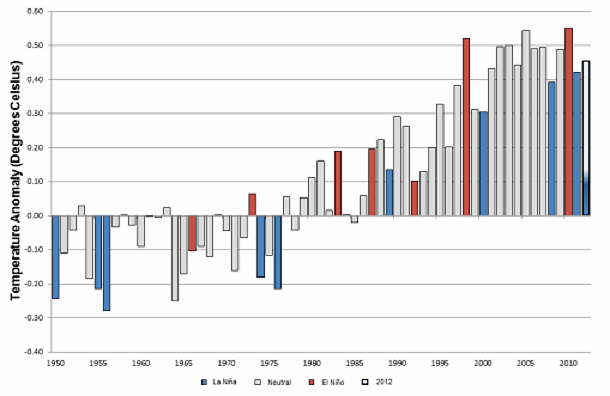
Global land and ocean surface temperature anomalies with respect to the 1961-1990 base period (Source: WMO)
Precipitation also varied, with drier-than-average conditions across much of the central United States, northern Mexico, northeastern Brazil, central Russia, and south-central Australia. Northern Europe, western Africa, north-central Argentina, western Alaska, and most of northern China were meanwhile wetter than average.
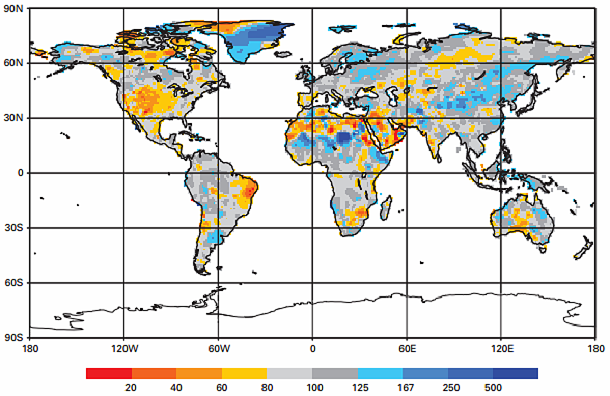
Annual precipitation anomalies for global land areas for 2012; gridded 1.0-degree rain gauge-based analysis as percentages of average focusing on the 1951–2000 base period (Source: Global Precipitation Climatology Centre, Deutscher Wetterdienst, Germany)
According to data from the Global Snow Laboratory, snow cover extent in North America during the 2011/2012 winter was below average. The previous two winters (2009/2010 and 2010/2011) had the largest and third largest snow cover extent, respectively, since records began in 1966.
On the other side, the Eurasian continent snow cover extent during the winter was above average, resulting in the fourth largest snow cover extent on record. Overall, the northern hemisphere snow cover extent was above average – 590000 km2 above the average of 45.2 million km2.
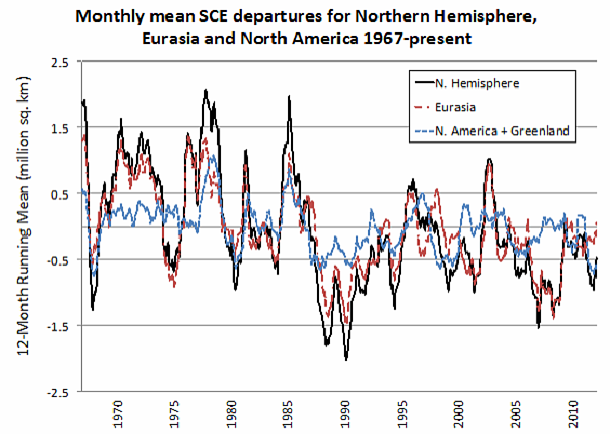
Twelve-month running anomalies of monthly snow cover extent over Northern Hemisphere lands (including Greenland) as a whole and Eurasia and North America separately between November 1966 and December 2012. Anomalies are calculated from NOAA snow maps. Mean hemispheric snow extent is 25.0 million sq. km for the full period of record. Monthly means for the period of record are used for 9 missing months between 1968 and 1971 in order to create a continuous series of running means. Missing months fall between June and October, no winter months are missing. (Credit: Rutgers University Climate Lab)
Nearly half of the surface of Greenland’s ice sheet melt naturally every summer but ice cover melted dramatically in July 2013, with an estimated 97 % of the ice sheet surface having thawed. This was the largest melt extent since satellite records began 34 years ago. A high-pressure system brought warmer-than-average conditions to Greenland, which are associated with the rapid melting, particularly across the lower elevations.
The difference between the maximum Arctic sea-ice extent (March 20, 2013) and the lowest minimum extent (September 16, 2013) was 11.83 million km2. Antarctic sea-ice extent in March was the fourth largest on record at 5.0 million km2 or 16 % above the 1979–2000 average. During its growth season, the Antarctic sea-ice extent reached its maximum extent since records began in 1979 , at 19.4 million km2.
According to statement, physical characteristics of extreme weather and climate events are being increasingly shaped by climate change. WMO Secretary-General Michel Jarraud dubbed it a “disturbing sign of climate change.” Jarraud also noted that the rate of warming varies from year to year due to a range of factors, including the El Nino and La Nina weather phenomena in the Pacific Ocean, as well as volcanic eruptions.
THE 10 MAJOR WEATHER AND CLIMATE EVENTS OF THE YEAR
• Global temperature continued to record positive anomalies; 2012 ranked among the 10 warmest years on record (base period: 1961–1990).
• Arctic sea ice continued its fast decline, reaching the lowest minimum sea-ice extent on record.
• Extreme heat affected Canada, the United States and Europe.
• Extreme drought conditions affected the United States and southeastern Europe.
• West Africa was severely hit by extreme flooding.
• The populations of Europe, northern Africa and northern Asia were acutely affected by extreme cold and snow conditions.
• Pakistan was affected by severe flooding for a third consecutive year.
• Hurricane Sandy, the costliest tropical cyclone of the year, ravaged the eastern seaboard of the United States.
• Typhoon Bopha, the deadliest tropical cyclone of the year, hit the Philippines in December.
• The polar ozone hole was the second smallest in the past 20 years.
The newly released statement points that the continued upward trend in atmospheric concentrations of greenhouse gases and the consequent increased radiative forcing of the Earth’s atmosphere confirm that the warming trend will continue.
In a summary of current climate change findings and figures, WMO experts point that:
- there is a strong scientific consensus that the global climate is changing and that human activity contributes significantly,
- human-induced climate change is caused by greenhouse gas emissions from industry, transport, agriculture and other vital economic sectors,
- atmospheric concentrations of the greenhouse gases that cause climate change continue to rise,
- global temperatures continue to climb,
- the Arctic is changing rapidly,
- sea levels are changing globally,
- recent trends in extreme events are consistent with the expected impacts of climate change.
The 2012 climate assessment, the most detailed to date, will inform discussion at WMO’s Executive Council meeting (15-23 May 2013).
WMO Information Note with a summary of current climate change findings and figures
Source: World Meteorological Organisation

Earlier reporting
Nothing on Watchers was published in the last 24 hours. These are older articles.
- Winds high above the Arctic broke a 68-year record by collapsing in early November, and while the eastern US has already had a taste of the cold it shook loose, forecasters say a second wave could arrive around Thanksgiving weekend
- On October 22, 2017, a single flash of lightning stretched 515 miles from eastern Texas to near Kansas City, a distance that takes eight hours to drive, and nobody realized how far it had gone until scientists went back through the satellite data years later Epicenter
- CPC posts a slight risk of heavy rain from the Gulf Coast to the Northeast urban corridor November 25-29, and a moderate risk of West Coast wind and Sierra snow on November 25
- Florida's east coast faces a moderate flash flood risk Wednesday through Friday, with 4 to 8 inches of rain forecast and the St. Johns River near Cocoa already in major flood at 17.13 feet
