
SciShow: 3 Ways to save Earth from an asteroid
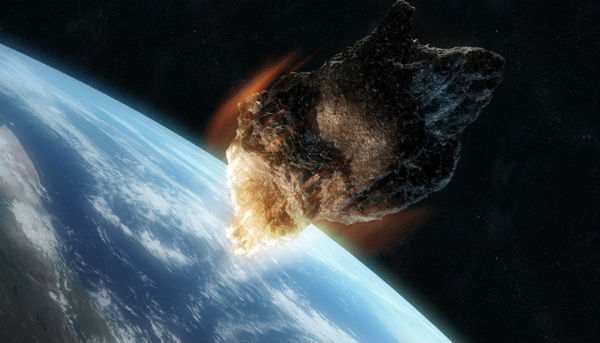
Featured image: Artist rendering asteroid (Credit: HUB/JHU)
Hank from SciShow gives us the skinny on three plans NASA scientists have come up with to save Earth from an asteroid impact.

Source: SciShow

Earlier reporting
Nothing on Watchers was published in the last 24 hours. These are older articles.
- Asteroid 2026 WA passed Earth at 126,400 km, about a third of the Moon's distance, at 07:59 UTC on November 17
- On October 22, 2017, a single flash of lightning stretched 515 miles from eastern Texas to near Kansas City, a distance that takes eight hours to drive, and nobody realized how far it had gone until scientists went back through the satellite data years later Epicenter
- CPC posts a slight risk of heavy rain from the Gulf Coast to the Northeast urban corridor November 25-29, and a moderate risk of West Coast wind and Sierra snow on November 25
- Florida's east coast faces a moderate flash flood risk Wednesday through Friday, with 4 to 8 inches of rain forecast and the St. Johns River near Cocoa already in major flood at 17.13 feet

This all sounds very much like a novel I just read called “THE MYOSHI EFFECT” which is about what happens when a giant asteroid hurtles toward earth, and how they try to destroy it. “THE MYOSHI EFFECT” is a black humor but very factual. Weird how fiction imitates life.
Anybody thought about anchoring a large solar powered gyro at a perpendicular axis on one of the asteroid’s poles relative to the asteroid’s axis of rotation to cause an asteroid up to a few hundred metres to ‘spin down’ in a relatively short order of time? This may not necessarily change its course, but it might be a good first step in allowing for other options more applicable to non-rotating asteroids, such as tethering it to a rocket to pull it off course, or paint balling the sunlit side white to enhance solar radiation pressure with only half the amount of white paint balls necessary, and with all paint balls also impacting on the sunlit side as well. (but cover or stow away the solar panels during the paint balling process!)
But as for really big asteroids in the kilometer rages… we may need to decide between chancing one big strike at a single location or almost guaranteeing many, many smaller but still very devastating strikes at numerous locations including orbiting satellites too, if a Hollywood style approach is used.