
Asteroid 2012 DA14: Orbital approach and motion simulation
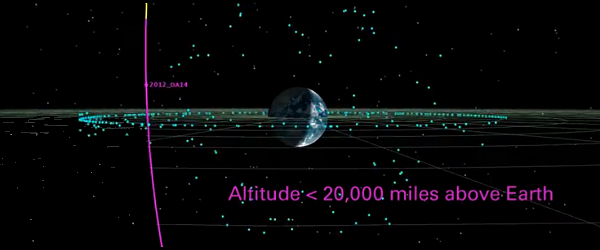
Image credit: TW

The following video shows asteroid 2012 DA14 simulated apparent motion, as visible from the Virtual telescope observing site, in Central Italy. Time is running 50x faster than reality. The field of view is of about 13×10 degress. It covers a time span from 18:30 to 20:30 UTC.

Video made by G. Masi using TheSkyX Pro from Software Bisque
To capture the event, AGI aerospace engineers have used our Systems Tool Kit(STK) software to create an animation showing:
-2012 DA14's deep space trajectory as it approaches Earth
-The pass by Earth below the GEO Belt and crossing the equatorial plane from South to North
-A closeup of the asteroid during its closest approach
-A highlighted portion of Earth orbit that it is expected to pass through

An interactive scenario is available here: http://downloads.agi.com/u/blogs/2012…
You can view it in 3D, add satellites from the database, fuse it with user trajectories and/or calculate close approaches to orbiting satellites with STK Conjunction Analysis Tools(CAT) available here: http://www.agi.com/stk-conjunction-an….
AGI engineers have also created a demo using Cesium, a WebGL virtual globe and map engine. Click here to run the demo:http://cesium.agi.com/2012DA14/
Credit: AstrowebTV / Virtual Telescope, AGI

Published in the last 24 hours
- Asteroid 2026 WJ to pass Earth at 1.7 lunar distances at 04:20 UTC on November 22, with 2026 WD following at 4.4 lunar distances on November 23
- High Risk of excessive rainfall covers Florida’s Space Coast as St. Johns River near Cocoa reaches 5.67 m
- Cyclone Akvan crossed the north Andhra Pradesh and south Odisha coasts close to Gopalpur on November 20 with 70-80 km/h winds gusting to 90, and has weakened into a deep depression
- A broad low over southeastern Florida and the northwestern Bahamas has a 30 percent chance of subtropical or tropical development within 48 hours and a 50 percent chance within 7 days, the National Hurricane Center says
