
Penumbral lunar eclipse on November 28, 2012
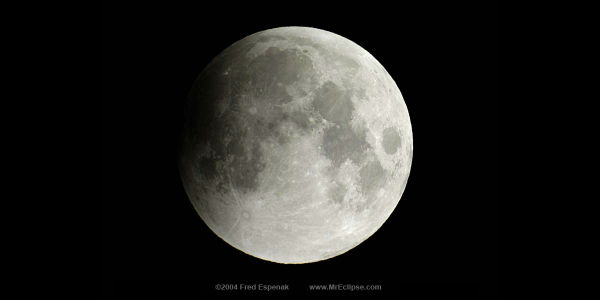
Image credit: Deep penumbral lunar eclipse in 2004 (Photo ©2004 by Fred Espenak)
On November 28, 2012 the moon will slide through the Earth’s pale outer shadow or penumbra, resulting in a penumbral lunar eclipse. A penumbral lunar eclipse occurs when the Earth moves between the Sun and Moon but the three celestial bodies do not form a perfectly straight line. The Earth revolves around the Sun and the Moon circles the Earth. During Full Moon, the Earth passes roughly between Moon and Sun.

First penumbra contact will occur at 12:15 UTC (7:15 a.m. EST). A weak penumbral eclipse of the Moon occurs before and/or during dawn Wednesday morning for western North America. You should look for a weak shading on the Moon’s north or upper right side. The farther in from the West Coast you are, the brighter the dawn and the lower the Moon will be. The penumbral eclipse takes place high in the middle of the night for the longitudes of Australia and Japan, in late evening of the 28th local date for China and Southeast Asia, and early that evening for India with the Moon still low in the east.
Eastern Canada and the USA will miss the eclipse entirely since it begins after moonset. Observers in western Canada and the USA will have the best views with moonset occurring sometime after mid-eclipse. To catch the entire event, one must be in Alaska, Hawaii, Australia, or East Asia.
 Penumbral Lunar Eclipse of November 28 visibility map (“Five Millenium Canon of Lunar Eclipses” Espenak & Meeus / NASA)
 This chart depicts the penumbral lunar eclipse viewing times in the United States for the Nov. 28, 2012, lunar eclipse. (Credit: Joe Rao – Hayden Planetarium/SPACE.com)
Observers on the southern hemisphere stand “upside-down” compared to observers on the northern hemisphere, so they also see the Moon “upside-down”. The orientation of a lunar eclipse and the direction in which the shadow appears to move across the Moon’s surface can therefore vary according to latitude.
Slooh Space Camera will webcast live from Canary Islands.
 A total penumbral lunar eclipse dims the moon in direct proportion to the area of the sun’s disk blocked by the Earth. This comparison shows the southern shadow penumbral lunar eclipse of January 1999 (left) to the same moon outside of the shadow (right) demonstrates this subtle dimming. (Credit: Wikipedia)
How to Photograph the Lunar Eclipse
The moon will be full and at its apogee at the time of eclipse. Apogee is farthest point in its orbit from Earth. The moon will be positioned 6 degrees northwest of Aldebaran and about 8 degrees west of Jupiter, located in the constellation Taurus. You can spot dimmer Pleiades above them.
Penumbral Lunar Eclipse of November 28
“Five Millennium Canon of Lunar Eclipses: -1999 to +3000“
The November 28 penumbral lunar eclipse is the 11th member of Saros 145, a series of 71 eclipses in the following sequence: 18 penumbral, 10 partial, 15 total, 20 partial, and 8 penumbral lunar eclipses. Lunar eclipses of Saros 145 all occur at the Moon’s descending node and the Moon moves northward with each eclipse. The series began with a penumbral eclipse near the southern edge of the penumbra on August 11, 1832. The series will end with a penumbral eclipse near the northern edge of the penumbra on September 16, 3094. The total duration of Saros series 145 is 1262.11 years.
All Eclipses from 1900 to 2100

Earlier reporting
Nothing on Watchers was published in the last 24 hours. These are older articles.
- On October 22, 2017, a single flash of lightning stretched 515 miles from eastern Texas to near Kansas City, a distance that takes eight hours to drive, and nobody realized how far it had gone until scientists went back through the satellite data years later Epicenter
- CPC posts a slight risk of heavy rain from the Gulf Coast to the Northeast urban corridor November 25-29, and a moderate risk of West Coast wind and Sierra snow on November 25
- Florida's east coast faces a moderate flash flood risk Wednesday through Friday, with 4 to 8 inches of rain forecast and the St. Johns River near Cocoa already in major flood at 17.13 feet
- Cyclone Akvan to make landfall between Nellore and Visakhapatnam around noon on November 20, IMD forecasts 120-130 km/h winds gusting to 145

[…] middle of the night for the longitudes of Australia and Japan, in late evening of the 28th local date for China and Southeast Asia, and early that evening for India with the Moon still low in the […]