
Venus and Jupiter show in July

Image credit: TW
The brightest planets in the solar system are converging for a beautiful sunrise sky show in early July.
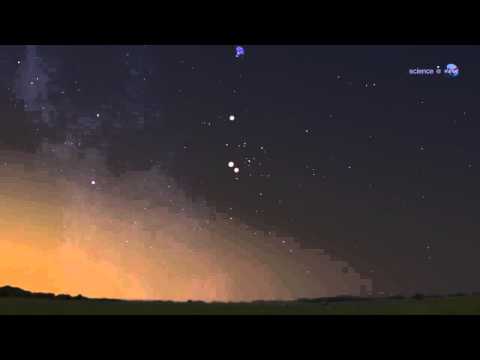
Every morning this July, the two brightest planets (Venus –4.7 and Jupiter –2.1) in the solar system will put on a show before sunrise. Look out on east you will see Venus and Jupiter, shining side by side, so close together you can hide them behind your outstretched palm.
And, by the way, Earth is at aphelion, its farthest from the Sun for the year (just 1/30 farther than at perihelion in January).

Three mornings later, on July 7th, Venus and Jupiter will line up with Aldebaran, the bright red eye of Taurus the Bull. Aldebaran is a red giant star of first magnitude. Together with Venus and Jupiter, it forms an almost perfect vertical line in the brightening dawn sky.

On July 9th, Venus and Aldebaran converge to form an eye catching planet-star pair. Scarcely more than a degree of arc will separate the two celestial bodies as Jupiter looks down from overhead.

And then, on July 15th, a 12% crescent Moon joins the show, forming a bright celestial triangle with Venus and Jupiter. That’s caused by Earthshine, sunlight reflected from our own planet onto the otherwise dark lunar landscape.
A crescent Moon with Earthshine is considered to be one of the prettiest sights in the heavens. And a crescent Moon with Earthshine plus Venus and Jupiter – that’s worth waking up!
Source: science.nasa.gov.

Published in the last 24 hours
- Male toads abandoned a pond in Italy five days before a deadly 2009 earthquake, while a scientist was counting them Epicenter
- An asteroid was spotted 19 hours before it exploded over Sudan in 2008, and students picked its pieces off the desert Epicenter
- A wave up to 3 m (10 feet) high rose out of Lake Michigan on a sunny June morning in 1954 and swept fishermen off Chicago’s piers, and when a second came 10 days later, warnings had cleared the shore Epicenter
- Just 12 inches of rushing water can carry away most cars, and more than half of US flood drownings happen to people who drive into flood water Epicenter
