
Earth’s equinoxes and solstices
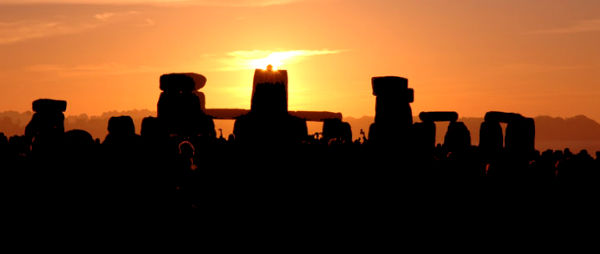
Image credit: Pete Strasser (Tucson, Arizona, USA)
An equinox occurs twice a year, when the tilt of the Earth’s axis is inclined neither away from nor towards the Sun, the center of the Sun being in the same plane as the Earth’s equator. The term equinox can also be used in a broader sense, meaning the date when such a passage happens. Around the equinox, the night and day have approximately equal length. At an equinox, the Sun is at one of two opposite points on the celestial sphere where the celestial equator and ecliptic intersect. These points of intersection are called equinoctial points: the vernal point and the autumnal point. By extension, the term equinox may denote an equinoctial point.
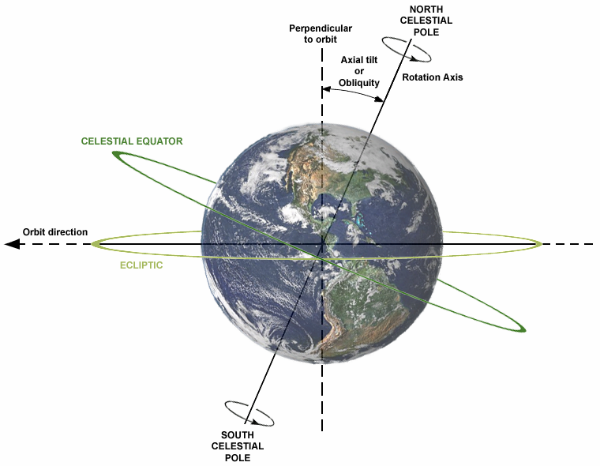
An equinox happens each year at two specific moments in time, when there is a location (the subsolar point) on the Earth’s equator, where the center of the Sun can be observed to be vertically overhead, occurring around March 20 and September 22 each year. Although the word equinox is often understood to mean “equal
| UT date and time of solstices and equinoxes | ||||||||
|---|---|---|---|---|---|---|---|---|
| year | Equinox Mar | Solstice June | Equinox Sept | Solstice Dec | ||||
| day | time | day | time | day | time | day | time | |
| 2007 | 21 | 00:07 | 21 | 18:06 | 23 | 09:51 | 22 | 06:08 |
| 2008 | 20 | 05:48 | 20 | 23:59 | 22 | 15:44 | 21 | 12:04 |
| 2009 | 20 | 11:44 | 21 | 05:45 | 22 | 21:18 | 21 | 17:47 |
| 2010 | 20 | 17:32 | 21 | 11:28 | 23 | 03:09 | 21 | 23:38 |
| 2011 | 20 | 23:21 | 21 | 17:16 | 23 | 09:04 | 22 | 05:30 |
| 2012 | 20 | 05:14 | 20 | 23:09 | 22 | 14:49 | 21 | 11:11 |
| 2013 | 20 | 11:02 | 21 | 05:04 | 22 | 20:44 | 21 | 17:11 |
| 2014 | 20 | 16:57 | 21 | 10:51 | 23 | 02:29 | 21 | 23:03 |
| 2015 | 20 | 22:45 | 21 | 16:38 | 23 | 08:20 | 22 | 04:48 |
| 2016 | 20 | 04:30 | 20 | 22:34 | 22 | 14:21 | 21 | 10:44 |
| 2017 | 20 | 10:28 | 21 | 04:24 | 22 | 20:02 | 21 | 16:28 |
A solstice is an astronomical event that happens twice each year when the Sun reaches its highest position in the sky as seen from the North or South Pole. At the solstices, the Sun stands still in declination. That means the seasonal movement of the Sun’s path (as seen from Earth) comes to a stop before reversing direction. The solstices, together with the equinoxes, are connected with the seasons. In many cultures the solstices mark either the beginning or the midpoint of winter and summer.
The term solstice can also be used in a broader sense, as the date (day) when this occurs. The day of the solstice is either the “longest day of the year” or the “shortest day of the year” for any place on Earth, because the length of time between sunrise and sunset on that day is the yearly maximum or minimum for that place. (Wikipedia)

Source:OurAmazingPlanet
Charts of 2012 equinox, solstice & cross-quarter moments


[…] 23 09:51 18:06 The Watchers – Earth's equinoxes and solstices […]
And, Old Sol is clipping along pretty good, too; thus, our elliptical orbit–we are out in front at perhelion, and behind (lagging) at apohelion.
The sun leaves a corona, an invisible ‘tail’, like a comets’; thus, in ‘summer’ (n. hemis.) we bathe in all that ‘stuff’.
Around Oct. 31 or so, we exit the corona–could this be the natural phenomenon behind the tradition of Hallowe’en?
I don’t believe in that stuff, myself, but it’s interesting to ponder whether superstitions have real basis, innit? Like, if the Little Green Guys said to the cavemen, ‘Lookit, here it is, in terms you might undrstand’–and thus started the tradition of dumbing it up, by dumbing it down…
Just sayin, something to ponder, on a looong Sunday aftrnoon…
G.