
A bright meteor lit up the night sky above Atlanta
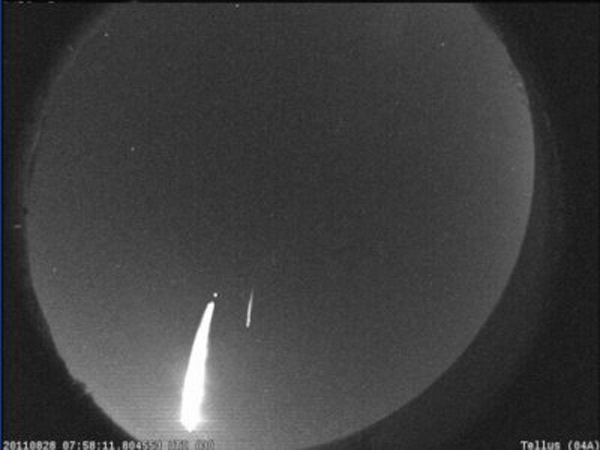
Image credit: TW
A bright meteor lit up the night sky above Atlanta on Sunday, August 28, 2011, in a dazzling display caught by NASA cameras.
The meteor streaked over Atlanta, Ga., and its surrounding cities at the mind-blowing speed of about 52,800 mph (84,970 kph).
NASA's network of all-sky cameras, which monitors the sky for meteor and fireball events, caught several views of the "shooting star" from different cities, including a video recorded from Cartersville, Ga., though it was difficult to pinpoint the meteor's core. <Video of the Atlanta meteor >
The meteor was too bright for the all-sky camera in Cartersville, Ga., to accurately determine the center of light, so manual analysis will be required to determine a more accurate end point. The meteor was streaking over the Atlanta suburb of Duluth at an altitude of about 65 miles (105 kilometers) when it was first spotted, and fizzled out at a point about 26 miles (42 km) between the towns of Stockbridge and McDonough.
Astronomers have different names for space rocks depending on where they are.
Small rocks and dust particles in space are considered meteoroids until they encounter Earth's atmosphere. If they blaze up in a bright fireball or flash, they are called meteors, and if any remnants reach the Earth's surface, they are called meteorites . (Space.com)
If you spot a meteor, you can check this NASA website to see if it the space agency has identified its origins: http://fireballs.ndc.nasa.gov/

Earlier reporting
Nothing on Watchers was published in the last 24 hours. These are older articles.
- Right about now, Voyager 1 is crossing a line no human-made object has ever reached, a full light-day from Earth, which means a message NASA sends tonight won't arrive until tomorrow night, and the spacecraft's answer won't make it home until the night after that
- Asteroid 2026 WA passed Earth at 126,400 km, about a third of the Moon's distance, at 07:59 UTC on November 17
- On October 22, 2017, a single flash of lightning stretched 515 miles from eastern Texas to near Kansas City, a distance that takes eight hours to drive, and nobody realized how far it had gone until scientists went back through the satellite data years later Epicenter
- CPC posts a slight risk of heavy rain from the Gulf Coast to the Northeast urban corridor November 25-29, and a moderate risk of West Coast wind and Sierra snow on November 25

It also flew over Albany, NY, it was huge:-)
wow a nice read. Keep us posted love this