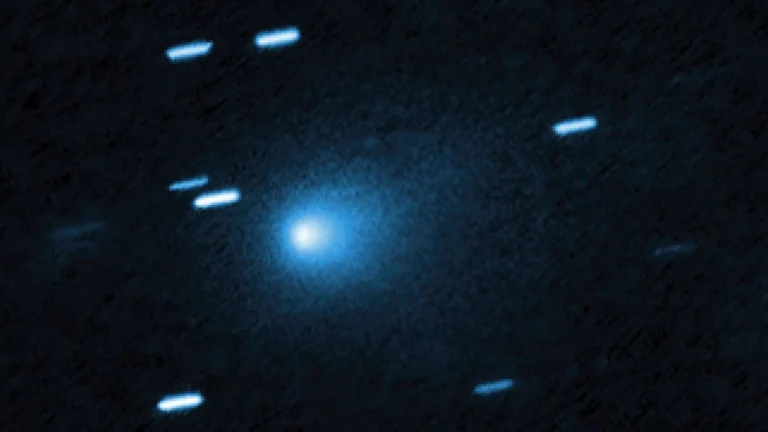
• 3I/ATLAS completes inbound leg of its Solar System passage on October 29

    Interstellar object 3I/ATLAS (C/2025 N1 ATLAS) will reach its perihelion distance of about 1.36 AU from the Sun on October 29, 2025, marking the midpoint of its one-time passage through the Solar System. The hyperbolic object will be unobservable from Earth during the event but will later pass within 97 million km (60 million miles) of Venus and 54 million km (34 million miles) of Jupiter on its way out of the system.

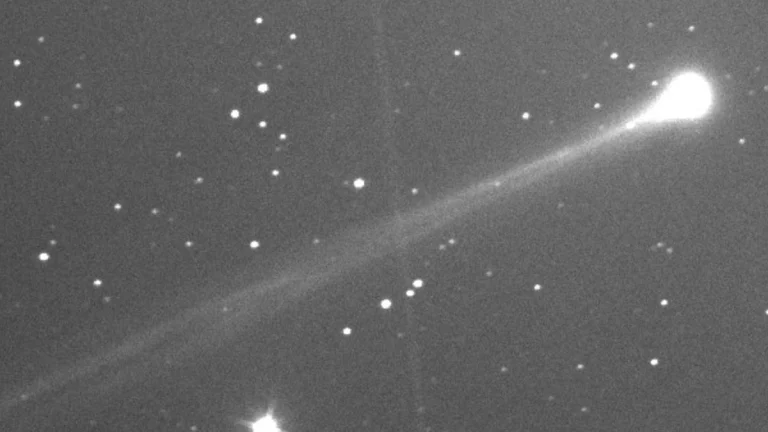
  • CME forecast to strike interstellar Comet 3I/ATLAS on September 24-25

    A coronal mass ejection (CME) launched from the Sun on September 19 is forecast by NASA’s ENLIL model to strike interstellar Comet 3I/ATLAS on September 24 or 25, an extremely rare event that comes as the comet brightens 40-fold and prepares to disappear into the Sun’s glare.

  • Comet SWAN25B surprises astronomers after perihelion outburst

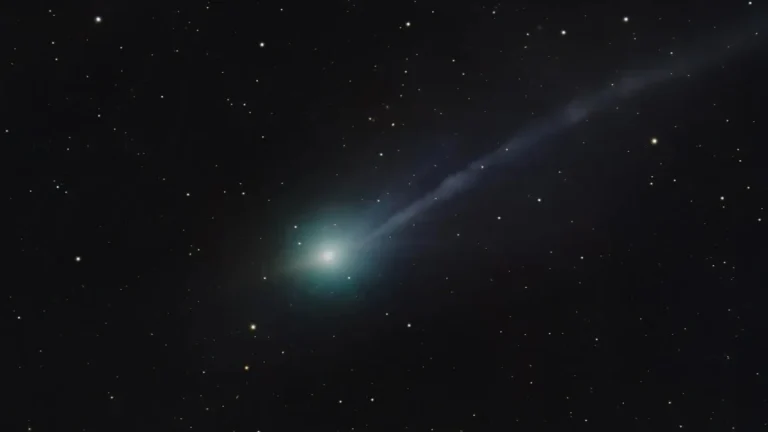
    A newly discovered comet, designated SWAN25B, emerged from behind the Sun in early September 2025 and was added to the Minor Planet Center’s Possible Comet Confirmation Page on September 12. The object is currently reported at magnitude 8.3 in MPC data, with independent amateur estimates placing it slightly brighter at magnitude 7.4–7.5. Orbit calculations are still in progress.

  • Comet C/2024 G3 (ATLAS) puts on spectacular show in Southern Hemisphere skies

    Comet C/2024 G3 (Atlas), which made its closest approach to Earth on January 14, 2025, and reached perihelion a day later, is creating spectacular photographic opportunities as it brightens in the night sky. Astronomers and skywatchers in the Southern Hemisphere have reported a visible coma and an extended tail, making it one of the most striking comets of recent years.

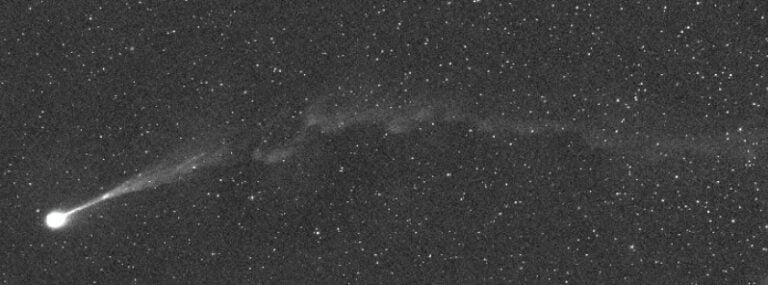
  • Comet Nishimura’s tail ripped off by a CME

    On September 2, 2023, a coronal mass ejection (CME) launched by our sun hit Comet Nishimura (C/2023 P1), causing a disconnection event and stripping its tail. This encounter occurred while the comet was located about halfway between the orbits of Mercury and Venus.

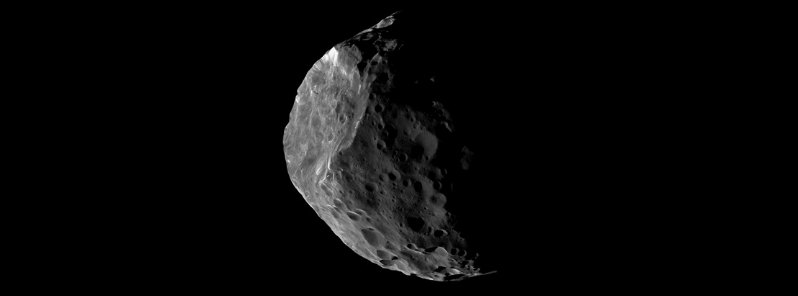
  • Giant comets pose a much greater hazard to life than asteroids

    The discovery of hundreds of giant comets in the outer planetary system over the last two decades means that these objects pose a much greater hazard to life than asteroids, a team of astronomers from Armagh Observatory and the University of Buckingham report. The…