
X45 superflare of 2003 rivaled Carrington Event and carried potential to trigger a planetary-scale power-grid collapse
A solar flare of extraordinary intensity erupted from Active Region 10486 at 19:29 UTC on November 4, 2003, overwhelming every X-ray detector in orbit and leaving scientists temporarily blind to its true scale. Only later would they learn it reached about X45 — the most powerful ever measured in the Space Age. Its radiative power rivaled that of the 1859 Carrington Event, yet most of its debris was ejected harmlessly sideways into space. Had Active Region 10486 faced Earth, researchers estimate the geomagnetic index Dst could have dropped below –850 nanoteslas — enough to trigger a planetary-scale power-grid collapse.


On November 4, 2003, X45 solar flare saturated the X-ray detectors on several Sun-observing spacecraft. Credit: ESA/NASA SOHO
On the evening of November 4, 2003, satellites orbiting Earth detected a rapid rise in soft X-rays coming from the Sun. Within seconds, the GOES-12 sensors hit their upper limit. For about twelve minutes, the detectors were completely saturated, unable to measure the true intensity. The recorded value of X17.4 was only a lower bound.
The flare came from NOAA active region 10486, a tangled magnetic complex large enough to swallow fifteen Earths placed side by side. It occupied a position near S19 W83 on the Sun’s western limb at the time of eruption, pointing its fury away from Earth. The geometry would prove critical: it prevented the direct impact of the blast on our planet.
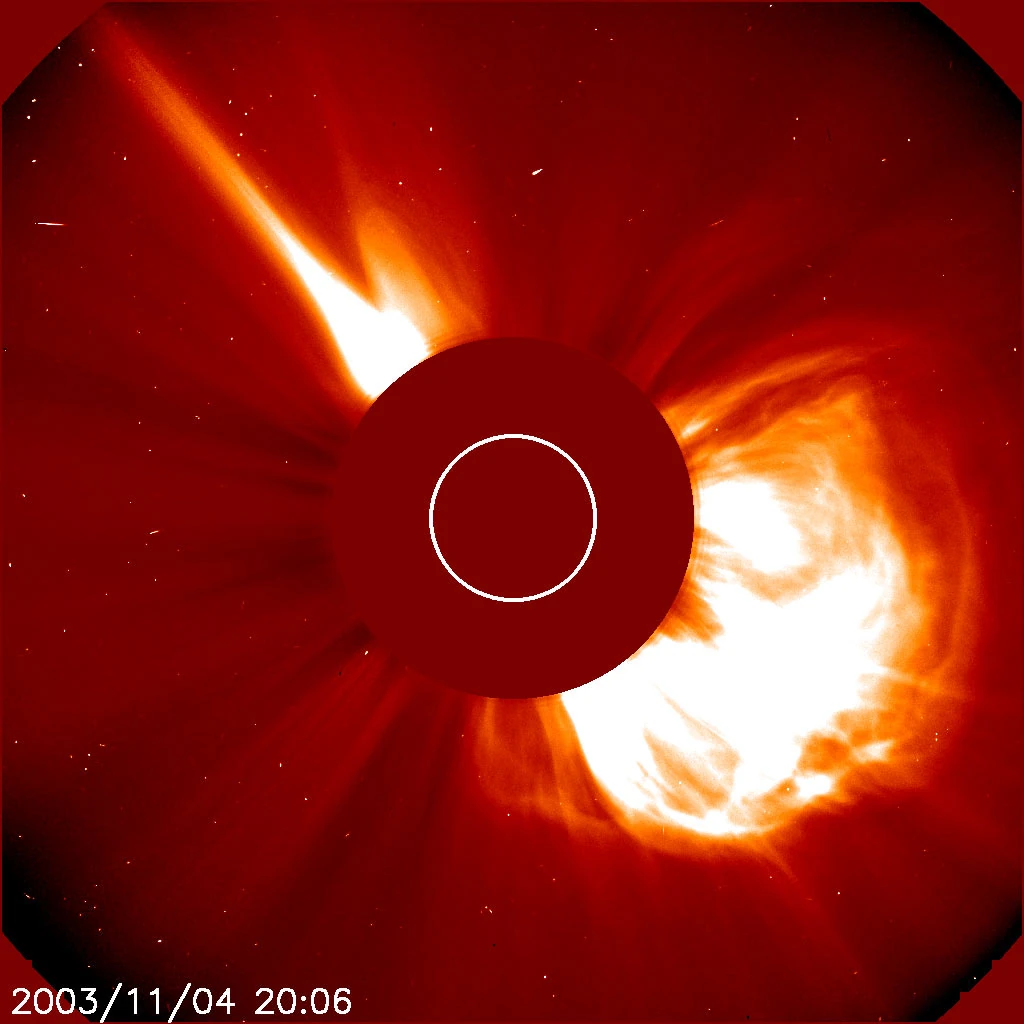
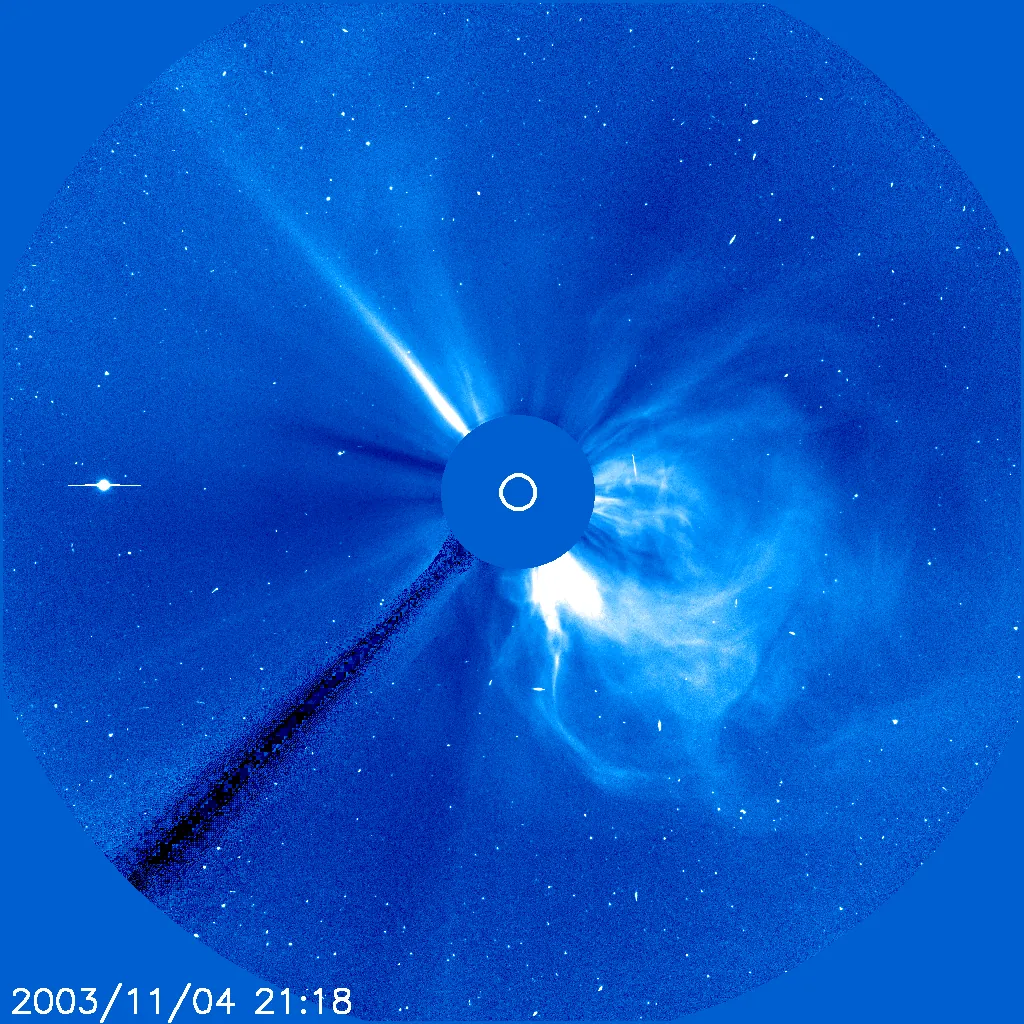
Space-based imagery from the Solar and Heliospheric Observatory (SOHO) showed a vast coronal mass ejection (CME) expanding at speeds between 1 900–2 700 km/s (1 180–1 680 mps). Even with that oblique trajectory, the event caused an “R5 extreme” radio blackout over North America as the flare’s X-rays instantly over-ionized the upper atmosphere.
Across the world, radio operators heard nothing but static. High-frequency links failed for several hours, and airlines that used polar routes diverted flights to lower latitudes to avoid radiation exposure. It was the strongest disruption of the communications spectrum in modern records.
Measuring what no instrument could record
With GOES sensors overwhelmed, scientists turned to a natural detector far larger than any satellite: Earth’s ionosphere. A team led by Neil Thomson at the University of Otago examined changes in very-low-frequency (VLF) radio transmissions that bounce between the ground and the ionized upper atmosphere. The shape of those signals allowed them to infer the flare’s true X-ray intensity.
Their analysis, published in Geophysical Research Letters, revealed a peak close to X45 with an uncertainty of about ±5. Other researchers confirmed the estimate by analysing riometer data and the total radiative energy emitted. The convergence of results left little doubt: this was the largest solar flare directly observed since the dawn of the satellite era.
The technique effectively used the planet itself as a measuring device. The sudden ionization of the D-region, around 60–90 km (37–56 miles) above the surface, changed the path of radio waves in a way that could be calibrated against flares of known size. By comparing those phase shifts, the team reconstructed the missing top of the GOES curve.
This indirect approach has since become a key tool for evaluating extreme events that saturate detectors. Without it, the true power of the 2003 flare might have remained unknown.
A modern echo of the Carrington Event
The November 2003 eruption invited immediate comparison with the legendary Carrington Event of 1859. That nineteenth-century storm caused auroras as far south as the Caribbean and sent electric currents racing through telegraph wires. Although no instruments then measured solar X-rays, modern reconstructions suggest the Carrington flare may have reached between X40 and X80 in equivalent energy.
By that yardstick, the 2003 flare belongs in the same class. It emitted a comparable level of radiative power but directed most of its debris harmlessly sideways into space. Had active region 10486 faced Earth, scientists estimate the geomagnetic index Dst could have plunged below –850 nanoteslas, a level consistent with a planetary-scale power-grid failure.
Even at an angle, the flare’s effects rippled through near-Earth space. The associated proton storm reached “S4 severe” levels, damaging satellite electronics and forcing several spacecraft, including ACE and SOHO, into protective safe modes. Days later, a weaker glancing coronal mass ejection still produced bright auroras over Canada and the northern United States.
These observations turned the Halloween–November 2003 outbreak into a benchmark for extreme space weather. Every major forecasting center now uses it as a calibration point for model validation.
Why giant flares arrive when cycles decline
One of the enduring mysteries of solar physics is why some of the most violent eruptions occur not at the height of a solar cycle but as it begins to wane. The 2003 flare erupted late in Solar Cycle 23, months after maximum activity had passed.
Statistical analyses of previous cycles reveal a pattern. During the decline, the Sun’s magnetic fields reorganize. Old active regions decay, their magnetic roots sink below the surface, and new flux tubes rise to interact with the remnants. These interactions can store tremendous energy. When magnetic reconnection finally releases it, the resulting flare can exceed anything produced during peak sunspot counts.
This “late-cycle giant” phenomenon has appeared repeatedly: in the closing years of Cycles 19, 21, 22 and 23. Forecasters now treat it as a significant indicator of elevated risk. As Solar Cycle 25 enters its descending phase, large magnetically twisted sunspot groups similar to AR 10486 have already reappeared, reminding observers that the pattern persists.
Understanding the physical mechanism behind these late-cycle outbursts remains a major research goal. Models involving subsurface flux cancellation and helicity transfer are being tested with data from NASA’s Solar Dynamics Observatory (SDO) and ESA’s Solar Orbiter.
The limits of our instruments and what changed after 2003
The 2003 flare exposed a critical weakness in the world’s monitoring network: detector saturation. Instruments built to record ordinary X-class events could not handle something several times stronger.
Since then, NOAA’s GOES-R series and newer missions such as SDO and Solar Orbiter have introduced radiometers with extended dynamic range and multiple overlapping channels. They are designed to continue recording well beyond X20, preventing data loss even during extreme events.
In parallel, ground-based and spaceborne sensors that observe radio emissions, ionospheric absorption and ultraviolet signatures now provide redundancy. Even if one system clips, others capture complementary data, allowing scientists to reconstruct complete flare profiles.
The lessons learned from 2003 changed how agencies classify and verify solar events. Modern forecasts combine direct X-ray flux with ionospheric and radio diagnostics, ensuring that future outbursts can be fully quantified.
What a direct hit could have done
Had the November 4 flare been Earth-directed, the consequences would have been severe. Magnetohydrodynamic simulations indicate that a CME moving at 2 500 km/s (1 550 mps) toward Earth could induce electric fields of 2–5 volts per kilometer in long conductors, driving geomagnetically induced currents into transmission networks. These currents are sufficient to push high-voltage transformers into core saturation and thermal stress, risking permanent damage and large-scale outages across interconnected grids.
Prolonged power loss at this scale would propagate into critical infrastructure. Water treatment and pumping stations would face shutdowns, creating supply interruptions in urban and agricultural regions. Fuel pipelines and gas distribution networks, which rely on electric pumping and control systems, would slow or halt. Refrigeration and food logistics chains would degrade rapidly without stable power, affecting storage, transport, and retail supply.
Hospitals and emergency services would rely on backup generation, which is finite and unevenly distributed. Telecommunications networks, cloud services, and financial transactions would experience outages, complicating coordination and recovery. Satellite networks would be affected simultaneously, reducing redundancy in navigation, timing, and communication.
Atmospheric expansion driven by energy deposition would increase drag on low-Earth-orbit satellites, while radiation exposure and surface charging would threaten higher-orbit spacecraft. GNSS navigation performance would degrade under ionospheric disturbance, and HF communication routes could become unreliable. Aviation rerouting at high latitudes to avoid elevated radiation levels above 200 microsieverts per hour would create delays, fuel constraints, and capacity bottlenecks.
Sustained disruption of utilities, logistics, and communication systems could produce localized social strain, particularly in densely populated regions and supply hubs. Access to food, water, medical care, and fuel would become uneven, and civil-order challenges could emerge in areas experiencing extended outages or resource shortages.
The cumulative impact could match or exceed major natural disasters in scale and duration, particularly given the limited global capacity to replace damaged grid components.
Because AR 10486 was just beyond the limb, the event served as a near-miss demonstration of the Sun’s capability without forcing a full-scale test of modern infrastructure resilience.
Preparing for the next extreme event
Two decades later, that lesson remains relevant. Solar Cycle 25 is approaching the same stage where large late-cycle flares historically emerge. Agencies such as NOAA’s Space Weather Prediction Center, NASA Goddard’s Space Weather Research Center, and the European Space Agency’s Space Situational Awareness programme have built continuous monitoring networks to issue early alerts.
These centres now run coupled models that link solar surface magnetism, interplanetary plasma flows and Earth’s magnetosphere in near real time. The goal is to forecast not only when a flare might occur but also how its ejected material will interact with our planet’s magnetic field.
The 2003 event serves as the calibration point for those models. It demonstrated that instrument saturation is not just a technical problem but a knowledge gap that can hide the true scale of solar extremes.
If statistics and history are any guide, another flare of this scale is inevitable. Instruments today can measure them precisely, but real-world warning time for grid operators may be minutes rather than days, providing only a limited opportunity to protect infrastructure.
As a technology-dependent civilization, we are still highly exposed to severe space-weather events and sometimes it feels like nobody cares. While work to harden power grids and satellite networks continues, full resilience remains an unresolved challenge even for the most advanced nations.

I’m a science journalist and researcher at The Watchers, contributing to the Epicenter edition, where I cover peer-reviewed scientific research and emerging discoveries across Earth and space sciences. With a background in astronomy and a passion for environmental science, I’ve worked in shark and coral conservation in Fiji, conducting reef and shark-behavior research, contributing to mangrove restoration, and earning PADI Open Water and Coral Reef Certifications. I bring a blend of scientific rigor and storytelling to illuminate the discoveries shaping our planet and beyond.

Commenting rules and guidelines
We value the thoughts and opinions of our readers and welcome healthy discussions on our website. In order to maintain a respectful and positive community, we ask that all commenters follow these rules.