
What causes the aurora borealis? Northern lights explained
The aurora borealis forms when charged particles ejected from the Sun during solar storms interact with Earth’s magnetic field and collide with gases in the upper atmosphere. As these energetic particles funnel along magnetic field lines toward the poles, they strike atoms of oxygen and nitrogen, transferring energy that is then released as visible light. This process generates shimmering bands of green, red, and violet light that trace the structure of Earth’s magnetosphere, varying in color depending on the altitude and type of atmospheric gas involved.
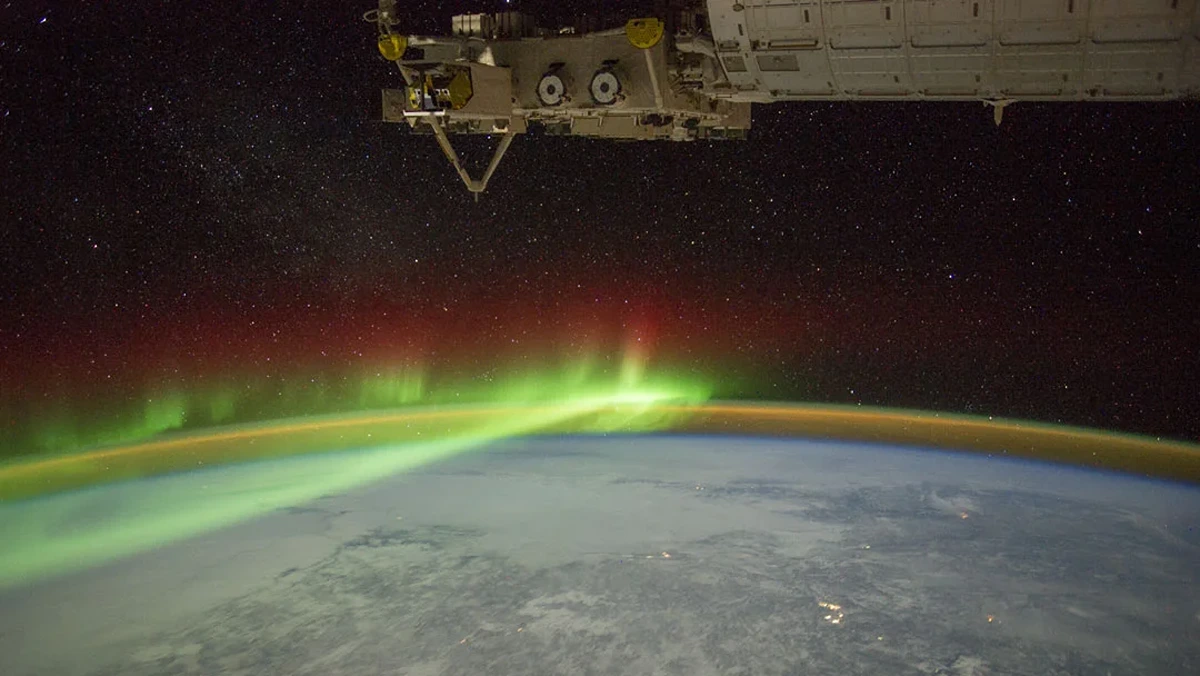
View from the International Space Station, showcasing the vibrant aurora, airglow, and the ancient Manicouagan Crater in Canada. Image credit: NASA/ISS
With views as if the Earth itself were breathing light, what really is behind this otherworldly spectacle we know as the aurora borealis? These swoon-worthy lights are a result of the interaction between the magnetic fields of the Sun and the Earth.
Northern lights begin with intense solar storms erupting on the Sun’s surface and sending huge clouds of charged particles that race through space. Some of them end up reaching Earth, where most get deflected by the planet’s magnetic field. But near the poles, that shield isn’t as strong, and a few of those particles slip through.
As they come in contact with the upper atmosphere, they crash into atoms of oxygen and nitrogen. That impact gives the atoms a burst of energy, causing them to glow. The result is the aurora, which comprises moving waves of green, pink, and violet light shaped by Earth’s magnetic field lines. What we’re seeing is a collision between solar energy and our atmosphere, turned into something breathtaking.
Whether you’re watching from the Arctic or the Antarctic, this phenomenon has a name accordingly; i.e, aurora borealis in the north and aurora australis in the south.
Colors of the northern lights
As previously explained, the colors of the northern lights come from charged particles colliding with different gases in Earth’s upper atmosphere.
During these collisions, the energy is transferred to atoms and molecules, which briefly absorb it before releasing it again as light. The exact colors we see depend on several factors, including the type of gas involved, the altitude at which the collision occurs, the density of the atmosphere at that level, and the amount of energy the particles carry.
Here is a breakdown of the prevalent colors appearing in the aurora borealis:
- Green – This is the dominant color in most aurora displays. It’s produced when charged particles hit oxygen atoms between 100 and 200 km (62 and 124 miles) above Earth. Since oxygen is abundant at this altitude, green tends to stand out the most in the night sky.
- Red- This shade comes from high-altitude oxygen, over 200 km (124 miles) above Earth. When solar activity is strong, these oxygen atoms release a slow, steady red light that can streak across the sky like a smear, giving it the moniker of blood aurora. Since there’s not much oxygen that high up, red is one of the rarest aurora colors and usually only shows up during powerful solar storms.
- Pink, purple, and blue – Shades of pink, purple, and blue in the auroras are caused by nitrogen about 100 km (62 miles) above Earth. These colors appear when solar activity is high enough to allow charged particles to slip past the oxygen layer and reach the nitrogen layer below.
- Yellow – This phenomenon occurs when multiple colors combine, typically during periods of high solar activity.
Best time to catch the northern lights
Auroral activity does not occur on a fixed schedule, but patterns have been observed. Auroras are more frequent around the equinoxes in March and September, a phenomenon first documented in 1973 by Christopher T. Russell and Robert L. McPherron, who explained it as the result of how the Sun’s magnetic field interacts with Earth’s.
The best time to catch the aurora is during the dark nights of winter, when there’s less sunlight in the atmosphere to drown it out. Auroras are brighter and more dynamic during periods of high solar activity, particularly during the solar maximum phase of the 11-year solar cycle.
Both the Earth and Sun have magnetic fields with poles that shift and rotate. During equinoxes, their magnetic fields tend to align in opposite directions, allowing solar wind particles to more easily penetrate Earth’s magnetosphere. Additionally, Earth’s tilt positions its magnetic poles at a right angle to the incoming solar wind, enhancing particle entry and leading to more intense auroral events.
The Kp index, which measures geomagnetic activity on a scale from 0 to 9, is commonly used to estimate aurora visibility. Values of Kp6 or higher indicate strong chances of auroras being visible beyond the polar regions.
Best regions to catch the aurora in the sky
Aurora borealis is typically concentrated in a ring-shaped area around the northern magnetic pole known as the auroral oval or auroral annulus. This region spans roughly 3 000 km (1 864 miles) in diameter and includes high-latitude countries such as Norway, Sweden, Finland, and Iceland, where auroral activity is most consistent.
During geomagnetic storms or periods of solar maximum, the auroral oval expands toward lower latitudes. Temporary auroral visibility has been documented in areas such as the United Kingdom, Canada, and the northern United States.
Do the northern lights make a sound?
There are anecdotal accounts of sounds associated with auroras, described as faint hissing, crackling, or popping noises. While difficult to verify under standard atmospheric conditions, some researchers have begun investigating the phenomenon seriously.
One hypothesis suggests that these sounds may be related to atmospheric electricity, particularly during geomagnetic storms.
Another theory points to atmospheric inversion layers, where temperature stratification near the ground may influence acoustic propagation.
Although the physical mechanisms remain uncertain, historical reports of audible auroras date back centuries.

My passions include trying my best to save a dying planet, be it through carpooling or by spreading awareness about it. Research comes naturally to me, complemented by a keen interest in writing and journalism. Guided by a curious mind and a drive to look beyond the surface, I strive to bring thoughtful attention and clarity to subjects across Earth, sciences, environment, and everything in between.

Commenting rules and guidelines
We value the thoughts and opinions of our readers and welcome healthy discussions on our website. In order to maintain a respectful and positive community, we ask that all commenters follow these rules.