
Variations in Length of Day linked to core movements
Movements within Earth’s molten outer core are causing millisecond-scale changes in the length of a day (LOD), according to researchers from the Swiss Federal Institute of Technology Zurich (ETH Zurich). Their findings, reported on November 26, 2024, are based on historical eclipse data analyzed using advanced machine learning (ML) and it traces rotational speed variations over the past 3 000 years.
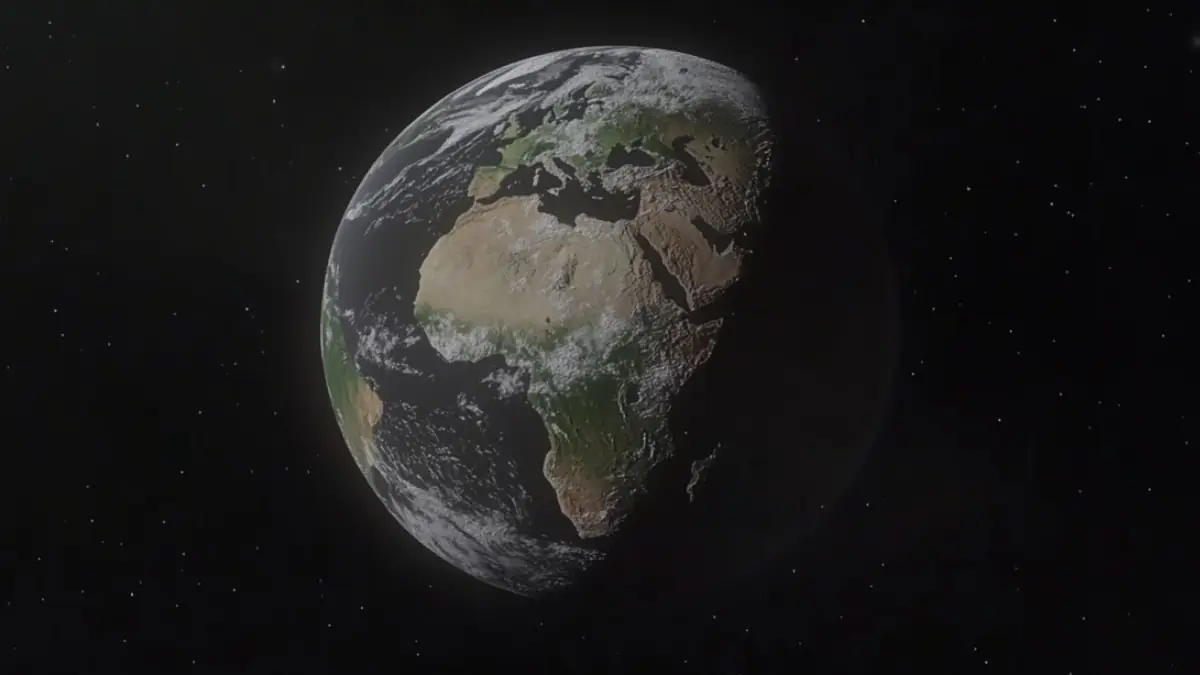
Image credit: The Watchers
Scientists from ETH Zurich and other institutions presented findings that examined length of a day (LOD) fluctuations from 720 BCE to 2020. They assessed the impacts of climatic and core movements by combining historical eclipse and lunar occultation records with Bayesian Physics-Informed Neural Networks (BPINNs).
Their results confirmed that core magnetohydrodynamic (MHD) interactions align closely with observed LOD variations while climatic factors played a minimal role.
Earth’s rotation takes approximately 24 hours (86 400 seconds) to complete but small changes can occur over time.
For centuries, scientists have linked these variations to the gravitational pull of the moon and the shifting of Earth’s crust after the last ice age. New research now shows that movements within Earth’s core could be responsible for these long-term fluctuations in the LOD.
Long-term trends and lunar gravitational effects on Earth’s rotation
Over centuries, the LOD has gradually increased by about 1.72 milliseconds per century. This change is mainly caused by the moon’s gravitational pull which slows Earth’s rotation, and the slow rebound of landmasses after the last ice age, known as glacial isostatic adjustment (GIA).
The moon’s pull adds approximately 2.45 milliseconds per century, while GIA offsets this by about 0.73 milliseconds per century.
Climatic contributions to Earth’s rotational changes
Climatic changes, such as melting polar ice, shifting glaciers, and changes in water distribution on land, were analyzed using historical and contemporary sea-level data collected by researchers over several years.
The findings showed that these factors caused only small changes in the LOD, often moving in the opposite direction of observed trends. These effects, with amplitudes under 0.4 milliseconds, were about 10 times weaker than the changes linked to movements in the Earth’s core.
Core movements and geophysical processes
The molten iron in Earth’s outer core causes changes in angular momentum that affect the planet’s rotational speed.
Scientists used BPINNs to analyze geomagnetic data, drawing from the Archeomagnetic Kalman Model for 14 000 years (ArchKalmag14k model) for historical records and the Combined Observational Model (COV-OBS.x2) for modern observations.
The tangential geostrophic (TG) model, which represents large-scale movements in the core, matched millennial variations in the LOD, with amplitudes ranging from 3 to 4 milliseconds.
“The observed LOD fluctuations align with reconstructed models based on tangential geostrophic dynamics,” Dr. Mostafa Kiani Shahvandi, a geophysicist and lead researcher at ETH Zurich, noted.
“This suggests that fluid motion in the outer core is a primary driver.”
Challenges in alternative models for Earth’s rotation variations
Researchers also explored Magneto-Archimedes-Coriolis (MAC) wave models, which incorporate Coriolis, pressure, Lorentz, and buoyancy forces. These reconstructions showed limited correlation with observed LOD fluctuations, especially on millennial scales.
Amplitudes reached only about 1 millisecond which is insufficient to explain larger variations.
“The MAC wave models may require refined parameters to better align with empirical data,” Dr. Shahvandi remarked.
The role of core movements in Earth’s rotational patterns
The study shows the role of core movements in altering the LOD over timeframes spanning decades to millennia.
Researchers found that large-scale flows in the molten outer core are sufficient to explain these variations, without requiring the presence of stratified layers. This finding also addresses Munk’s enigma of sea-level rise, suggesting that mantle processes, rather than core activity, are the main factors driving long-term rotational trends.
Technological advancements in studying core movements
The study used BPINNs to combine geophysical concepts with neural network models, making it possible to accurately reconstruct changes in the LOD within acceptable uncertainty levels.
The researchers analyzed how variations in core flow affect Earth’s angular momentum by employing Monte Carlo methods and advanced mathematical frameworks.
“This methodology offers a promising avenue for understanding Earth’s internal processes,” Dr. Siddhartha Mishra, a co-author of the study, explained.
Historical observations and data sources in the study of Earth’s rotation
The study utilized LOD data from eclipse and lunar occultation records spanning 720 BCE to 2020. Temporal resolution varied, with 100-year intervals before 1600, 10-year intervals between 1600 and 1800, and annual observations post-1800.
Modern measurements from the International Earth Rotation and Reference Systems Service (IERS) validated historical findings to ensure consistency across datasets.
The tangential geostrophic model provides a strong explanation for LOD variations but some areas remain unexplored.
The effects of gravitational coupling with the inner core have not been properly investigated and the parameters in MAC wave models need improvement.
References:
1 Length of Day Variations Explained in a Bayesian Framework, Mostafa Kiani Shahvandi, Jérõme Noir, Siddhartha Mishra, Benedikt Soja, Geophysical Research Letters – November 26, 2024 – https://doi.org/10.1029/2024GL111148 – OPEN ACCESS

Rishika holds a Master’s in International Studies from Stella Maris College, Chennai, India, where she earned a gold medal, and an MCA from the University of Mysore, Karnataka, India. Previously, she served as a Research Assistant at the National Institute of Advanced Studies, Indian Institute of Science, Bengaluru, India. During her tenure, she contributed as a Junior Writer for Europe Monitor on the Global Politics website and as an Assistant Editor for The World This Week. Her work has also been published in The Hindu newspaper, showing her expertise in global affairs. Rishika is also a recipient of the Women Empowerment Award at the district level in Haryana, India, in 2022.

Commenting rules and guidelines
We value the thoughts and opinions of our readers and welcome healthy discussions on our website. In order to maintain a respectful and positive community, we ask that all commenters follow these rules.