
Sudden blast of asteroid 2023 CX1 over France reveals new impact risk
Asteroid 2023 CX1 exploded at 28 km (17 miles) altitude over Normandy, France, on February 13, 2023, releasing 98% of its kinetic energy in a sudden atmospheric blast, according to a new study.
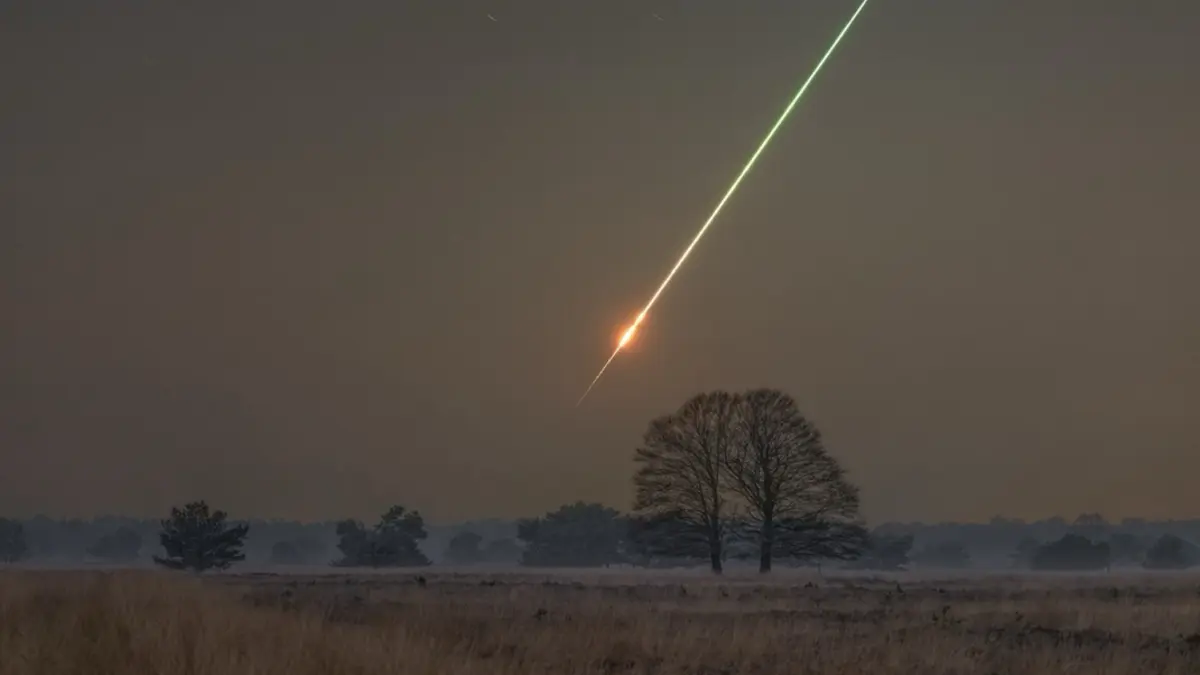
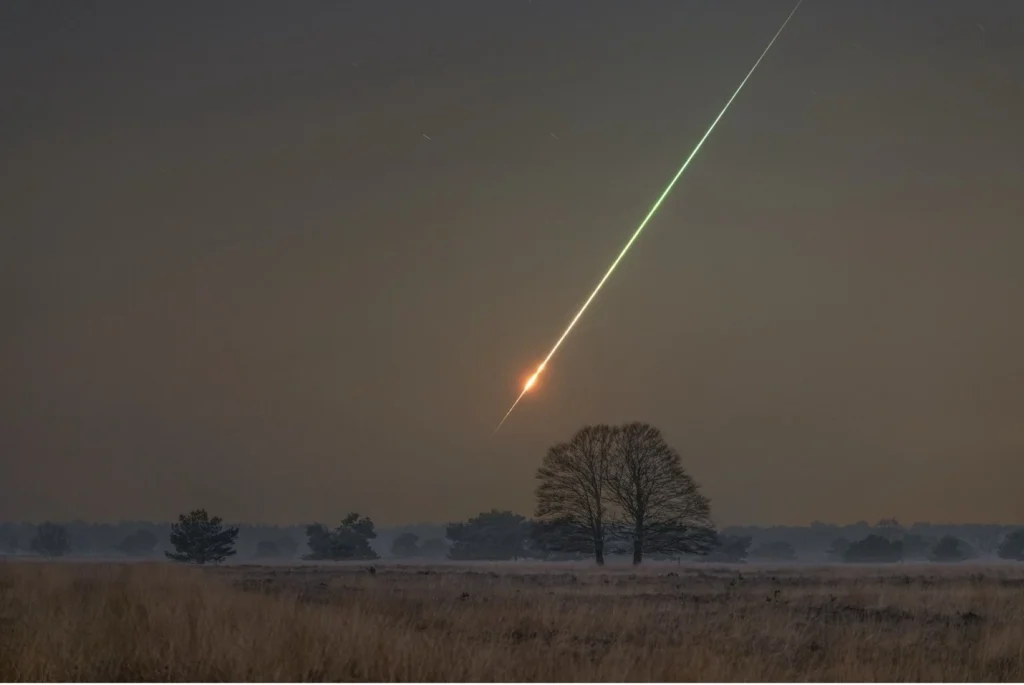
Impact of asteroid 2023 CX1 on February 13, 2023, as seen from the Netherlands. Credit: Gijs de Reijke
Asteroid 2023 CX1 fragmented abruptly instead of breaking apart gradually. At a dynamic pressure of 4 MPa, it disintegrated almost instantly, releasing 98% of its total energy in a concentrated region at 28 km (17 miles) altitude. This sudden failure produced a spherical shock wave, unlike the usual cylindrical energy distribution of most fireballs.
Calculations from NASA Ames Research Center showed that the zone affected by high overpressures was about four times larger than expected for an asteroid of this size. Because the blast occurred lower in the atmosphere, the potential for damage at ground level was significantly higher.
This revealed a new risk profile: even small, common asteroids can generate concentrated airbursts that pose outsized hazards compared to their size. Researchers now recognize a previously overlooked population of impactors that must be accounted for in planetary defense.
Implications for planetary defense
The discovery confirms the existence of a class of abrupt fragmenters linked to L-type ordinary chondrites. These objects can hold together under rising atmospheric pressure before catastrophically breaking apart in a single burst.
Planetary defense models have generally assumed that small asteroids disperse their energy gradually across a wide altitude range. The sudden fragmentation of 2023 CX1 shows that this assumption is incomplete.
Authors of the study suggest that for future predicted entries where dynamic pressures above 3–4 MPa are expected, emergency planners may need to consider precautionary evacuations beneath projected disruption zones.
This was the seventh asteroid impact predicted before entry, following events such as 2008 TC3 over Sudan and 2018 LA over Botswana. Each detection helps scientists refine their understanding of how asteroids behave during atmospheric entry, a critical step in preparing for larger impacts in the future.
Predicted Earth impactors
Updated at 11:20 UTC on May 16, 2026| Object / Type | Discovery date (UTC) | Impact date (UTC) | Impact location | Dimensions (~) | Energy released (kt) | Notes |
|---|---|---|---|---|---|---|
| 2008 TC3 (Apollo) | October 6, 2008 at 06:39 | October 7, 2008 at 02:46 | Nubian desert, Sudan | 4 m (13.1 feet) | 1 | 600 meteorites found. Total weight 11 kg. |
| 2014 AA (Apollo) | January 1, 2014 at 06:18 | January 2, 2014 at 03:06 | Atlantic Ocean | 3 m (9.8 feet) | 0.5 – 0.1 | – |
| 2018 LA (Apollo) | June 2, 2018 at 08:22 | June 2, 2018 at 16:44 | Botswana/South Africa | 3 m (9.8 feet) | 0.4 | At least 24 meteorites found. Ejected by asteroid Vesta. Howardite-Eucrite-Diogenite (HED) type material |
| 2019 MO (Apollo) | June 22, 2019 at 07:24 | June 22, 2019 at 21:25 | Puerto Rico | 5 m (16.4 feet) | 6 | Possibly Alinda asteroid. NEXRAD weather radar detected falling meteorites over water. |
| 2022 EB5 (Apollo) | March 11, 2022 at 19:24 | March 11, 2022 at 21:22 | Jan Mayen Island, Norway | 1 m (6.4 feet) | 2 | – |
| 2022 WJ1 (Apollo) | November 19, 2022 at 04:53 | November 19, 2022 at 08:27 | Ontario, Canada | 1 m (3.2 feet) | – | Most meteorites fell in water. |
| 2023 CX1 (Apollo) | February 12, 2023 at 20:18 | February 13, 2023 at 02:59 | Normandy, France | 1 m (3.2 feet) | – | Over 22 meteorites. |
| 2024 BX1 (Apollo) | January 20, 2024 at 20:48 | January 21, 2024 at 00:33 | Berlin, Germany | 0.7 – 1.6 m (2.23 – 5.2 feet) / ~140 kg | – | About 200 meteorites. Total weight 1.8 kg. |
| 2024 RW1 (Apollo) | September 4, 2024 at 05:43 | September 4, 2024 at 16:39 | Luzon, Philippines | 1.1 – 2.4 m (3.6 – 7.9 feet) | 0.2 | – |
| 2024 UQ | October 22, 2024 | October 22, 2024 at 10:54 | Eastern Pacific Ocean | 1 m (3.2 feet) | 0.15 | – |
| 2024 XA1 | December 3, 2024 at 05:55 | December 3, 2024 at 16:15 | Siberia, Russia | 70 cm (2.3 feet) | – | – |
| 2026 JN4 | May 15, 2026 at 08:08 | May 15, 2026, at 13:44 | Arafura Sea region | 0.65 – 1.4 m (2.1 – 4.5 feet) | – | – |
Discovery and atmospheric entry
Asteroid 2023 CX1 was detected in space about seven hours before it entered Earth’s atmosphere. The warning gave astronomers and the public time to prepare for its arrival. Observers across Europe photographed and filmed the fireball, providing valuable data for trajectory reconstruction.
The asteroid was nearly spherical, with a diameter of 72 ± 6 cm (28 inches) and an estimated mass of about 650 ± 160 kg (1 430 pounds). Unlike other small asteroids that often fragment high in the atmosphere, this one penetrated deeper before its catastrophic breakup
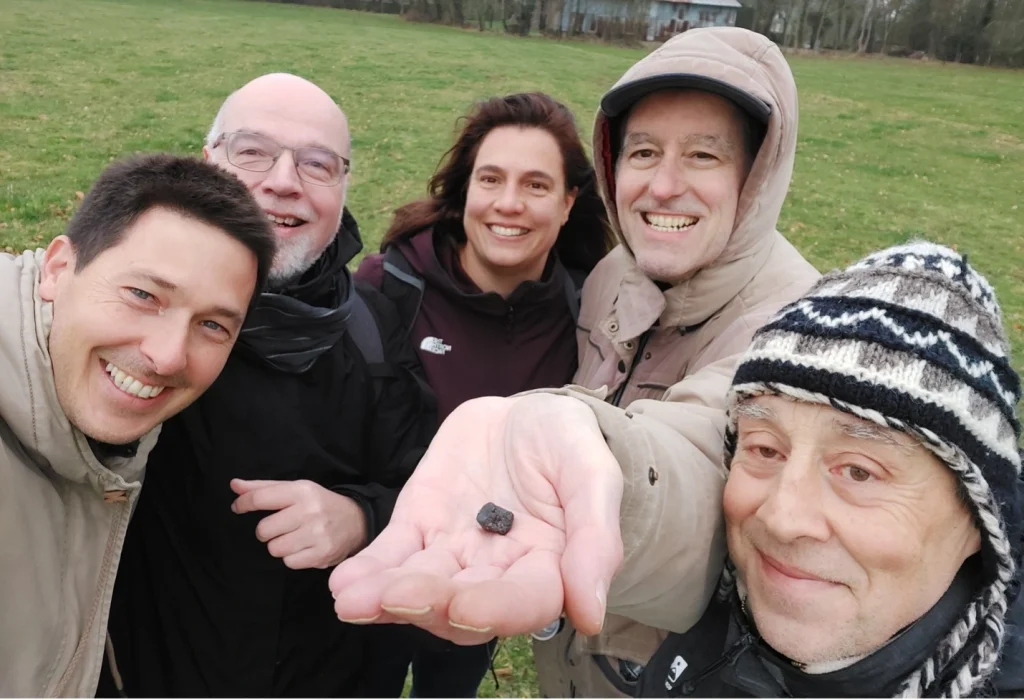
Meteorite recovery in Normandy
The recovery effort was led by Peter Jenniskens of the SETI Institute and NASA Ames Research Center, alongside François Colas of the Paris Observatory, who heads the FRIPON fireball camera network. Together with FRIPON/Vigie-Ciel volunteers, the team began searching near Saint-Pierre-le-Viger in Normandy.
Strong winds displaced meteorites away from the expected fall line, making the search more difficult. The first meteorite was found only hours after the team’s arrival.
A second fragment, weighing just 3 g, was recovered by Jenniskens the following day and is now housed in the Natural History Museum in Paris. This confirmed the strewn field and provided material for laboratory analysis.
Composition and classification
Laboratory tests revealed that 2023 CX1 was a low-iron “L-type” ordinary chondrite. These are the most common meteorites recovered on Earth, representing fragments of ancient parent bodies that formed during the early Solar System.
Although L chondrites are common, the fragmentation behavior of 2023 CX1 was unusual. Instead of gradually weakening under pressure, it failed suddenly and violently. The fireball displayed a bright double flare toward its end, marking the moment of catastrophic disruption.
Historical and scientific context
The event adds to a historical record of asteroid airbursts that have raised awareness of planetary defense risks. In 1908, the Tunguska explosion flattened more than 2 000 km² (770 mi²) of forest in Siberia. In 2013, the Chelyabinsk meteor injured more than 1 500 people in Russia, mostly from glass shattered by shock waves.
Both those events involved much larger objects that fragmented higher in the atmosphere. In contrast, 2023 CX1 was a small asteroid less than a meter across, yet its abrupt fragmentation produced an unexpectedly strong shock wave.
This highlights the importance of monitoring even small near-Earth objects. Their unpredictable fragmentation behaviors can amplify their hazards far beyond what size alone suggests.
New class of hazardous impactors
The impact of asteroid 2023 CX1 over France was modest in size but profound in implications. By exploding suddenly and releasing nearly all of its energy in one concentrated blast, it revealed a new class of hazardous impactors.
Future planetary defense strategies must adapt to include these abrupt fragmenters, which are more common than previously assumed and can still threaten populated areas despite their small size.
References:
1 Small Asteroids Can Explode – SETI – September 17, 2025
2 Catastrophic disruption of asteroid 2023 CX1 and implications for planetary defence – Auriane Egal – September 17, 2025 – https://doi.org/10.1038/s41550-025-02659-8

I’m a science journalist and researcher at The Watchers, contributing to the Epicenter edition, where I cover peer-reviewed scientific research and emerging discoveries across Earth and space sciences. With a background in astronomy and a passion for environmental science, I’ve worked in shark and coral conservation in Fiji, conducting reef and shark-behavior research, contributing to mangrove restoration, and earning PADI Open Water and Coral Reef Certifications. I bring a blend of scientific rigor and storytelling to illuminate the discoveries shaping our planet and beyond.

Commenting rules and guidelines
We value the thoughts and opinions of our readers and welcome healthy discussions on our website. In order to maintain a respectful and positive community, we ask that all commenters follow these rules.