
Study shows Earth’s carbon thermostat can overshoot, triggering ice ages
Researchers at the University of California, Riverside, published a study in Science on September 25, 2025, showing that Earth’s long-term carbon regulation system can sometimes overcorrect. Their model suggests that warming events may, under certain conditions, tip into ice-age–scale cooling over hundreds of thousands of years.
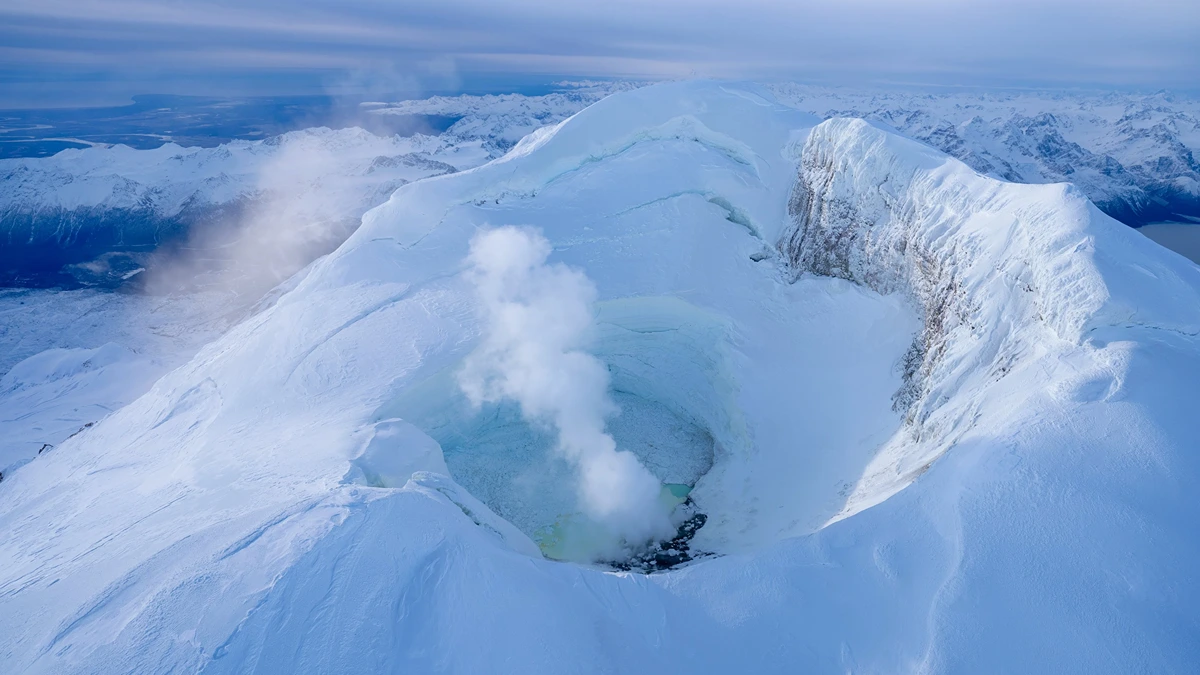
Image credit: AVO. Acquired at 12:46 UTC on December 4, 2024.
The study finds that Earth has more than one thermostat. The classic silicate-weathering feedback stabilizes climate slowly, but a faster system involving plankton, oxygen, and phosphorus can push the planet into extreme cooling.
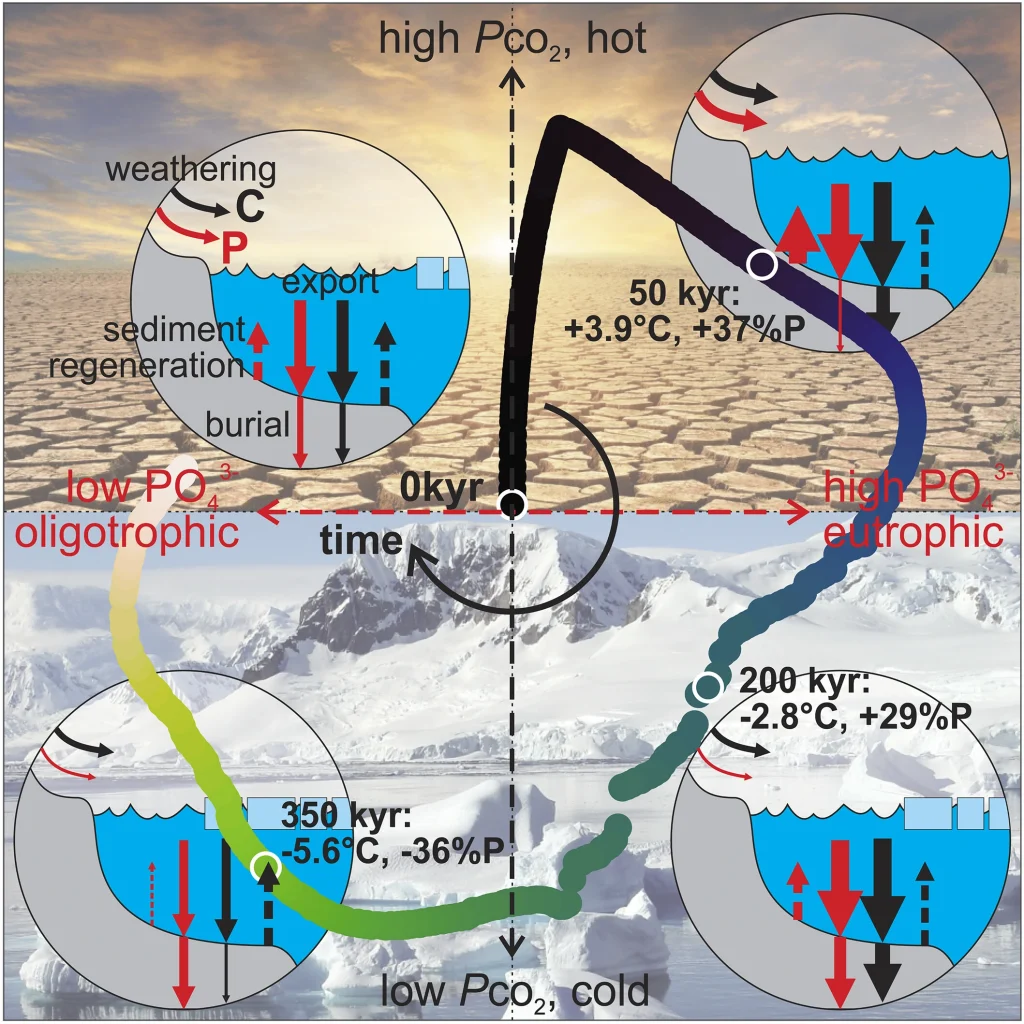
In simulations, this organic-burial thermostat outcompeted rock weathering after a surge of CO2. As oxygen in the oceans fell, phosphorus recycling fueled plankton blooms. Their burial of carbon in sediments continued even after atmospheric CO2 dropped below initial levels.
The result was not balance, but overshoot. Surface temperatures fell below the starting point, in some cases by more than 6°C (11°F), enough to mimic the onset of an ice age.
The severity of this overshoot depends on background oxygen. At today’s high levels, the feedback is weaker, meaning only modest long-term cooling would occur.
In Earth’s past, when oxygen in the atmosphere and oceans was much lower, the effect became extreme. The model shows that substantially reduced oxygen favored persistent eutrophic oceans, efficient phosphorus recycling, and runaway carbon burial.
This offers a mechanism for the Neoproterozoic snowball Earth events, when glaciers extended to the tropics and the planet was nearly frozen solid.
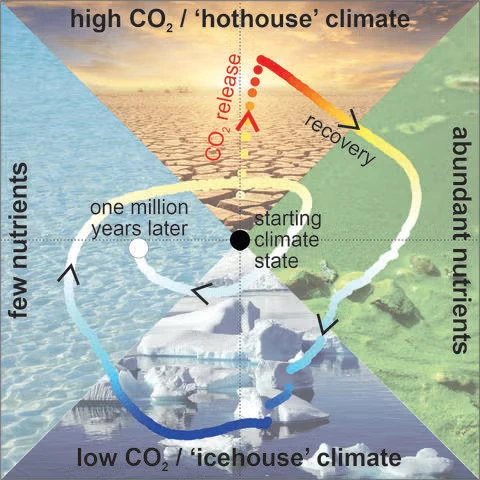
The thermostat instability does not play out on human timescales. The modeled overcooling took several hundred thousand years (100 000–500 000 years).
“At the end of the day, does it matter much if the start of the next ice age is 50 000, 100 000, or 200 000 years into the future? We need to focus now on limiting ongoing warming,” Ridgwell said.
What geology can teach climate science
This discovery helps explain why Earth’s climate history includes both stability and violent swings. For most of its past, the silicate-weathering thermostat kept temperatures within a livable range.
But when nutrient recycling and oxygen levels aligned, the faster thermostat took over, driving cooling far beyond the starting state. These interactions between geology, biology, and chemistry reveal that life itself can destabilize climate.
The study also shows that which thermostat dominates depends on the initial balance of carbon and phosphorus cycling. Climate stability is therefore contingent, not guaranteed.
How the researchers modeled instability
The UC Riverside team used an intermediate-complexity global carbon–climate model designed to run over million-year timescales.
It included silicate weathering on land, kerogen weathering as a CO2 source, nutrient supply and burial in the oceans, organic carbon burial in marine sediments, and phosphorus regeneration under low-oxygen conditions.
By coupling these processes with ocean circulation, the researchers captured how feedbacks reinforce each other. Their experiments revealed that when oxygen falls and nutrient recycling accelerates, organic carbon burial dominates the carbon cycle.
Implications for life and habitability
The study shows how deeply microbial life and nutrient cycling shape planetary climates. Plankton blooms and their burial in sediments do not only respond to climate; they can drive it into new states.
This has implications beyond Earth. Planets with oceans and microbial life may face similar instabilities. A world with the wrong balance of oxygen and nutrients could swing between extremes rather than remain stable and habitable.
Limits and future directions
The model is efficient enough to simulate hundreds of thousands of years (100 000–500 000 years) but does not include the full complexity of Earth-system dynamics.
The authors note that further work should test these findings with other models and compare results with geological evidence, including isotopic records and sediment cores.
By doing so, scientists can better understand how often runaway cooling has occurred and whether it may happen again.
References:
1 Instability in the geological regulation of Earth’s climate – Dominik Hülse – Science – September 25, 2025 – DOI: 10.1126/science.adh7730
2 Carbon cycle flaw can plunge Earth into an ice age – UCR – September 25, 2025

I’m a science journalist and researcher at The Watchers, contributing to the Epicenter edition, where I cover peer-reviewed scientific research and emerging discoveries across Earth and space sciences. With a background in astronomy and a passion for environmental science, I’ve worked in shark and coral conservation in Fiji, conducting reef and shark-behavior research, contributing to mangrove restoration, and earning PADI Open Water and Coral Reef Certifications. I bring a blend of scientific rigor and storytelling to illuminate the discoveries shaping our planet and beyond.

Commenting rules and guidelines
We value the thoughts and opinions of our readers and welcome healthy discussions on our website. In order to maintain a respectful and positive community, we ask that all commenters follow these rules.