
Seamount count could jump by over 125% with new SWOT data
A quiet revolution is unfolding in the deep, where NASA’s SWOT satellite is turning ripples on the ocean’s surface into a map of the hidden world below—revealing lost mountain ranges, tracing ancient tectonic scars, and illuminating the secret pathways of heat and life undersea. With its enhanced detection abilities, the SWOT satellite could more than double the known number of seamounts, increasing estimates from 44 000 to approximately 100 000.
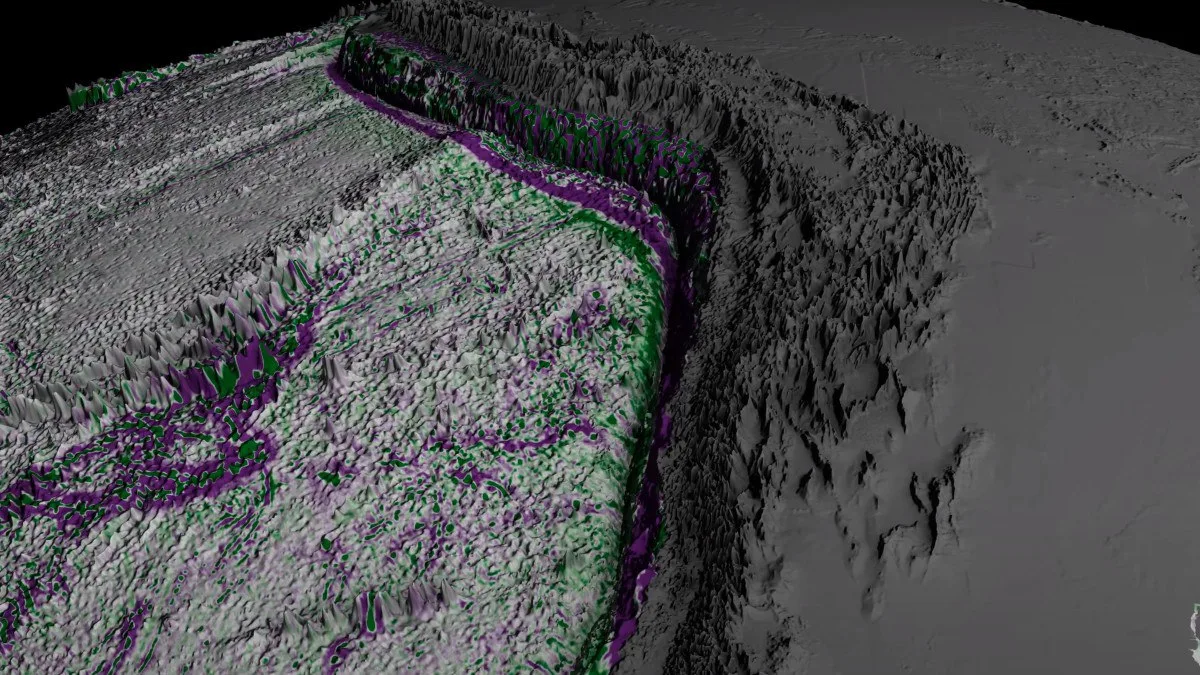
SWOT satellite image of the ocean-bed near the South American coastline. Image credit: NASA
Although the ocean covers 70% of our planet, only 26% of the global seafloor has been explored by scientists. Given the area it covers, this is a relatively low number in the grand scheme of things. Humans have ventured forth to the planets in outer space but have been unsuccessful in charting their own waters.
Having precise maps of the ocean bed is crucial for a wide range of marine operations, including safe navigation and the installation of submarine communication lines. These maps also enhance our grasp of deep-ocean currents and tidal systems, which play a vital role in sustaining marine ecosystems and shaping geological activity like tectonic shifts.
Features such as seamounts (underwater mountains formed by volcanic activity) and smaller underwater formations help guide the movement of heat and nutrients through the ocean’s depths, often serving as hotspots for marine life.
Now, a team funded by the National Aeronautics and Space Administration (NASA) has released one of the most detailed seafloor maps ever made, based on observations from the Surface Water and Ocean Topography (SWOT) satellite.
Previously, researchers have used sonar-equipped ships to capture highly precise and detailed images of the seafloor. Despite this capability, only about 26% of the ocean floor has been mapped using such direct methods.
Developed through a partnership between NASA and the National Centre for Space Studies (CNES), the SWOT satellite is capable of surveying approximately 90% of Earth’s surface within a 21-day cycle. Its ability to make repeated, high-precision measurements allows it to detect extremely subtle variations in sea surface height. These variations are influenced by structures hidden beneath the water, structures that were unbeknownst to mankind before.
Drawing on twelve months of this satellite data, David Sandwell, a geophysicist at the Scripps Institution of Oceanography, led a study focusing on underwater features like seamounts, abyssal hills, and the transition zones where continental crust gives way to oceanic crust.
Earlier generations of ocean-monitoring satellites were able to identify only the largest underwater structures—typically seamounts rising more than 1 km (0.6 miles) above the seafloor. In contrast, the advanced sensitivity of the SWOT satellite allows it to pick up much smaller features, including seamounts under 500 m (1 640 feet) tall. This improved detection capability could more than double the current seamount count, raising estimates from 44 000 to around 100 000.
These seamounts exert a significant influence on the dynamics of oceans since they interface with deepwater currents. They concentrate nutrients against their slopes as they modify water flow, causing these regions to become fertile ground that hosts dense marine life within areas that might otherwise be unpopulated or sparsely populated.
SWOT’s advanced capabilities have revolutionized the way scientists study and understand the ocean floor. With the ability to image finer details of features such as abyssal hills and smaller seamounts, the satellite is illuminating the enormous unexplored landscapes below the sea.
Far from being static lumps on the ocean floor, these formations are key players in the ocean’s rhythm. They guide the flow of deep currents, stir up nutrients, and quietly influence life in places sunlight never reaches.

My passions include trying my best to save a dying planet, be it through carpooling or by spreading awareness about it. Research comes naturally to me, complemented by a keen interest in writing and journalism. Guided by a curious mind and a drive to look beyond the surface, I strive to bring thoughtful attention and clarity to subjects across Earth, sciences, environment, and everything in between.

Commenting rules and guidelines
We value the thoughts and opinions of our readers and welcome healthy discussions on our website. In order to maintain a respectful and positive community, we ask that all commenters follow these rules.