
Ground uplift and earthquake swarms at Campi Flegrei follow a single nonlinear process
A detailed analysis of unrest at the Campi Flegrei in southern Italy shows that earthquake swarms since 2005 are governed by cumulative ground uplift rather than time, according to a study published in Scientific Reports on December 5, 2025.
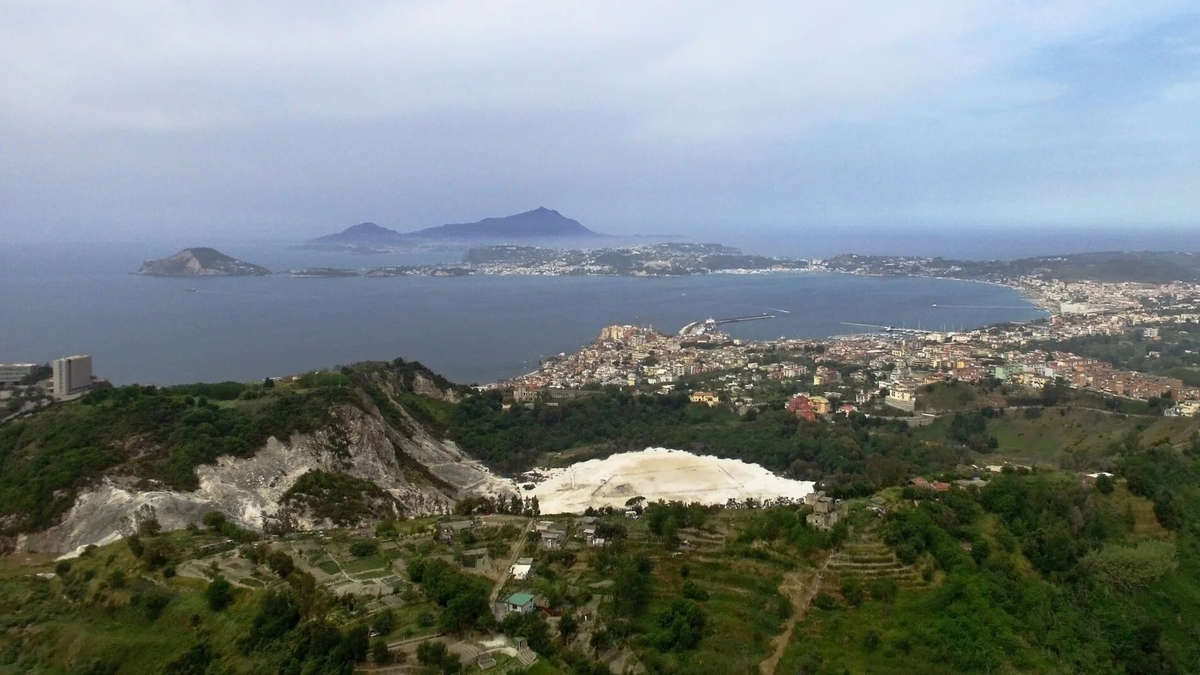
View of the Solfatara crater, part of the densely populated Campi Flegrei volcanic area. Credit: Alessandro Fedele
Campi Flegrei is a large volcanic caldera shaped by two major explosive eruptions about 39 000–15 000 years ago that created the present depression west of Naples and left a complex system of faults, fractures, and hydrothermal pathways in the shallow crust.
Since the last eruption in 1538, which formed Monte Nuovo, the area has not returned to long-term stability. Instead, it has experienced repeated cycles of subsidence and uplift known as bradyseism, documented since Roman times through archaeological markers and modern geodetic measurements.
Four major episodes of unrest have occurred since 1950 — the 1950–1952 phase, 1970–1972, 1982–1984, and the ongoing unrest that began in 2005. Each episode involved ground deformation, but the intensity and seismic response differed significantly.
The current unrest is the longest and one of the most energetic in the historical record. Since 2005, cumulative uplift has reached about 4.3 m (14.1 feet), exceeding the deformation observed during several earlier crises and raising sustained concern because of the dense population living above the caldera.
Understanding how this deformation translates into seismic activity is essential for interpreting unrest at Campi Flegrei and for assessing how similar calderas may behave worldwide.
Twenty years of uplift and earthquakes seen together
The study analyzes seismic and geodetic data collected between January 2005–June 2024. The earthquake catalogue includes more than 11 000 events recorded by the Istituto Nazionale di Geofisica e Vulcanologia, filtered to include only magnitudes above the completeness threshold.
Ground deformation is measured using continuous GNSS observations from the RITE station. This station lies within the area of maximum uplift and captures the characteristic Gaussian-shaped deformation field observed across the caldera.
Rather than removing long-term background subsidence, the researchers retained the full vertical displacement signal. This choice reflects the integrated contribution of all deformation processes acting during unrest, including tectonic, magmatic, and hydrothermal components.
The uplift history shows two distinct exponential growth phases beginning in 2008 and again after 2013. A clear change in slope occurs around 2012, coinciding with a strong earthquake swarm and increased hydrothermal activity, including new fumarolic vents.
This temporal alignment suggests that changes in uplift dynamics are directly linked to changes in seismic behavior, motivating a joint analysis of deformation and earthquake occurrence.
Why time-based models fall short at volcanoes
Most classical earthquake models describe seismicity as a function of time.
While these approaches work well in tectonic settings, where aftershocks decay gradually following a mainshock, earthquakes at Campi Flegrei occur in swarms without a dominant mainshock and with rapid accelerations and decays that do not follow standard temporal laws.
In this context, time becomes a poor proxy for the physical processes driving seismicity. Instead, cumulative ground uplift better reflects stress accumulation, fluid pressurization, and inelastic deformation in the shallow crust.
By using uplift rather than time as the primary variable, the study directly links seismicity to the physical forcing of the system. This shift allows earthquake occurrence to be interpreted as a response to deformation rather than to elapsed time.
This perspective aligns with observations from other volcanic systems, where seismicity often tracks changes in deformation and gas output more closely than it tracks the passage of time.
A nonlinear relationship between deformation and seismicity
Previous studies proposed that the cumulative number of earthquakes increases exponentially with ground uplift, sometimes followed by a linear phase. When applied to the full 2005–2025 dataset, these models fail to reproduce the observed behavior.
The new analysis shows that a double logarithmic relationship provides a statistically superior fit. In practical terms, this means that earthquake production becomes progressively less efficient as uplift increases.
During the early stages of deformation, relatively small amounts of uplift are associated with rapid increases in the number of earthquakes. As uplift continues, much larger deformation increments are required to generate additional earthquakes.
This behavior indicates that the system does not respond linearly to stress accumulation. Instead, it reflects a progressively damped response as the crust accommodates deformation through mechanisms other than brittle failure.
The result highlights the importance of nonlinearity in volcanic systems, where fracture networks, fluids, and rock properties evolve continuously during unrest.
Earthquake swarms as a cascading but inefficient process
To explain the observed relationship, the authors introduce an epidemic-style model for earthquake occurrence. In this framework, each earthquake can trigger others, creating a cascading process similar to aftershock sequences.
Unlike tectonic settings, however, the triggering efficiency decreases as uplift progresses. This reduced efficiency is a key feature of the model and reflects the evolving mechanical state of the volcanic crust.
As deformation accumulates, part of the imposed stress is absorbed by plastic deformation or aseismic processes. This reduces the amount of stress available to generate new earthquakes.
The model also includes a saturation effect that limits runaway growth. As more earthquakes occur, the ability of each event to trigger additional ones diminishes, naturally shortening swarm duration.
Together, these features explain why volcanic swarms are intense but short-lived, and why they differ fundamentally from tectonic aftershock sequences.
What uplift reveals about the state of the crust
The results suggest that the shallow crust beneath Campi Flegrei does not transition cleanly between elastic, quasielastic, and inelastic regimes. Instead, it appears to deform through a continuous process dominated by fluid-driven stress and damage accumulation.
The decreasing efficiency of earthquake triggering implies that increasing uplift corresponds to increasing inelastic deformation. Rocks may fracture, heal, and deform plastically while fluids redistribute stress through permeable pathways.
This behavior is consistent with observations of highly fractured volcanic media, where stress is dissipated across a wide range of structures rather than concentrated on a few major faults.
The model-inferred saturation effect also points to a heterogeneous crust with a broad distribution of fracture strengths. In such systems, damage accumulation slows further seismic activity even as deformation continues.
These insights provide a more unified view of how volcanic crust responds to sustained pressurization.
Implications for long-term monitoring and hazard understanding
The authors emphasize that their model is not designed for short-term earthquake forecasting. It cannot predict the timing of individual swarms or identify immediate precursors of eruptions.
Instead, it provides a framework for estimating the amount of cumulative seismicity that may accompany continued deformation. Because uplift directly reflects physical forcing, it offers a robust long-term indicator of unrest evolution.
If similar relationships are observed at other volcanoes, deformation-driven epidemic models could help compare unrest intensity across different systems. This would support a more consistent interpretation of long-term volcanic behavior.
Continued monitoring of ground uplift remains critical at the volcano. Changes in deformation rate may signal shifts in how the system accommodates stress, even if short-term seismic fluctuations remain unpredictable.
The study reinforces the idea that deformation is not just a symptom of unrest, but a key driver of volcanic seismicity.
Why this research matters now
Campi Flegrei lies beneath one of the most densely populated volcanic regions on Earth. Understanding how its unrest evolves is essential for long-term risk awareness, even in the absence of imminent eruption.
This research shows that more uplift does not automatically mean proportionally more earthquakes. Instead, it reveals a complex nonlinear coupling shaped by the inelastic nature of volcanic crust.
By reframing seismicity as a deformation-driven cascading process, the study offers a clearer physical explanation for the short-lived, swarm-like behavior typical of volcanoes.
The findings suggest a general framework that may apply to restless calderas worldwide. Testing this approach elsewhere could significantly improve how scientists interpret prolonged volcanic unrest.
References:
1 Interplay between ground deformation and seismicity during the 2005–2025 unrest at Campi Flegrei – Cataldo Godano et al. – Nature Scientific Reports – December 5, 2025 – https://doi.org/10.1038/s41598-025-27259-4 – OPEN ACCESS

I’m a science journalist and researcher at The Watchers, contributing to the Epicenter edition, where I cover peer-reviewed scientific research and emerging discoveries across Earth and space sciences. With a background in astronomy and a passion for environmental science, I’ve worked in shark and coral conservation in Fiji, conducting reef and shark-behavior research, contributing to mangrove restoration, and earning PADI Open Water and Coral Reef Certifications. I bring a blend of scientific rigor and storytelling to illuminate the discoveries shaping our planet and beyond.

Commenting rules and guidelines
We value the thoughts and opinions of our readers and welcome healthy discussions on our website. In order to maintain a respectful and positive community, we ask that all commenters follow these rules.