
Extreme drought and rainfall years in the western Mediterranean now occur about ten times more often
A five-century precipitation record reconstructed from tree rings in eastern Spain shows that exceptionally rare drought and rainfall years have occurred about ten times more frequently since 2000 than during the previous 500 years.
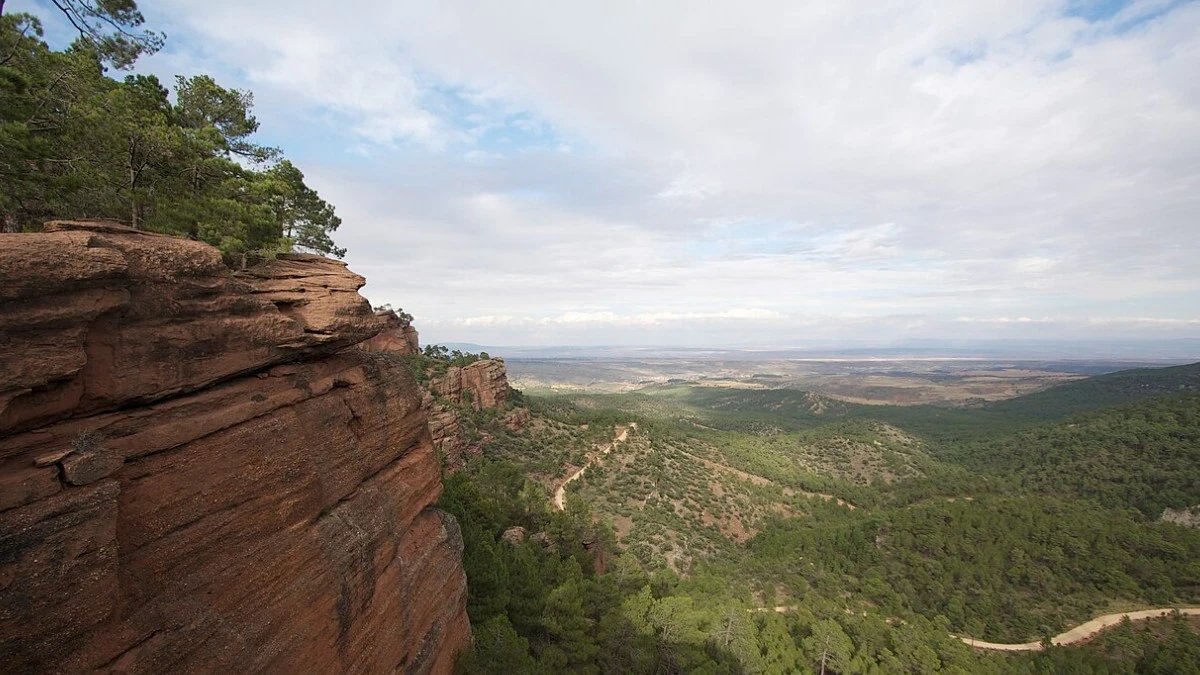
Protected Landscape of the Ródeno Pine Forests, near Teruel, Spain. Credit: Manuel Alende Maceira
A new tree-ring-based precipitation reconstruction from eastern Spain extends regional hydroclimatic records back to 1505 and shows that exceptionally rare drought and rainfall years have become far more frequent since the late 20th century. The record indicates that recent decades stand out against five centuries of variability, with levels of volatility not previously observed within the reconstruction period.
The reconstruction was developed from a dense network of tree-ring width measurements collected from Scots pine (Pinus sylvestris) and black pine (Pinus nigra) growing in the Iberian Range. These mountain forests occupy elevations between 1 300 –2 000 m (4 265–6 560 feet) and are strongly limited by moisture availability, making them suitable natural archives of past precipitation variability.
Instrumental precipitation records in this part of Spain generally extend back little more than a century, limiting the ability to place recent droughts and floods in a longer historical context. The tree-ring chronology assembled for this study spans 520 years and retains a strong, coherent climate signal across its full length, allowing recent conditions to be evaluated against a much broader baseline.
The final dataset consists of 173 individual tree-ring series from 103 trees sampled at five sites within a 100 km (62 miles) radius. Statistical coherence between sites is high, supporting the construction of a single regional chronology. The chronology is considered reliable for climate reconstruction from 1505 through 2024 based on standard subsample signal strength criteria.
Tree growth was calibrated against cumulative precipitation using multiple gridded climate datasets. High-resolution precipitation products for Spain consistently showed stronger relationships with tree growth than coarser global datasets. The strongest and most stable climate signal was found for precipitation accumulated over 320 days extending from 16 August of the previous year to 30 June of the current year. This window integrates autumn recharge, winter snowfall, and spring moisture, while excluding the peak summer drought when tree growth is minimal.
The final reconstruction explains up to 63% of observed precipitation variance during the late instrumental period, substantially higher than typical values reported for earlier Mediterranean hydroclimate reconstructions. Calibration and verification tests demonstrate that the statistical relationship between tree growth and precipitation remains stable through time, with no evidence of non-stationarity within the instrumental record.
Across the full 1505–2024 period, the reconstruction shows pronounced multi-decadal and multi-centennial variability. Periods of prolonged dryness and wetness occur throughout the record, including clusters of extreme years during the 16th, 18th and early 19th centuries. However, the overall amplitude of year-to-year variability remains comparatively moderate during much of the pre-20th century record.
The 19th century emerges as a particularly stable interval, with low variability and a small number of years outside the central range of reconstructed precipitation. This contrasts sharply with conditions observed since the beginning of the 20th century. Variability increases gradually after 1900 and accelerates after the mid-1970s, as shown by a sustained rise in running standard deviation values.
Extreme-event analysis reveals that both tails of the precipitation distribution have expanded in recent decades. Years falling below the 1st percentile and above the 99th percentile occur far more frequently after 2000 than during earlier centuries. While the period from 1505 to 2000 averages roughly 1.6% of years in these most extreme categories, the interval from 2001 to 2024 reaches an occurrence rate of about 16.7%, representing an order-of-magnitude increase.
Extremely dry years identified in the reconstruction include 1526, 1527, 1879, 1931, 2005, and 2012, while extremely wet years include 1534, 1546, 1575, 1645, 1716, 1940, 2010, and 2013. These events are defined using percentile thresholds derived from the full reconstructed series, providing an objective measure of rarity relative to the long-term baseline.
Spatial correlation analysis shows that the reconstructed precipitation signal is not limited to the immediate sampling area. The strongest correlations are centred over eastern and central Iberia, with significant extensions into southern France and northern Italy. This pattern indicates that the reconstruction captures regional-scale hydroclimatic variability associated with western Mediterranean circulation rather than purely local effects.
Independent historical evidence provides additional context for the reconstruction. Comparisons with drought indices derived from rogation ceremony records show periods of significant correspondence during the late 18th and early 19th centuries, when both proxies indicate frequent and severe hydroclimatic stress. Agreement is strongest during intervals with dense and consistent documentary coverage, while correlations weaken later as social and institutional changes reduced the reliability of rogation practices.
Documentary sources describing floods and prolonged rainfall further support the reconstruction for many of the wettest pre-20th century years. Several reconstructed wet years coincide with historically documented flooding in the Ebro basin and Mediterranean river systems, particularly during autumn-to-spring seasons consistent with the precipitation window captured by tree growth.
The reconstruction differs fundamentally from continental-scale drought atlases based on indices that integrate temperature and evapotranspiration. Direct comparison shows weak overall correspondence, reflecting differences in spatial scale, target variables, and seasonal sensitivity. This highlights the importance of regional precipitation reconstructions for understanding hydroclimate dynamics in complex terrain such as the Iberian Range.
By providing a five-century record of quantitatively reconstructed precipitation, this study establishes a long-term baseline against which recent variability can be assessed. The findings show that while hydroclimatic extremes are not unprecedented in the region, the frequency and magnitude observed since the late 20th century exceed those recorded at any other time within the last 500 years.
References:
1 A five-century tree-ring record from Spain reveals recent intensification of western Mediterranean precipitation extremes – Marcos Marín-Martín et al. – EGU – November 13, 2025 – https://cp.copernicus.org/articles/21/2205/2025/ – OPEN ACCESS

I’m a science journalist and researcher at The Watchers, contributing to the Epicenter edition, where I cover peer-reviewed scientific research and emerging discoveries across Earth and space sciences. With a background in astronomy and a passion for environmental science, I’ve worked in shark and coral conservation in Fiji, conducting reef and shark-behavior research, contributing to mangrove restoration, and earning PADI Open Water and Coral Reef Certifications. I bring a blend of scientific rigor and storytelling to illuminate the discoveries shaping our planet and beyond.

Commenting rules and guidelines
We value the thoughts and opinions of our readers and welcome healthy discussions on our website. In order to maintain a respectful and positive community, we ask that all commenters follow these rules.