
AI uncovers nearly 1 000 hidden earthquakes beneath East Antarctica
Scientists have discovered nearly 1 000 previously undetected earthquakes beneath East Antarctica after applying machine-learning techniques to seismic records collected decades ago, revealing that one of Earth’s most remote regions is far more seismically active than once believed. The findings were published in Science on May 28, 2026.
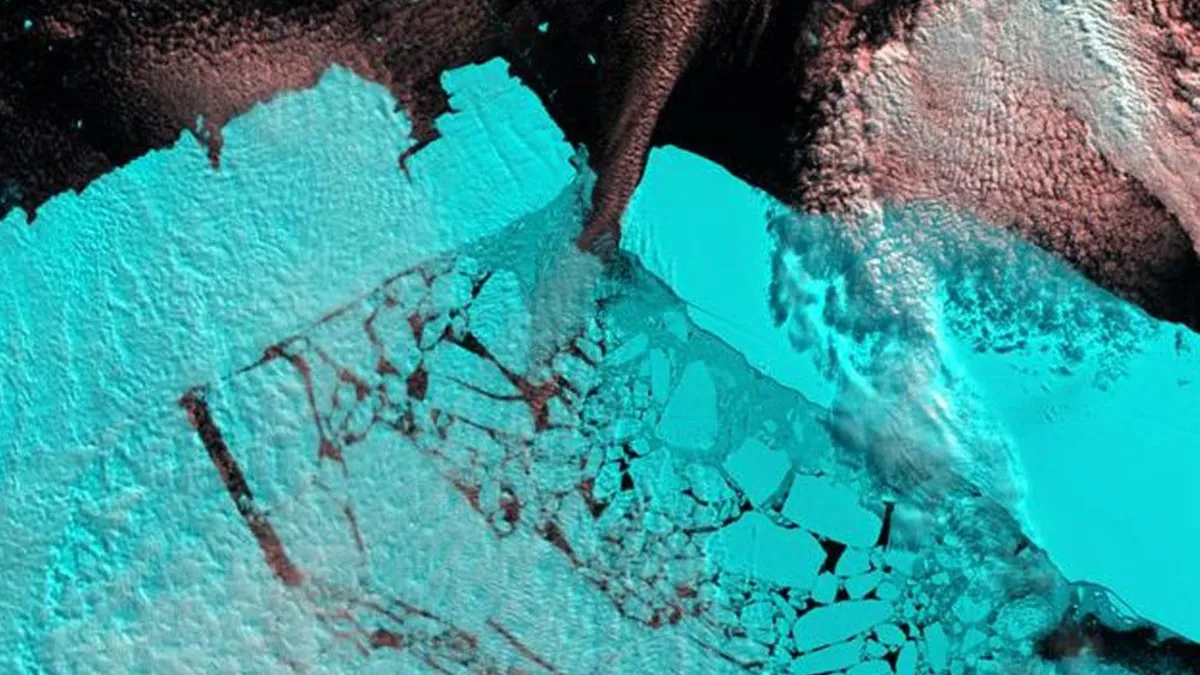
Drygalski Ice Tongue, Antarctica. Credit: NASA
The earthquakes were not found during a new Antarctic field campaign. Instead, researchers reanalyzed seismic data recorded by 49 stations between 2001 and 2004 and again between 2012 and 2015. Advanced artificial intelligence techniques identified hundreds of events that earlier detection methods had missed, including more than 500 earthquakes occurring 100–150 km (62–93 miles) beneath the surface.
The discovery, reported in the journal Science, challenges long-standing assumptions about where deep earthquakes occur. Earthquakes at these depths, known as intermediate-depth earthquakes, are typically associated with subduction zones where one tectonic plate sinks beneath another. East Antarctica lies far from any active plate boundary, making the concentration of deep earthquakes beneath David Glacier an unexpected finding.
David Glacier occupies a critical geological position between East and West Antarctica. The glacier extends roughly 1 100 km (684 miles) and serves as a transition zone between East Antarctica’s cold, rigid crust and upper mantle and warmer, weaker rock beneath parts of West Antarctica. According to the study, that contrast creates a sharp change in tectonic strength capable of concentrating stresses deep underground.
The researchers found that many of the earthquakes cluster where warm mantle material uplifts the edges of the stronger East Antarctic lithosphere. As the rigid rock bends, stresses accumulate and are released as earthquakes. The mechanism offers a possible explanation for how seismic activity can occur at depths where the temperatures and pressures are generally considered unfavorable for the type of rock failure responsible for most shallow earthquakes.
The concentration of seismicity beneath David Glacier is particularly intriguing because similar activity was not detected along much of the surrounding Transantarctic Mountains. The study suggests local geological conditions play an important role in focusing stresses within a relatively narrow region.
The findings also raise questions about the role of Antarctica’s ice sheet. David Glacier drains approximately 4% of the East Antarctic Ice Sheet, and the region has experienced long-term changes in ice thickness over thousands of years. The researchers conclude that glacial loading and unloading may contribute to regional stress conditions, although the exact relationship remains uncertain.
Despite the large number of newly detected earthquakes, the events are small, with magnitudes ranging from 1.6 to 3.5, and there is no evidence that they threaten the overlying ice sheet. The study’s significance lies not in any immediate hazard but in what it reveals about processes operating deep beneath the Antarctic continent.
The discovery also demonstrates how advances in earthquake detection are transforming scientists’ understanding of Earth’s interior. What appeared for decades to be a largely quiet region may instead have been a place where seismic activity went unnoticed because the available tools were not sensitive enough to detect it.
As glaciologist Richard Alley of Penn State, who was not involved in the research, observed, Antarctica’s apparent lack of earthquakes may have reflected a lack of tools capable of listening for them. By revisiting old seismic records with new analytical techniques, researchers have revealed a hidden population of earthquakes and opened a new window into the interaction between Earth’s rigid outer shell, the hotter mantle beneath it, and one of the planet’s largest ice sheets.
References:
1 Upper-mantle earthquakes beneath East Antarctica – Long M. Ho et al. – Science – May 28, 2026 – https://www.science.org/doi/abs/10.1126/science.aea9895

I’m a science journalist and researcher at The Watchers, contributing to the Epicenter edition, where I cover peer-reviewed scientific research and emerging discoveries across Earth and space sciences. With a background in astronomy and a passion for environmental science, I’ve worked in shark and coral conservation in Fiji, conducting reef and shark-behavior research, contributing to mangrove restoration, and earning PADI Open Water and Coral Reef Certifications. I bring a blend of scientific rigor and storytelling to illuminate the discoveries shaping our planet and beyond.

Intermediate-depth earthquakes, could this broad criteria apply to Greenland? That example might experience similar neo-Euler stresses, too. The anisotropies of the flux lying beneath.
We do similar off INGV and Geonet servers with ML, powerful, 4-D high-resolution previously-hidden surprises, deep slab, narrow zones, it is revolutionary, empowering for citizen science.