I'm a dedicated researcher, journalist, and editor at The Watchers. With over 20 years of experience in the media industry, I specialize in hard science news, focusing on extreme weather, seismic and volcanic activity, space weather, and astronomy, including near-Earth objects and planetary defense strategies. You can reach me at teo /at/ watchers.news.

  • Asteroid 2026 FS5 passed within 0.1 lunar distance of Earth

    Asteroid 2026 FS5 passed Earth at a distance of 0.120 LD (0.00031 AU / 46 133 km / 28 666 miles) from the center of our planet at 11:40 UTC on March 22, 2026, becoming the third closest known asteroid flyby within 1 lunar distance recorded so far this year. Its closest point was about 39 762 km (24 707 miles) above Earth’s surface.

  • Rare severe weather outbreak brings tornado risk to Gulf states

    A rare severe convective setup is forecast to develop across the Gulf region, including the United Arab Emirates, Qatar, and eastern Saudi Arabia, on March 26–27, 2026, as a deep low-pressure system and strong upper-level trough interact with high instability and wind shear. The environment may support organized thunderstorms capable of producing tornadoes, alongside heavy rainfall, hail, and damaging winds.

  • Major multi-day rainfall event forecast across Middle East from March 25-31

    A large-scale storm system is forecast to bring heavy to extremely heavy rainfall across parts of the Middle East, including Iraq, Iran, and the Gulf states, between March 25 and 31, 2026, raising flood risk in urban and desert regions. Authorities in the United Arab Emirates have issued warnings for unstable conditions with rain, strong winds, and reduced visibility, while flooding has already caused fatalities in Oman. Parts of the region might see a year’s worth of rain or more through the course of the event.

  • Geomagnetic storm reaches G3 levels after March 18 CME impacts Earth

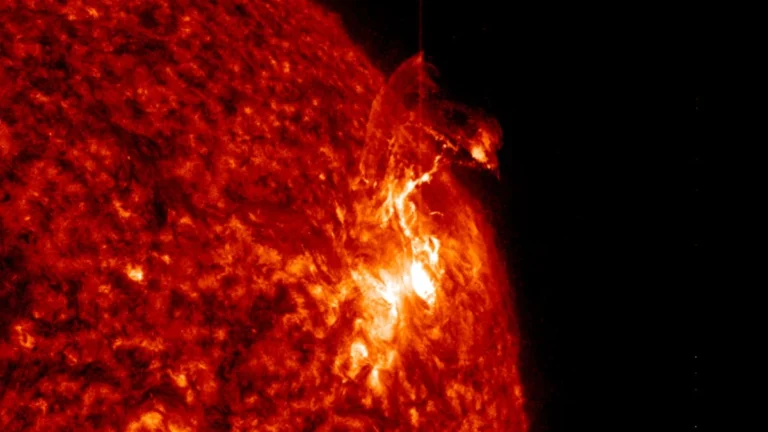
    A G3 – Strong geomagnetic storm developed late on March 20 into early March 21, 2026, after a coronal mass ejection that left the Sun on March 18 impacted Earth. The storm intensified after at least two CME arrivals, with solar wind speeds reaching 567 km/s and the interplanetary magnetic field turning strongly southward to −28 nT.