I’m a science journalist and researcher at The Watchers, contributing to the Epicenter edition, where I cover peer-reviewed scientific research and emerging discoveries across Earth and space sciences. With a background in astronomy and a passion for environmental science, I’ve worked in shark and coral conservation in Fiji, conducting reef and shark-behavior research, contributing to mangrove restoration, and earning PADI Open Water and Coral Reef Certifications. I bring a blend of scientific rigor and storytelling to illuminate the discoveries shaping our planet and beyond.

  • Early-season wildfires surge across the United States with over 611 000 ha (1.51 million acres) burned year-to-date

    Wildfire activity intensified across the United States in March 2026, with 44 large fires burning approximately 399 800 ha (987 989 acres) as of March 27. Since January 1, more than 611 000 ha (1.51 million acres) have burned from 15 436 fires, well above the 10-year average, while evacuations, burn bans, and localized impacts were reported as containment improved in several key incidents by March 29.

  • All five canonical nucleobases used in DNA and RNA detected in Ryugu samples

    All five canonical nucleobases used in DNA and RNA were identified in pristine samples returned from asteroid Ryugu by Japan’s Hayabusa2 mission, according to a study published in Nature Astronomy on March 16, 2026. The results support the view that key prebiotic compounds can form through non-biological processes in extraterrestrial environments and may have contributed to early Earth’s chemical inventory.

  • Airborne surveys show more than 90% snowpack loss in Arizona’s Upper Black River Basin

    Airborne snow surveys in the Upper Black River Basin of eastern Arizona showed snow water equivalent falling from about 11.7 million m3 (9.5 thousand acre-feet) on February 23 to about 987 000 m3 (0.8 thousand acre-feet) by March 12, 2026, a decline of more than 90% in less than three weeks. The basin feeds the Salt River system upstream of Roosevelt Dam, part of the reservoir network supplying water to more than 2.5 million people in the Phoenix metropolitan area.

  • Damaging winds, hazardous surf and alpine snow impact south-eastern Australia

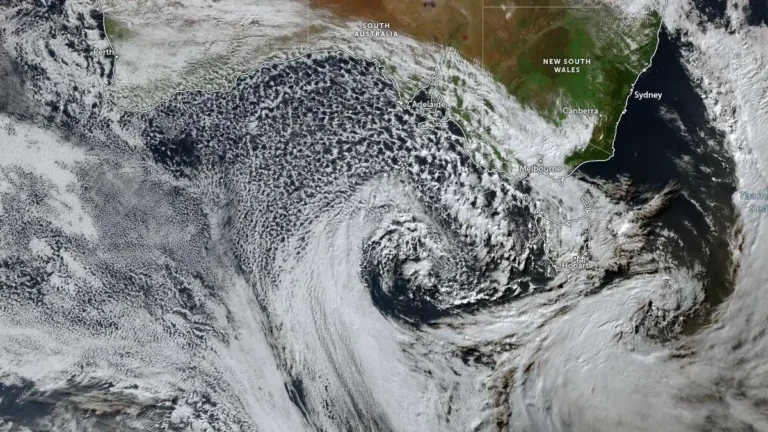
    A multi-hazard weather system began affecting south-eastern Australia on March 26, 2026, bringing severe thunderstorms to parts of New South Wales, followed by damaging winds, hazardous surf along the NSW coast, a sharp temperature drop, and snow in alpine areas. Forecasts through March 28 called for gusts up to 120 km/h (75 mph) in exposed coastal areas, offshore wave heights of several meters, and wintry conditions over higher terrain, while NSW SES reported hundreds of storm-related incidents during the initial phase of the event.

  • Severe drought triggers water restrictions in Southwest Florida

    Modified Phase III “Extreme” Water Shortage restrictions will take effect across the Southwest Florida Water Management District region on April 3, 2026, following severe drought conditions and declining water supplies. The order imposes one-day-per-week irrigation limits and additional conservation measures, with stricter enforcement and localized rules implemented by utilities such as Pinellas County.

  • Record March heat accelerates peak of wildflower bloom in Death Valley National Park

    A record-breaking March heat wave across the southwestern United States accelerated the wildflower bloom cycle in Death Valley National Park, causing peak conditions to occur earlier than typical seasonal patterns. The National Park Service (NPS) reported that lower elevation flowers have already begun setting seed following intense heat and high winds, while the National Weather Service (NWS) reported that hundreds of daily temperature records were set or tied across parts of the region.

  • Critical fire weather conditions forecast across central New Mexico into the southern High Plains

    Critical fire weather conditions are forecast across central New Mexico into the southern High Plains from Thursday morning, March 26, through early Friday, March 27, 2026, as sustained west-southwesterly winds of 30–40 km/h (20–25 mph), relative humidity as low as 5–15%, and record to near-record heat support rapid fire spread and drying of fine fuels.

  • Red Flag Warnings issued for parts of Wyoming, Nebraska, and South Dakota

    Red Flag Warnings were in effect across parts of Wyoming, Nebraska, and South Dakota on March 25, 2026, as strong winds, very low humidity, and unseasonably warm temperatures created conditions favorable for rapid wildfire spread. Additional fire weather warnings were also issued in parts of nearby states, while some warnings in Nebraska and Wyoming extended into March 26.

  • Subtropical low triggers Red Heavy Rain Warning in Northland, New Zealand

    A deep subtropical low prompted a Red Heavy Rain Warning for parts of Northland, New Zealand, on March 25, 2026, with 230–280 mm (9–11 inches) of rain forecast for areas east of Kaikohe from Doubtless Bay to Whangārei through early March 27. MetService and local authorities warned of dangerous river conditions, significant flooding and slips, with some communities at risk of isolation.

  • CERN achieves first transport of trapped antimatter by truck

    Scientists from CERN’s BASE experiment transported a trap containing 92 antiprotons across the laboratory’s main site on March 23, 2026, marking the first successful truck transport of trapped antimatter at CERN. The portable cryogenic trap remained operational during and after the move, demonstrating that antiprotons can be relocated for future high-precision measurements in lower-noise laboratories.