
Strong M6.0 earthquake hits Mindanao, Philippines
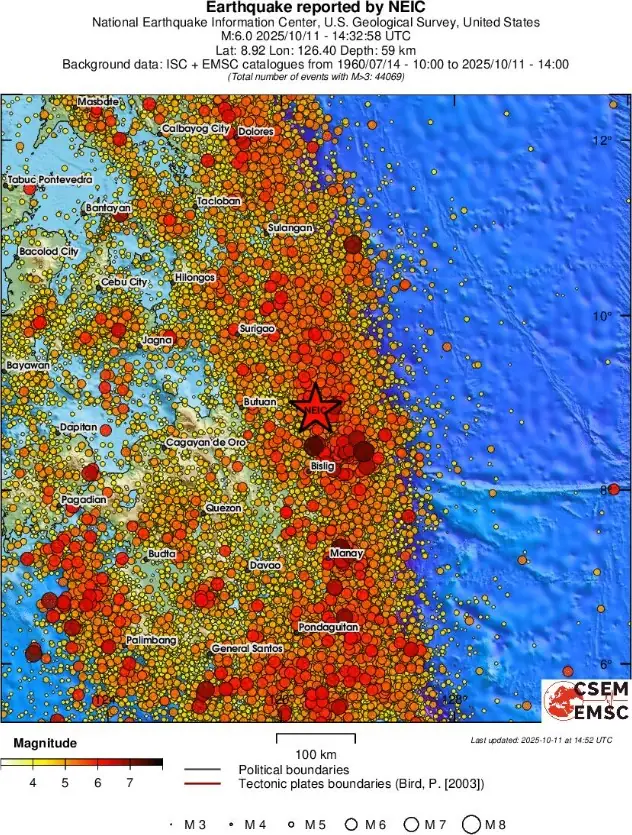
A strong earthquake registered by the USGS as M6.0 struck near Aras-asan, Mindanao, Philippines, at 14:32 UTC (22:32 LT) on October 11, 2025. The agency is reporting a depth of 59.3 km (36.8 miles). EMSC is reporting the same magnitude at a depth of 59 km (36.7 miles). This earthquake is likely part of the ongoing aftershock sequence following the M7.4 event off eastern Mindanao on October 10, 2025, in which at least 9 people were killed and more than 900 were injured.
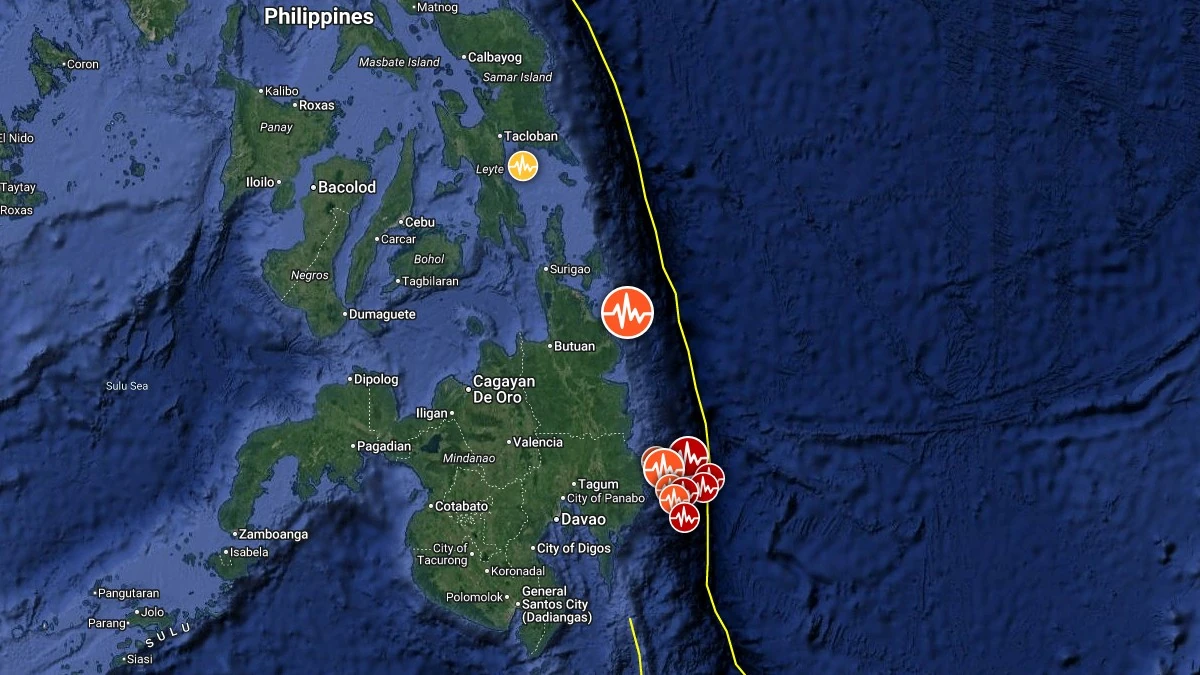
Epicenter of M6.0 earthquake in Aras-asan, Philippines on October 11, 2025. Credit: TW/SAM, Google
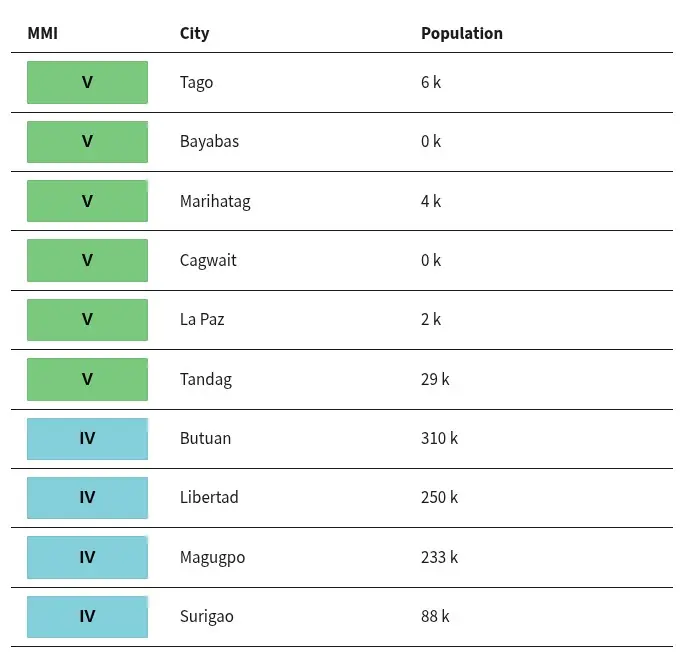
The epicenter was located 10 km (6.2 miles) ENE of Aras-asan (population 5 099), 28 km (17.4 miles) SE of Tandag (population 29 011), 46 km (28.6 miles) NE of Lianga (population 13 623), 58 km (36 miles) NNE of Tagbina (population 10 672), and 94 km (58 miles) E of Butuan (population 309 709), Caraga region, Philippines.
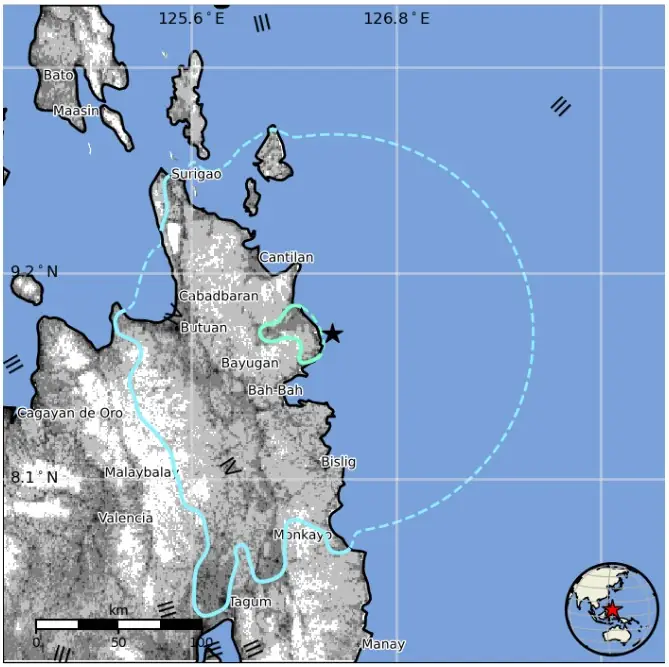
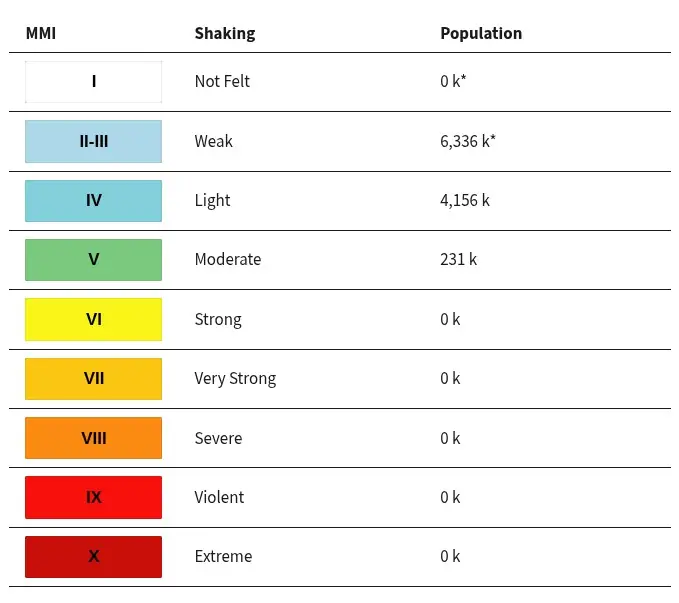
According to USGS PAGER data, 231 000 people are estimated to have felt moderate shaking, 4 146 000 light, and 6 336 000 weak.
There is no tsunami threat from this earthquake.
The USGS issued a Green alert for shaking-related fatalities and economic losses. There is a low likelihood of casualties and damage.
Overall, the population in this region resides in structures that are a mix of vulnerable and earthquake-resistant construction. The predominant vulnerable building types are unknown/miscellaneous types and heavy wood frame construction.
Recent earthquakes in this area have caused secondary hazards such as landslides that might have contributed to losses.
Liquefaction triggered by this earthquake is estimated to be limited in extent, and the number of people living in areas susceptible to liquefaction is relatively small. Landslides triggered by this event are not expected.
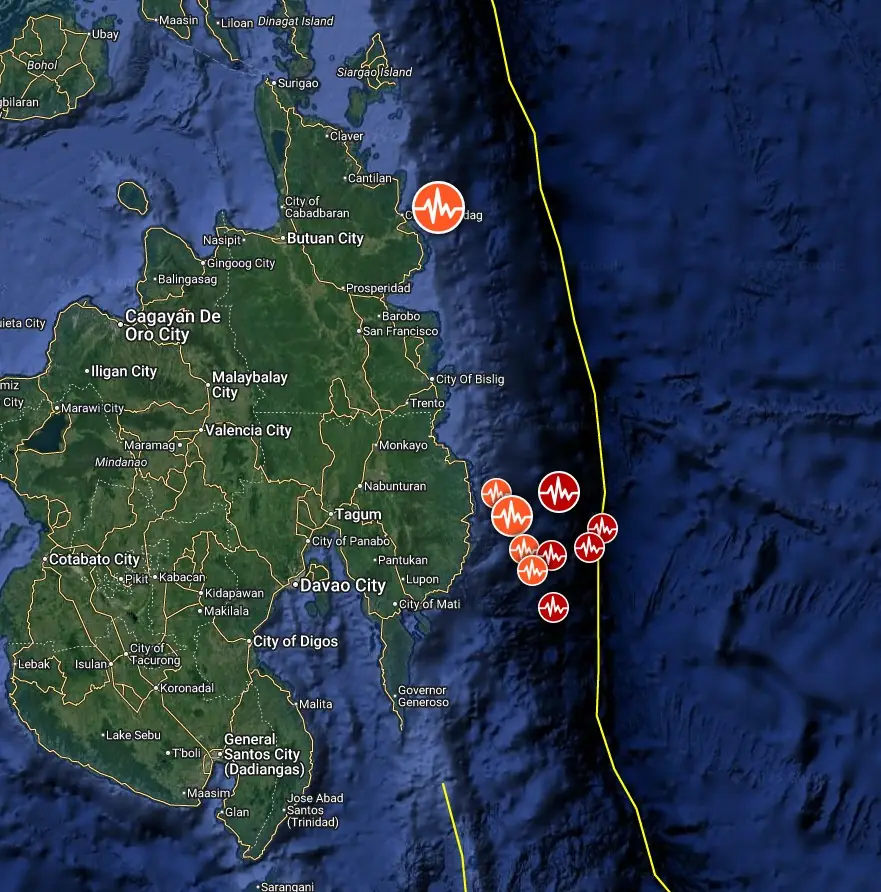
This earthquake is likely part of the ongoing aftershock sequence following the M7.4 earthquake that struck offshore near Manay, Davao Oriental, at 01:43 UTC (09:43 local time) on October 10, 2025. The main shock occurred off the east coast of Mindanao and was followed by a strong M6.7 to M6.8 aftershock later the same day.
According to the Philippine Institute of Volcanology and Seismology (PHIVOLCS), the two tremors formed a doublet event—two significant quakes occurring close together in time and space.
Tsunami warnings were issued for parts of Davao Oriental, Surigao del Sur, and neighboring coastal provinces but were lifted later after no significant tsunami waves were observed.
Initial assessments from PHIVOLCS, local authorities, and international news agencies report that the quake caused substantial damage and casualties across several provinces of Mindanao.
Updated figures compiled by local disaster agencies cite at least nine deaths and more than 941 injured, though these numbers are still being verified and are likely to change as rescue and assessment operations continue.
Damage reports indicate widespread structural impacts in Davao Oriental, Davao de Oro, and neighboring provinces. Residential homes, public buildings, schools, and hospitals were among the most affected.
Damage includes cracked walls, collapsed facades, and damaged bridges in several towns. Power interruptions were reported in parts of Mindanao due to damaged transmission lines, while communication disruptions briefly hampered rescue coordination. Emergency response teams have been deployed, with search and rescue operations focused on communities near the epicenter.
The 2025 M7.4 Davao Oriental earthquake is among the most powerful to strike the southern Philippines in recent years, occurring less than two weeks after a separate M6.9 event in Cebu that killed more than 75 people and injured hundreds. The two events, however, are not seismically connected.
Estimated population exposure to earthquake shaking
Selected cities exposed
Regional seismicity
References:
1 M6.0 earthquake Aras-asan, Philippines — USGS — October 11, 2025
2 M6.0 earthquake Mindanao, Philippines — EMSC — October 11, 2025

Teo Blašković founded The Watchers in 2011 and edited it until 2026, covering seismic and volcanic activity, extreme weather, space weather and near-Earth objects. Articles on this page are his archive.
Published in the last 24 hours
- Scientists directly observe how submarine landslides unfold in western Canada Epicenter
- Odisha evacuated 983,642 people before Phailin crossed near Gopalpur on 12 October 2013 with winds of 200-210 km/h gusting to 220, and 44 died, against 9,885 in the 1999 super cyclone. Cyclone Akvan crossed the same coast on 20 November 2026. Epicenter
- Lava fountains reached 1,900 feet (580 m) at Kīlauea Iki in 1959, the highest ever recorded at Kīlauea, as USGS forecasts episode 57 fountaining at Halemaʻumaʻu for November 22-26. Epicenter
- Novarupta in Alaska erupted about 3 cubic miles of magma in roughly 60 hours from 6 June 1912, 30 times Mount St. Helens in 1980, and strong northwesterly winds lifted that same loose ash on 16 November 2026, prompting an NWS SIGMET. Epicenter
