
Bright fireball with impact energy of 1.6 kilotons observed over southern Japan on August 19
A bright fireball lit up the night sky over southern Japan at 23:08 JST (14:08 UTC) on August 19, 2025, releasing an estimated 1.6 kilotons of energy as it disintegrated over the Pacific Ocean southeast of Kyushu.
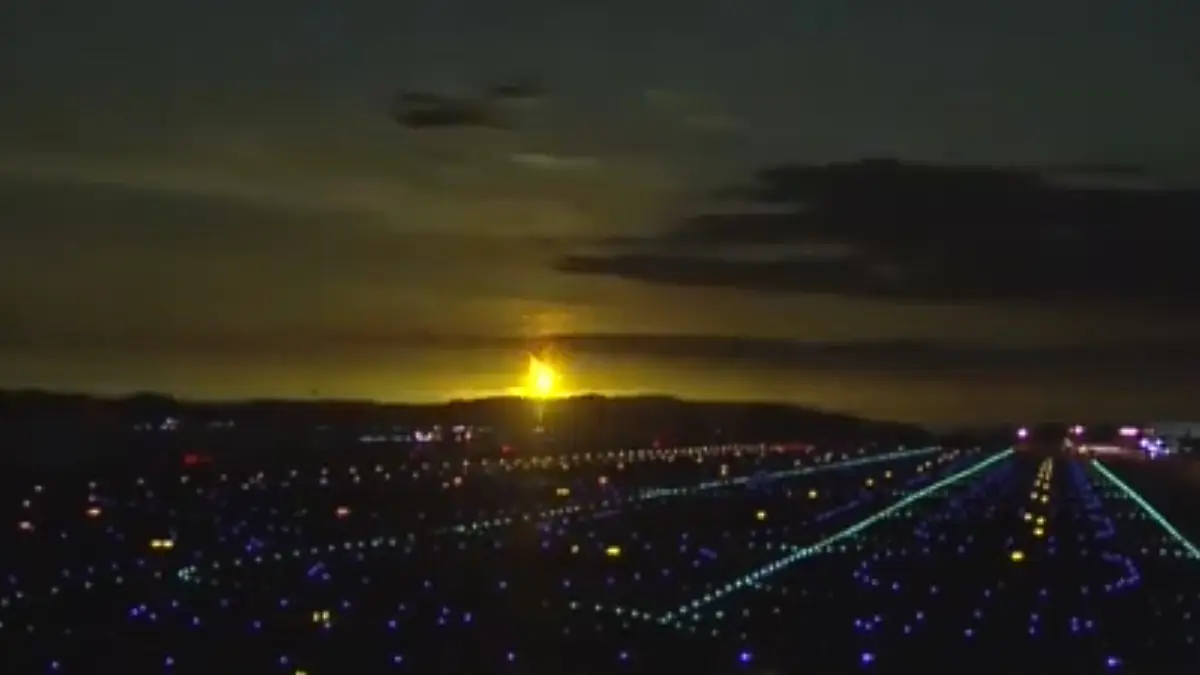
Bright fireball over Kyushu, Japan on August 19, 2025. Credit: JNN
A bright fireball was observed over southern Japan at 14:08 UTC on August 19. Data from United States Government sensors archived by NASA’s Center for Near Earth Object Studies (CNEOS), indicate a preliminary impact energy of about 1.6 kilotons of TNT equivalent. Peak brightness was located near 30.9°N and 131.8°E, southeast of Kyushu.
Dashcam recordings and surveillance footage captured the meteor’s entry, with one of the clearest views provided by Fukuoka Airport’s camera. Media reports noted a vivid blue glow illuminating the sky across Kyushu and Shikoku, and eyewitnesses described a brief flash bright enough to resemble daylight.


The Japan Meteorological Agency (JMA) has not issued a formal statement and no evidence of meteorite recovery has been confirmed.
The Kagoshima Regional Meteorological Observatory reported that monitoring equipment on Sakurajima volcano detected atmospheric vibrations generated by the fireball.
Preliminary analysis by the SonotaCo Network in Japan estimated an entry velocity of about 21 km/s (13 miles/s), an entry angle of 58°, and a terminal altitude near 18 km (11 miles). Based on these calculations, the fireball most likely disintegrated over the ocean.
A bright meteor, often described as a fireball, was observed streaking across the sky over the Sakurajima volcano and the city of Kagoshima in southern Japan.
— T_CAS videos (@tecas2000) August 19, 2025
The dramatic event lit up the night sky, making it appear as if it were daytime for a brief moment. It was captured on… pic.twitter.com/BYh074Gnrw
For comparison, the Chelyabinsk airburst in 2013 released approximately 440 kilotons of energy, making the August 19 event significantly smaller but still notable. Fireballs of this scale are expected globally a few times per year and rarely pose a hazard at ground level.

Teo Blašković founded The Watchers in 2011 and edited it until 2026, covering seismic and volcanic activity, extreme weather, space weather and near-Earth objects. Articles on this page are his archive.
Published in the last 24 hours
- One dead, 15 injured and 152 homes left uninhabitable across five regions of Peru after the M6.7 Junín earthquake of 20 November, COEN-INDECI reports.
- WPC flags a Slight Risk of excessive rainfall for the coastal Carolinas on Wednesday as a low forms off Florida and tracks up the East Coast on Thanksgiving Day.
- Scientists directly observe how submarine landslides unfold in western Canada Epicenter
- Odisha evacuated 983,642 people before Phailin crossed near Gopalpur on 12 October 2013 with winds of 200-210 km/h gusting to 220, and 44 died, against 9,885 in the 1999 super cyclone. Cyclone Akvan crossed the same coast on 20 November 2026. Epicenter
