
Rare footage shows large tsunami waves hitting Kamchatka coast after M8.8 earthquake, Russia
Rare footage shows large tsunami waves hitting Russia’s Kamchatka Peninsula following an M8.8 earthquake at 23:24 UTC (11:24 local time) on July 29, 2025. Video captured from a coastal cliff shows successive wave fronts surging ashore and rapidly inundating low-lying areas.

Tsunami waves advancing on the Kamchatka peninsula coastline following M8.8 earthquake on July 29, 2025. Credit: Kamchatka Life
Footage recorded from a coastal cliff in Kamchatka captures a rare visual sequence of tsunami wave dynamics, showing multiple wave fronts advancing in succession.
As each crest approaches, it generates a wide band of whitewater before overtopping the beach and flooding low-lying areas.
The tsunami was generated by M8.8 earthquake on July 29 along the Kuril–Kamchatka Trench megathrust fault. The rupture occurred at a shallow depth of 35 km (22 miles) and displaced the seafloor across an estimated area of 390 x 140 km (240 x 87 miles).
This displacement generated a trans-Pacific tsunami, with wave heights of 3–5 m (10–16 feet) reported along parts of the Russian Far East, including Severo-Kurilsk. Coastal infrastructure sustained damage, including port facilities, fish-processing plants, and a kindergarten.
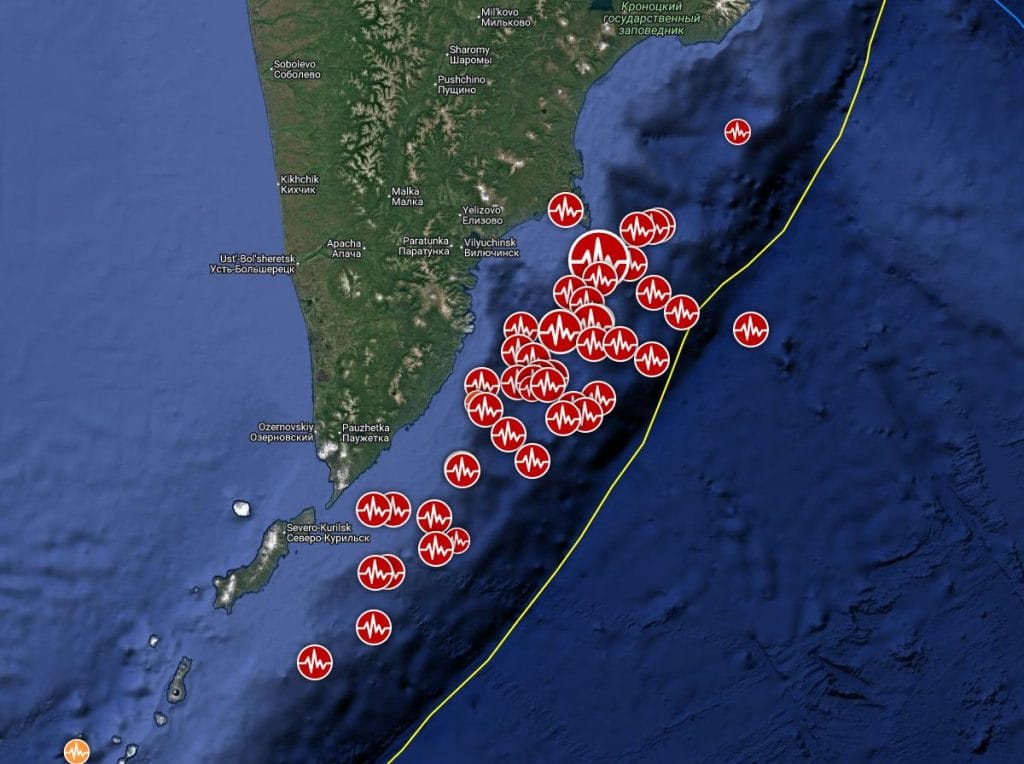
The tsunami inundated numerous coastal locations in Kamchatka and the Kuril Islands. Several vessels were damaged at dock or swept inland, while subsequent surges submerged sections of shoreline. Authorities reported multiple injuries but no confirmed fatalities.
Tsunami warnings, advisories, and watches were issued across the Pacific Rim, including Japan, the United States, Canada, Hawaii, and numerous island territories. Evacuations were conducted in coastal areas of Russia, Japan, and Hawaii.
In Hawaii, the highest wave heights included 1.7 m (5.6 feet) at Kahului, 1.5 m (4.9 feet) at Hilo, and 1.2 m (4 feet) at Haleiwa. Temporary evacuations were issued, but no significant damage occurred.
On the U.S. West Coast, 0.5–1.1 m (1.6–3.6 feet) tsunami waves were recorded from Crescent City to San Francisco Bay. Crescent City, known for tsunami amplification due to offshore bathymetry near the Mendocino Fracture Zone, recorded the highest tsunami wave heights ever observed in the continental United States during this event.
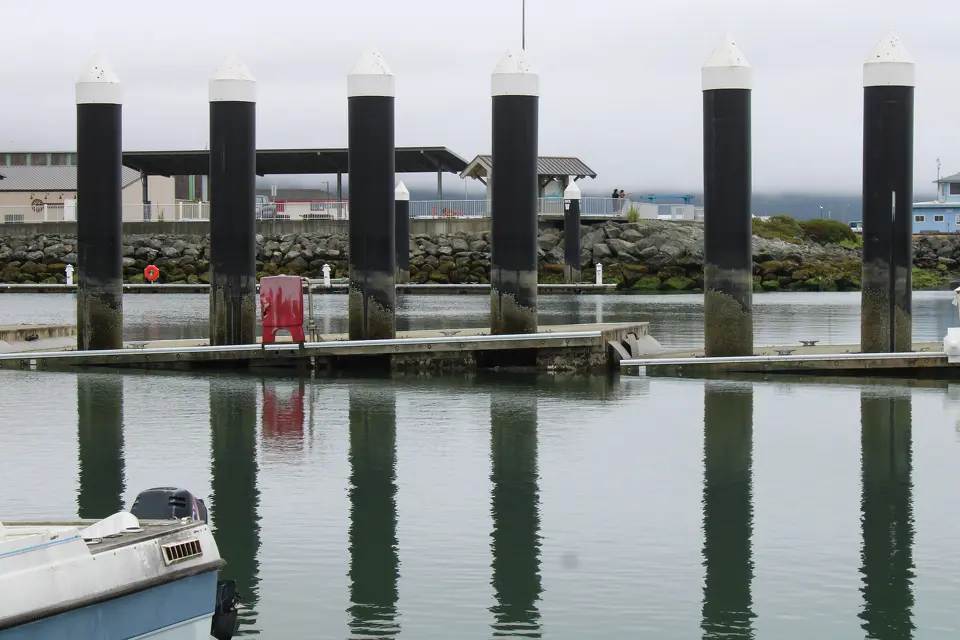
At approximately 02:40 LT on July 30, a significant wave surge lifted a concrete floating dock beyond safe limits, causing it to detach and submerge. H Dock was designed to break away under stress, protecting inner harbor structures but resulting in damage to electrical, water, and fire systems. While no injuries or vessel losses were reported, estimated local damage reached nearly 1 million USD.
In Japan, tsunami wave heights reached up to 1.3 m (4.3 feet) along parts of the eastern coast. One indirect fatality and at least 21 injuries were associated with the evacuation process. In Chile, waves below 1 m (3 feet) prompted precautionary evacuations of over 1.4 million people.
Over 420 aftershocks of magnitude 4.0 and above have been recorded in the Kamchatka–Kuril region in the days following the M8.8 mainshock.
This event ranks as the largest earthquake globally since the M9.0 Tōhoku earthquake in Japan in 2011. It is the strongest earthquake in Russia since the M9.0 Kamchatka earthquake in 1952 and the sixth-most powerful earthquake recorded instrumentally.
The last event of comparable magnitude was the M8.8 Maule earthquake in Chile in 2010.

I’m a science journalist and researcher at The Watchers, contributing to the Epicenter edition, where I cover peer-reviewed scientific research and emerging discoveries across Earth and space sciences. With a background in astronomy and a passion for environmental science, I’ve worked in shark and coral conservation in Fiji, conducting reef and shark-behavior research, contributing to mangrove restoration, and earning PADI Open Water and Coral Reef Certifications. I bring a blend of scientific rigor and storytelling to illuminate the discoveries shaping our planet and beyond.

Commenting rules and guidelines
We value the thoughts and opinions of our readers and welcome healthy discussions on our website. In order to maintain a respectful and positive community, we ask that all commenters follow these rules.