
Very deep partial solar eclipse of March 29, 2025
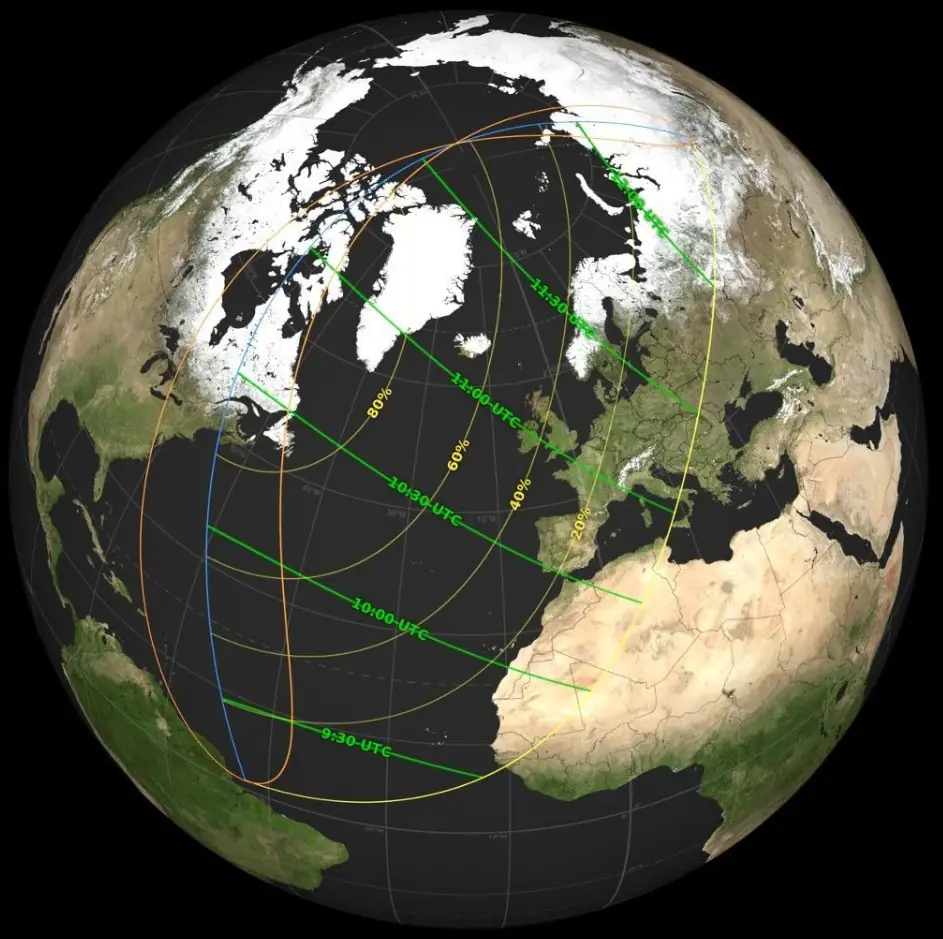
A very deep partial solar eclipse will occur between 08:50 and 12:43 UTC on March 29, 2025, across parts of the Northern Hemisphere, as the Moon passes in front of and partially blocks the Sun. The maximum eclipse, where the Moon covers the largest portion of the Sun, will take place at 10:47 UTC.

Partial solar eclipse seen from Delaware on June 10, 2021. Credit: NASA/Aubrey Gemignani
The partial solar eclipse on March 29, 2025, will be visible across North America, northwest Africa, Europe, and northern Russia.
The instant of the greatest eclipse will occur at 10:47 UTC (06:47 EDT in eastern USA and Canada, 08:47 WGT in Greenland, 10:47 GMT in northwest Africa, and 13:47 MSK in northern Russia), with the Sun positioned in the constellation Pisces. This event takes place just 0.8 days before the Moon reaches perigee, making it one of the deeper partial eclipses in recent history.
The eclipse magnitude is measured at 0.9376, meaning that nearly 94% of the Sun’s diameter will be obscured. The Gamma value, which determines the Moon’s position relative to Earth’s center, is calculated at 1.0405.
This eclipse belongs to Saros 149, marking the 21st occurrence in a series of 71 solar eclipses. Each event in this Saros cycle occurs at the Moon’s ascending node, with the Moon shifting slightly southward with each successive eclipse.
This deep partial eclipse is preceded by a total lunar eclipse on March 14. Both eclipses fall within the same eclipse season, an approximately 35-day period where the Sun and Moon align closely enough for multiple eclipses to occur.
Partial solar eclipses occur when the Moon passes between the Sun and Earth, but the Sun, Moon, and Earth are not perfectly aligned. As a result, only part of the Sun appears covered by the Moon.
However, this does not mean it is safe to observe the eclipse without protection. Looking directly at the Sun, even during a partial eclipse, can cause serious and permanent eye damage. Proper solar viewing glasses or indirect viewing methods, such as pinhole projectors, should be used to safely observe the event.

Rishika holds a Master’s in International Studies from Stella Maris College, Chennai, India, where she earned a gold medal, and an MCA from the University of Mysore, Karnataka, India. Previously, she served as a Research Assistant at the National Institute of Advanced Studies, Indian Institute of Science, Bengaluru, India. During her tenure, she contributed as a Junior Writer for Europe Monitor on the Global Politics website and as an Assistant Editor for The World This Week. Her work has also been published in The Hindu newspaper, showing her expertise in global affairs. Rishika is also a recipient of the Women Empowerment Award at the district level in Haryana, India, in 2022.
Published in the last 24 hours
- CPC posts a slight risk of heavy rain from the Gulf Coast to the Northeast urban corridor November 25-29, and a moderate risk of West Coast wind and Sierra snow on November 25
- Florida's east coast faces a moderate flash flood risk Wednesday through Friday, with 4 to 8 inches of rain forecast and the St. Johns River near Cocoa already in major flood at 17.13 feet
- Cyclone Akvan to make landfall between Nellore and Visakhapatnam around noon on November 20, IMD forecasts 120-130 km/h winds gusting to 145
- Radio pulses every 7.9 minutes reveal binary with white dwarf and Sun-like star Epicenter
