
Strong solar radiation storm in progress after M9.7 solar flare produced large CME

Featured image: Coronal mass ejection produced by M9.7 solar flare on June 8, 2024. Credit: NASA SDO/AIA 304, Helioviewer, The Watchers. Acquired at 01:35 UTC.
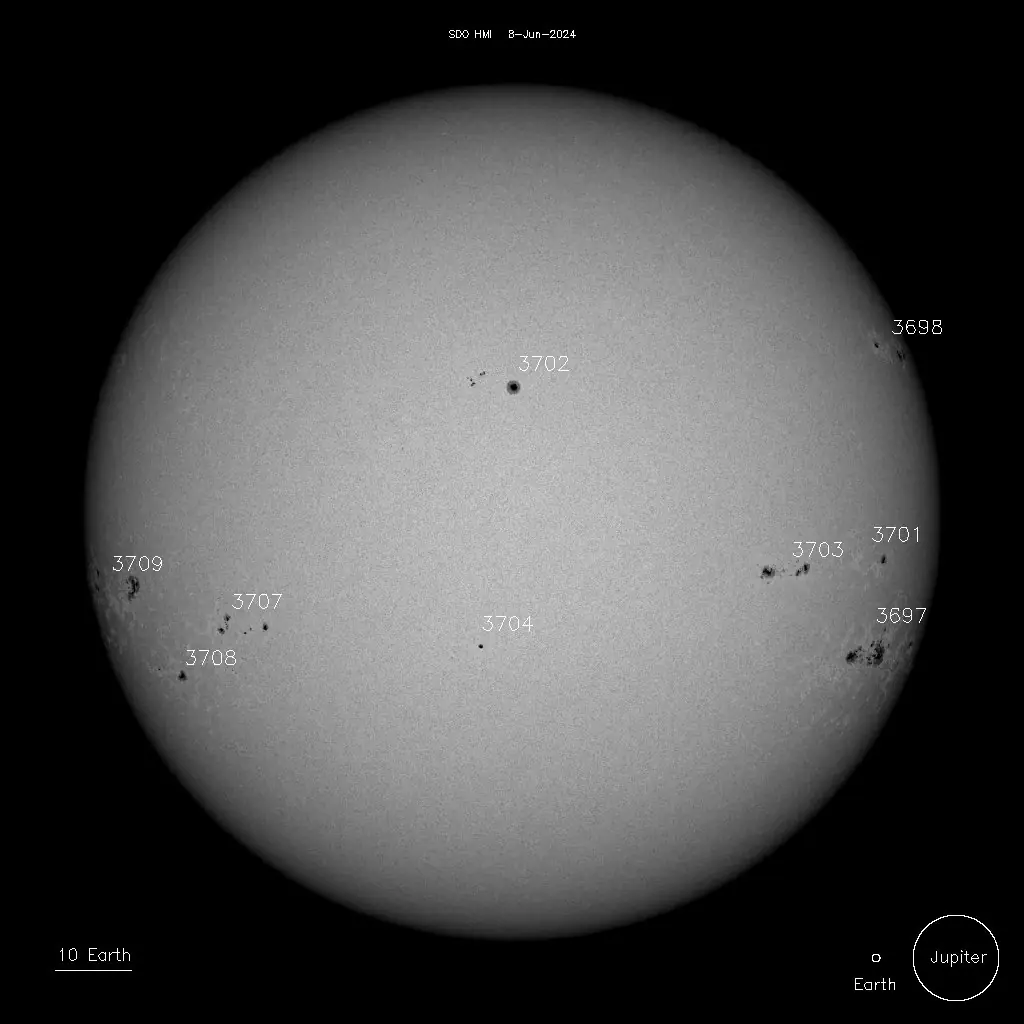
A strong, long-duration solar flare measuring M9.7 erupted from Active Region 3697 at 01:49 UTC on June 8, 2024. The event started at 01:23 and ended at 02:19 UTC, producing a strong CME. Shortly after, solar radiation storming began on Earth, reaching the S3 – Strong threshold at 08:00 UTC.
A Type II Radio Emission, with an estimated velocity of 894 km/s, was detected at 01:28 UTC, suggesting a coronal mass ejection (CME) was associated with the flare event.
A 10cm Radio Burst (tenflare) with a peak flux of 370 sfu was detected from 01:26 to 01:46 UTC. This indicated that the electromagnetic burst associated with a solar flare at the 10cm wavelength was double or greater than the initial 10cm radio background. It can be indicative of significant radio noise in association with a solar flare. While this noise is generally short-lived, it can cause interference for sensitive receivers including radar, GPS, and satellite communications.
In addition, a Type IV Radio Emission was detected at 01:57 UTC. Type IV emissions occur in association with major eruptions on the Sun and are typically associated with strong CMEs and solar radiation storms.
While most of the CME should be directed away from Earth, some of it may impact Earth on June 11.


Radio frequencies were forecast to be most degraded over the Pacific Ocean, eastern Asia, Indonesia, and northern Australia.


Proton flux started increasing around 02:00 UTC, reaching S1 – Minor solar radiation storm threshold at 02:50 UTC and S2 – Moderate at 04:50 UTC.
S2 – Moderate solar radiation storms can have various effects. Passengers and crew in high-flying aircraft at high latitudes may be exposed to elevated radiation risk. Satellite operations might experience infrequent single-event upsets. Additionally, there can be small effects on HF (high frequency) propagation through the polar regions, and navigation systems at polar cap locations could be affected. Moderate solar radiation storms occur approximately 25 times per solar cycle.

S3 – Strong solar radiation storm threshold was reached at 08:00 UTC.
Solar radiation storms of this strength can have significant effects. Radiation hazard avoidance is recommended for astronauts on EVA, and passengers and crew in high-flying aircraft at high latitudes may be exposed to radiation risk. Satellite operations are likely to experience single-event upsets, noise in imaging systems, and a slight reduction in the efficiency of solar panels. Additionally, HF (high frequency) radio propagation through the polar regions may be degraded, and navigation position errors are likely.
Strong solar radiation storms occur approximately 10 times per solar cycle.


“A huge solar storm may give us a glancing blow,” space weather physicist Dr. Tamitha Skov said. “Early NASA model predictions show the recent solar storm launch during the M9.7-flare could graze Earth midday [UTC] June 11. Aurora may come fast and hard, but not last very long.”
A huge #solarstorm may give us a glancing blow! Early NASA model predictions show the recent storm launch during the M9.7-flare could graze Earth midday June 11. #Aurora may come fast and hard, but not last very long. Also, the ongoing #radiation storm has reached S3-levels now.… pic.twitter.com/z73nFxCGNU
— Dr. Tamitha Skov (@TamithaSkov) June 8, 2024
Amazing eruption! It was associated with an M9.7 flare in AR 13697. It was preceded by a prominence eruption going to west and north. The eruption was accompanied by a spectacular global coronal wave, and later observed as a fast (~1500 km/s) asymmetric halo CME. pic.twitter.com/ZPn1Uv4faI
— Halo CME (@halocme) June 8, 2024

I'm a dedicated researcher, journalist, and editor at The Watchers. With over 20 years of experience in the media industry, I specialize in hard science news, focusing on extreme weather, seismic and volcanic activity, space weather, and astronomy, including near-Earth objects and planetary defense strategies. You can reach me at teo /at/ watchers.news.

Commenting rules and guidelines
We value the thoughts and opinions of our readers and welcome healthy discussions on our website. In order to maintain a respectful and positive community, we ask that all commenters follow these rules.