
In 2019, the Ronald Reagan Presidential Library hired hundreds of goats to eat 13 acres of brush around it; months later the Easy Fire surrounded the library, and the fire break the goats left behind slowed the flames before they reached the building
Vincent van Goat and Selena Goatmez were among the animals hired to eat brush around the Ronald Reagan Presidential Library in May 2019. Months later, when the Easy Fire surrounded the hilltop complex, library staff credited the herd’s appetite with helping firefighters protect the buildings and the presidential history inside.

Smoke rising from the Sandy Fire burning in Simi Valley on May 18, 2026. Credit: VCFD PIO
The library brought in 805 goats in May from a local vegetation-clearing business for the 2019 season. The reported treatment covered roughly 5.3 ha (13 acres) of scrub around the Simi Valley, California, complex, leaving less vegetation available to burn when the Easy Fire arrived about five months later.
The animals belonged to a business run by Scott Morris, whose herd included goats named Vincent van Goat and Selena Goatmez. Their assignment was to remove flammable vegetation before a fire started; the firefighting would still have to be done by people.

The Easy Fire reached a prepared perimeter
On October 30, 2019, the National Archives announced that the library and museum were closed because of a brush fire and lay within a mandatory evacuation area. The fire was part of a dangerous autumn in Southern California: earlier that month, the Saddleridge Fire had spread rapidly amid dry air and strong winds.
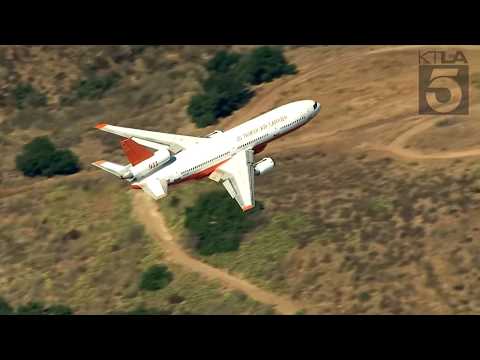
Wind drove the Easy Fire around the hilltop library, where the collections included presidential records, an Air Force One aircraft and a section of the Berlin Wall. Helicopters and fixed-wing aircraft supported the ground response, according to contemporary reporting citing the Ventura County Fire Department.
Investigators later linked the ignition to Southern California Edison equipment. In a November 2022 enforcement announcement, the California Public Utilities Commission said the utility had failed to install and maintain a 66 kV conductor and insulator safely enough to prevent contact with a steel pole when they swung in windy conditions.
The grazing could not prevent that electrical failure. Its purpose was to change the vegetation through which a fire would have to travel near the buildings; CAL FIRE records the Easy Fire as fully contained on November 2, 2019.
Hundreds of goats, with an uncertain head count
The contemporary reports agree on the operation’s broad scale but differ on its head count. Reuters reported 500 goats, while Voice of America reported 300; both described about 5.3 ha (13 acres) of brush clearance. These accounts support a herd numbering in the hundreds and an approximate treatment area.
Melissa Giller, the library spokeswoman, told Reuters that a firefighter believed the cleared strip had helped. The firebreak, she said, “made their job easier.” That is an operational assessment relayed by the library’s spokeswoman, rather than a measurement of flame speed or a controlled comparison with an ungrazed slope.
The National Archives later gave a similar account. In June 2023, Randle Swan, then the library’s acting deputy director and supervisory curator, said the cleared underbrush had limited the fire’s ability to keep moving and allowed it to be extinguished before reaching the main structure.
Eating the vegetation changes the path available to flames
The technique is called targeted or prescribed grazing: managers control where animals feed, when they arrive, and how long they remain to achieve a vegetation-management goal. A 2014 review by R. Lovreglio, O. Meddour-Sahar and V. Leone described its use in reducing both horizontal and vertical connections between fuels.
Horizontal connections allow fire to move between neighboring plants. Vertical connections, often called ladder fuels, allow flames to climb from low vegetation into taller shrubs and tree crowns. Goats browse leaves and small twigs as well as eating herbaceous plants, making them useful for treating brush that grass-focused grazers may leave behind.
Removing some of that material can reduce flame length and intensity and make suppression more feasible. Large woody stems and vegetation beyond the animals’ reach can still require cutting or other treatments; the result depends on the plants present and how the grazing is managed.
Field studies measure vegetation changes, with tradeoffs
A study published in December 2023 examined three grazed fuel breaks at Camp Williams, a Utah National Guard installation. E. Cohen, E. Thacker and T. Decker compared vegetation inside the breaks with nearby ungrazed reference areas using paired survey transects; their field observations came from 2015.
At Oak Springs, grazed plots had less sagebrush cover and lower sagebrush density. The other two sites showed no significant difference in shrub cover or density, showing that vegetation differences were not uniform across the three sites.
The researchers found no significant increase in cheatgrass cover at the three sites, but Beef Hollow’s grazed plots had less native bunchgrass cover and more bulbous bluegrass. Sampling covered only one year, and the study assessed vegetation rather than measuring the treatment’s performance during a wildfire.
That distinction matters at the Reagan Library, too. A cleared strip and a surviving building do not establish how much the grazing contributed separately from the crews and aircraft working there, or how the outcome would have differed without it.
A fuel break gives firefighters an opportunity
A July 2026 review led by Hamish Clarke examined the broader evidence for fuel breaks. Starting with 1 585 journal articles, the authors screened for relevant research and found only six studies that quantitatively assessed effectiveness across multiple fires and years while considering several explanatory factors.
Those studies supported fuel breaks as aids to fire suppression, with performance affected by weather, vegetation, maintenance, access, and available firefighting resources. Extreme conditions reduced effectiveness; the review also cautioned against transferring findings between ecosystems without adequate evidence.
The U.S. Forest Service’s September 2026 synthesis explains the practical role: treated strips provide places where crews can establish control lines, apply water or retardant, or conduct firing operations. Fuel breaks rarely stop spreading fire on their own, and overgrown breaks can give a misleading impression of protection.

The library’s grazing program requires repeated work
The National Archives’ September 2021 climate action plan described an established partnership with the Ventura County Fire Department. A shepherd used temporary electric fencing to guide grazing within approximately 46 m (150 feet) of buildings and property lines on the campus hillsides.
The plan recorded about 350 goats working for roughly two weeks in 2021, with longer stays in more heavily vegetated years. By June 2023, the agency described a season involving approximately 700 goats staying about two months.
The operation also includes ecological precautions. The fire department coordinates timing with federal wildlife officials to avoid disturbing nesting birds, and the animals spend time in a separate pasture after leaving the site to reduce the transfer of unwanted plants and seeds.
The site’s exposure continued: the Sandy Fire prompted an evacuation of the Reagan Library in May 2026. Maintaining vegetation clearance remains a recurring job in a landscape where fires can approach from surrounding hills.
For future assessments, the missing evidence is more specific than whether goats eat brush. Measurements of the remaining fuel, the fire’s behavior as it enters a treated strip, and the suppression work done there would help establish how much protection a particular grazing program provides under particular conditions.
References
1 This is how California is using goats to tackle deadly fires – Reuters, republished by the World Economic Forum – November 1, 2019. Reporting by Andrew Hay and Omar Younis.
2 Goats Help Save Reagan Library From Wildfires – Voice of America – October 31, 2019.
3 Reagan Presidential Library & Museum Closed Due to Wildfires – National Archives – October 30, 2019.
4 Saddleridge Fire explodes in Southern California, mandatory evacuation in San Fernando Valley – The Watchers – October 11, 2019.
5 CPUC STAFF PROPOSE PENALIZING SCE $1 MILLION FOR EASY FIRE – California Public Utilities Commission – November 15, 2022.
6 Easy Fire – CAL FIRE – incident began October 30, 2019; archive last updated October 21, 2022.
7 Lovreglio, R., Meddour-Sahar, O., and Leone, V. (2014). Goat grazing as a wildfire prevention tool: a basic review – iForest – Biogeosciences and Forestry, 7: 260–268 – March 26, 2014. DOI: 10.3832/ifor1112-007.
8 Cohen, E., Thacker, E., and Decker, T. (2023). Evaluating Targeted Grazing as a Fuels Treatment – Journal of the NACAA, 16(2) – December 2023. Full article.
9 Clarke, H., Syphard, A. D., Marshall, E., and Symon, C. (2026). Fuel breaks need more regime-scale empirical research: insights from a rapid evidence review – International Journal of Wildland Fire, 35(7): WF26057 – July 22, 2026. DOI: 10.1071/WF26057.
10 Science You Can Use: Wildfire Speed Bumps: The latest science on fuel breaks – U.S. Forest Service, Rocky Mountain Research Station – September 22, 2026; updated October 22, 2026.
11 Climate Action Plan – National Archives and Records Administration – September 2021, page 20.
12 Superhero Goats Return to Protect Reagan Library from Wildfires – National Archives – June 14, 2023. By Victoria Macchi and Kristin Phillips.
14 Easy Fire Burns Over 1,700 Acres in Simi Valley – The Daily Sundial, California State University, Northridge – October 31, 2019.

Rishav Kothari is Editor-in-Chief of The Watchers, where he runs the newsroom and covers earthquakes, volcanoes, severe weather and space weather.
Published in the last 24 hours
- In the winter of 1811–12, earthquakes near New Madrid, Missouri, shook so hard that witnesses saw the Mississippi River flow backward, and the shaking left a brand-new lake in Tennessee Epicenter
- On 28 August 1859 a solar storm shocked telegraph operators and threw sparks on other lines, and on 2 September Boston to Portland clerks unhooked their batteries and kept sending for more than two hours on the aurora's current alone. Epicenter
- A fish filmed 600 meters below the Pacific has a transparent head, and its eyes rotate inside it to follow prey Epicenter
- In 1927, Louisiana dynamited a Mississippi River levee to save New Orleans, flooding the homes of about 10,000 people downstream, and the city turned out never to need it Epicenter
