
New insights reveal Earth’s inner core exhibits 8.5-year wobble
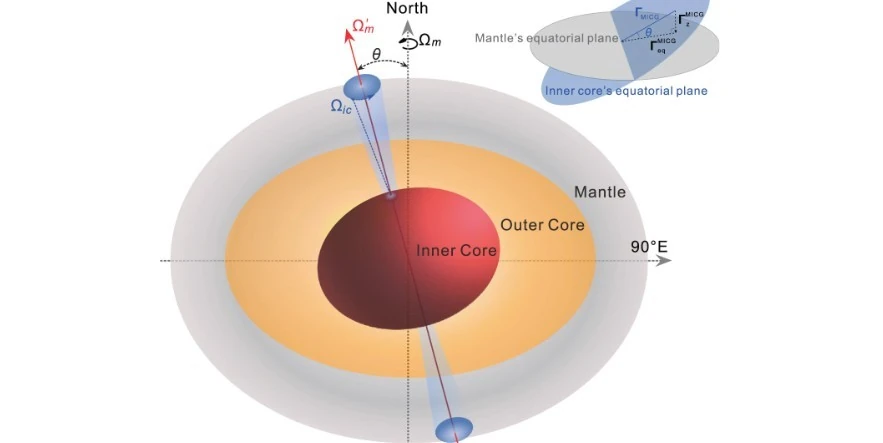
Image credit: Nature Communications, authors
Researchers from China have confirmed an 8.5-year Inner Core Wobble (ICW) in Earth’s polar motion and length-of-day variations, revealing a static tilt of about 0.17 degrees between the inner core and mantle, challenging long-standing assumptions about Earth’s internal dynamics.
The Earth’s inner core, a solid sphere primarily composed of iron and nickel spanning about 1 200 km (746 miles) in radius, has long been a subject of scientific intrigue. Now, a groundbreaking study published in Nature Communications has confirmed the existence of an 8.5-year Inner Core Wobble (ICW) in Earth’s polar motion and length-of-day variations, offering new insights into the Earth’s internal dynamics and density distribution.
Researchers, led by Professor Hao Ding of Wuhan University, embarked on this exploratory journey inspired by unconventional density structures revealed in Earth’s free oscillation. They discovered an 8.5-year signal in polar motion (PM) and length-of-day variations (ΔLOD), which led to the current study. This motion is characterized by a periodic oscillation of the inner core’s figure axis, influencing both the Earth’s rotation and its magnetic field.
The study utilized a detailed analysis of PM and ΔLOD of Earth’s rotation, identifying the 8.5-year signal as the manifestation of the ICW. This discovery comes after meticulously excluding external excitation sources such as atmospheric, oceanic, and hydrological factors. The consistent presence of this signal in both PM and ΔLOD strongly suggests a deep connection between the ICW and Earth’s rotational dynamics.
To understand the 8.5-year signal detected in PM and ΔLOD, the researchers examined the amplitudes of the ICW in both, leading to the inference of a static tilt angle of 0.17 degrees between the rotation axis of the inner core and the mantle. This tilt offers valuable constraints for the 3D density model of the mantle and questions traditional assumptions about the Earth’s interior, suggesting potential deviations from the previously believed perfect spherical form.
The periodic motion of the ICW indicates a density jump of about 0.52 g/cm³ at the inner core boundary, signifying a noticeable change in density at the boundary between the inner core and its surrounding layers. This finding has broader implications, as the static tilt may lead to changes in the shape of the liquid core, affecting the fluid motion and, consequently, the geomagnetic field.
The revelation of Earth’s ICW and its associated static tilt challenges the conventional understanding of Earth’s rotation and internal dynamics. This study not only adds a new chapter to our understanding of Earth’s geophysical processes but also opens up new avenues for scientific inquiry into the planet’s deepest secrets.
References:
1 Challenging assumptions: The 8.5-year rhythm of Earth’s inner core – Phys.org – December 18, 2023
2 Inner core static tilt inferred from intradecadal oscillation in the Earth’s rotation – An, Y., Ding, H., Chen, Z. et al. -Nat Commun 14, 8130 (2023). https://doi.org/10.1038/s41467-023-43894-9 – OPEN ACCESS

The Watchers team and our contributors bring the latest on extreme weather, earthquakes, volcanic eruptions, space weather, and all things science. We're all about making sense of the natural world and keeping you informed on what’s happening. Got a tip or a question? Hit us up using the form at newstips!

Commenting rules and guidelines
We value the thoughts and opinions of our readers and welcome healthy discussions on our website. In order to maintain a respectful and positive community, we ask that all commenters follow these rules.