
Very bright daylight meteor over New Zealand, loud boom reported

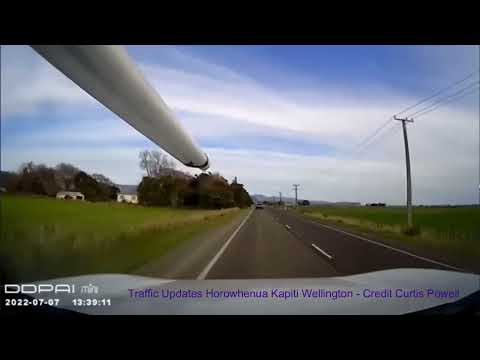
Featured image: Fireball over New Zealand on July 7, 2022. Credit: Curtis Powell
A very bright daylight meteor was seen and recorded over Wellington, New Zealand at around 01:50 UTC on July 7, 2022 (13:50 LT). This event lasted about 10 seconds and was followed by a loud boom. It left signatures on weather radars, seismometers, and geostationary satellites.
Residents described it as a massive flash of light, a giant streak of orange, followed by a blue smoke trail and a big bang. Some of them reported their homes rattled.
“It sounds like there has been a really interesting event somewhere in Wellington,” astronomer and Otago Museum director Dr. Ian Griffin said. “Many people have reported a ball of fire in the sky.”1
Alan Gilmore, an astronomer at Canterbury University’s Mount John Observatory, told Reuters that a bright meteor coming down through the atmosphere very fast was a rare occurrence over an urban area.
“This was glowing very brightly so it must have been quite a big object,” said Gilmore. The boom that people heard indicated the meteor had come within 60 km (37 miles) of earth, he said.2
Wellington Radar recorded a smoke trail from the meteor as it passed over the lower North Island. “It’s about the right place and time, and it’s not meteorological,” New Zealand’s Met Service meteorologists said.

GeoNet’s seismometers registered sound waves from the meteor, with the earliest arrival at around 13:50 LT on seismometer PLWZ on the east side of Palliser Bay.

The event was also recorded by a lightning mapper aboard NOAA’s GOES-17 satellite:

Keep reading
According to CNEOS, the fireball was detected at 01:49:26 UTC at an altitude of 35 km (21.7 miles) and latitude 41.7S / longitude 175.0E. The calculated total impact energy is 1.8 kt.
“If you’ve got video or photographs of the event it’s really important to keep them, as we might be able to use them to triangulate the position of the thing, and where it landed – if it did land,” Griffin said.1
“Also if you saw it and heard a bang, that’s quite interesting too. If you know the time between when you saw the flash of light heard the bang that gives us a sense of distance.”
“It might be quite scientifically important to retrieve the object,” Griffin said.
“Meteorites in this country are quite rare so actually getting one would be quite cool.”
In an amazing coincidence on this day in 1999, GeoNet recorded a large meteor that entered the Earth’s atmosphere to the northwest of New Zealand. It was seen by residents from Timaru to 90 Mile Beach in Northland.
References:
1 ‘Meteor’ lights up sky for a startling 10 seconds – Stuff – July 7, 2022
2 Meteor flashes across sky over Wellington, New Zealand – Reuters – July 7, 2022

Teo Blašković founded The Watchers in 2011 and edited it until 2026, covering seismic and volcanic activity, extreme weather, space weather and near-Earth objects. Articles on this page are his archive.
More reporting
- Venus’ extreme atmosphere could preserve mineral traces of its wetter past
- Curiosity’s 49th drill hole on Mars targets clues to ancient mineral formation
- Astronomers uncover hidden space debris in the Earth's geosynchronous region
- An 11-year snow experiment reveals how desert biocrusts respond to changing winters
