
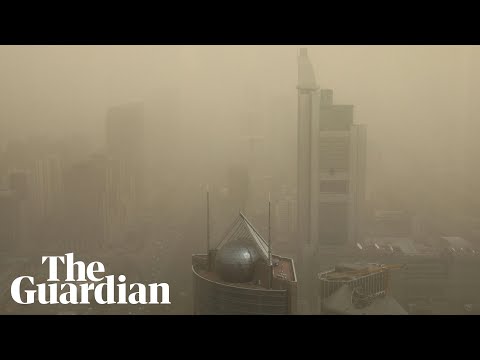
Beijing engulfed by third major dust storm in five weeks, China

Image credit: Kathy Long
China's capital Beijing has seen its third major dust storm in five weeks on Thursday, April 15, 2021. The storm is expected to continue in the coming days, affecting central and eastern China, according to the Guaizihu Meteorological Station.
Beijing's air quality index surged to 324 as of 08:00 UTC (16:00 LT) on Thursday, mainly due to larger particles of dust, reported the municipal authorities.
The situation worsened in the evening, with some parts of the city seeing an air quality index of more than 1 300, according to the Swiss IQAir.
The dust particles originated from Mongolia, and are expected to engulf central and eastern China by Friday, April 16, the Guaizihu Meteorological Station warned.
Compared to the two other similar events in March, the recent one has a higher wind speed, making the dust particles travel farther and faster.
"I don't feel good. We have had several dust storms this year," said resident Gary Zi. "The air quality is much worse than in previous years. Breathing becomes difficult. Sand gets into your eyes and your nose."
In a proposal to the parliament, delegates from the Gansu region said more than half o the dust storms that descend on China every year come from abroad, particularly from southern Mongolia.
See the sandstorm coming in Beijing today pic.twitter.com/ihng5lSkuE
— Zhou Lei (@ZhouLeiArt) April 15, 2021
Apocalyptic skies in Beijing tonight as another sandstorm rolls in, this time with added thunder and lightening. pic.twitter.com/TbjAEE33Cm
— Kathy Long (@ProducerKathy) April 15, 2021
Turned yellow again: Combination thunderstorm and sandstorm in #Beijing right now. pic.twitter.com/sEl2dR1ZuY
— ZouYue (@ZouYueTweets) April 15, 2021
A sandstorm has turned the skies yellow in Beijing, China today. pic.twitter.com/FUf1e6xdRD
— BBC Weather (@bbcweather) April 15, 2021

Published in the last 24 hours
- In September 1859, a solar storm lit up the night sky so brightly that gold miners in the Rocky Mountains woke up after midnight and started cooking breakfast, convinced the aurora glowing over their camp was the sunrise Epicenter
- A patch of warm Pacific water that could become the strongest El Niño in more than 70 years sits thousands of miles from any American town, yet it is already the main reason NOAA expects a wetter winter across the South and a milder one across the North
- A 19-year-old Nebraska teacher reportedly tied her pupils together with twine and led them to safety through a blizzard in January 1888 Epicenter
