
Relatively strong eruption at Sinabung volcano, Indonesia

Featured image: Mount Sinabung erupting on May 7, 2019. Credit: Sutopo Purwo Nugroho
A relatively strong eruption took place at Indonesian Sinabung volcano at 02:48 UTC (19:48 local time) on May 7, 2019.
According to the Darwin VAAC, the eruption produced a column of ash up to 4.6 km (15 000 feet) above sea level, drifting ESE. This is about 2 km (6 500 feet) above the crater.
The Aviation Color Code is Orange.
The eruption lasted 42 minutes and 49 seconds and had a maximum amplitude of 120 mm, the Head of Mount Sinabung Monitoring Post, Armen, said.
A thick ash column was produced and heavy ashfall was reported in several villages around the volcano. Simpangempat Subdistrict was the worst affected.
Officials deployed at least 3 fire engines and 18 officers to assist the cleaning process.

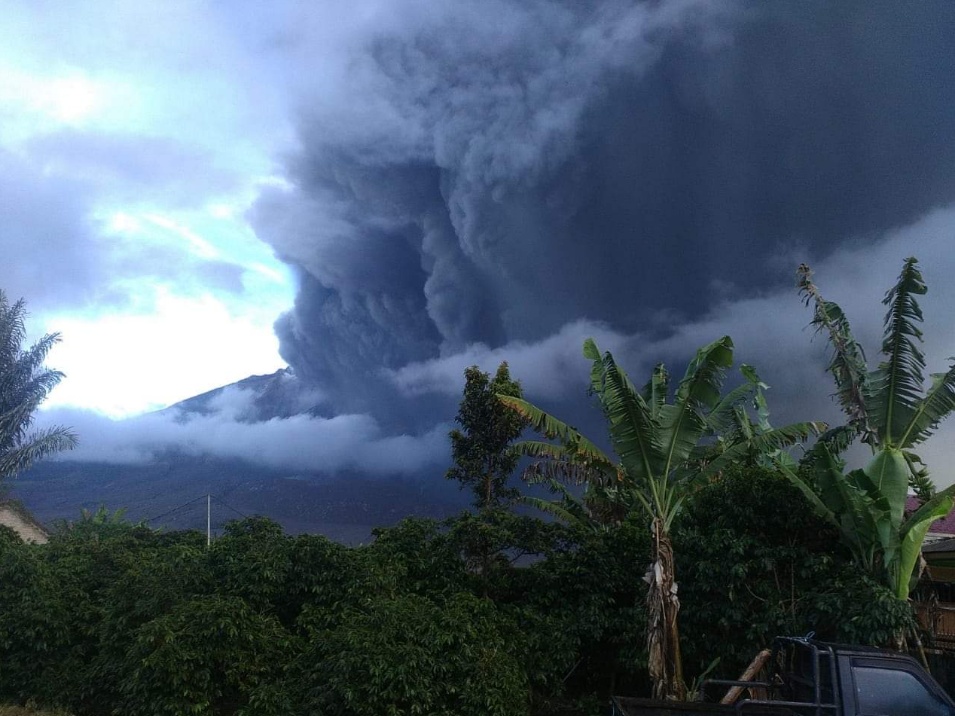
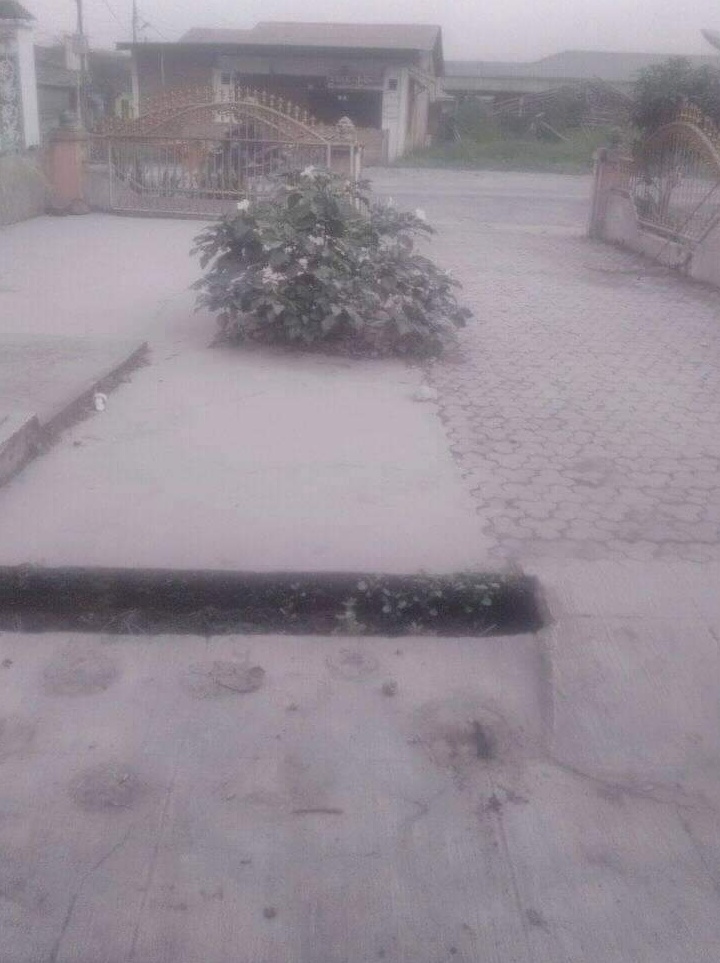

Images courtesy Sutopo Purwo Nugroho

The Alert Level remains at 4 (on a scale of 1-4), with a general exclusion zone of 3 km (1.8 miles) and extensions of 7 km (4.3 miles) on the SSE sector, 6 km (3.7 miles) in the ESE sector, and 4 km (1.2 miles) in the NNE sector.
Officials warned people living along nearby rivers to be alert for potential lahars, especially during heavy rains.
The last eruption of this volcano took place from June 20 – 22, 2018, generating ash plumes up to 3.7 km (12 000 feet) a.s.l. and drifting SE and E.
Geological summary
Gunung Sinabung is a Pleistocene-to-Holocene stratovolcano with many lava flows on its flanks. The migration of summit vents along a N-S line gives the summit crater complex an elongated form. The youngest crater of this conical, 2 460-m-high (8 070 feet) andesitic-to-dacitic volcano is at the southern end of the four overlapping summit craters.
An unconfirmed eruption was noted in 1881, and solfataric activity was seen at the summit and upper flanks in 1912.
No confirmed historical eruptions were recorded prior to explosive eruptions during August – September 2010 that produced ash plumes to 5 km (16 404 feet) above the summit. (GVP)

Teo Blašković founded The Watchers in 2011 and edited it until 2026, covering seismic and volcanic activity, extreme weather, space weather and near-Earth objects. Articles on this page are his archive.
Published in the last 24 hours
- A meteorite blew a crater beside a village near Lake Titicaca in 2007, and dozens of villagers who went to see it got headaches and nausea, though tests found nothing the rock had added to the water Epicenter
- The people who pay closest attention to the weather are the ones storms have already cost the most, a study of 946 students found, with one damaging storm making little difference to how much attention a student paid, but two or more making a clear one Epicenter
- The sea is falling in Juneau, Alaska, because land freed from melted glaciers is rising about 0.6 inches a year Epicenter
- A dam above Los Angeles collapsed just before midnight on March 12, 1928, and the flood killed more than 400 people, hours after the engineer who built it had spent two hours looking at a new leak and decided there was no danger Epicenter
