
New phreatic eruption at Merapi volcano, Indonesia
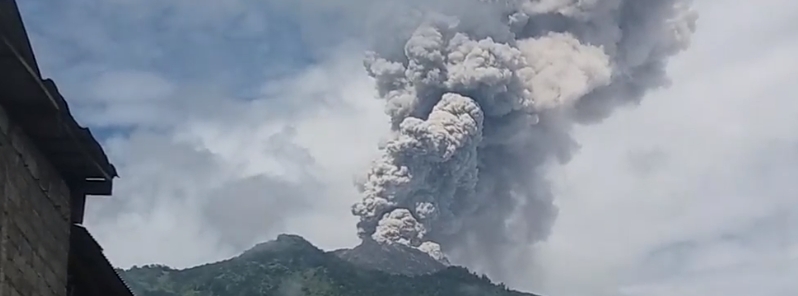
Image credit: Eruption of Mount Merapi, Indonesia on May 21, 2018.
Just 10 days after a powerful explosion at Mount Merapi in Magelang, Central Java, Indonesia, another phreatic eruption took place at the volcano at 01:25 local time on May 21, 2018 (18:25 UTC, May 20).
The explosion lasted 19 minutes and ejected ash up to 4.3 km (14 000 feet) above sea level. Volcanic ash was not identified on satellite imagery due to the meteorological cloud.
Ashfall was reported in several villages, the disaster mitigation agency spokesman Sutopo Purwo Nugroho said. The alert level of the volcano was not raised.
Erupsi freatik Gunung Merapi berlangsung 6 menit pada 21/5/2018 pukul 09.38 Wib. Tinggi asap 1.200 meter. Angin ke barat. Tidak ada lonjakan aktivitas kegempaan. Status tetap Normal. Masyarakat dihimbau tenang. Tidak perlu mengungsi. BPPTKG terus monitor aktivitas gunung. pic.twitter.com/AAjZBKTbfD
— Sutopo Purwo Nugroho (@Sutopo_PN) May 21, 2018
Gunung Merapi erupsi freatik lagi pada 21-5-2018 pukul 09.38 WIB. Tinggi kolom abu 1.200 meter. Status Normal (level I). Kondisi aman. Masyarakat belum perlu mengungsi. Dengan adanya erupsi freatik susulan tadi malam dan pagi ini perlu kita tingkatnya kewaspadaannya. pic.twitter.com/VbMKmcwXJT
— Sutopo Purwo Nugroho (@Sutopo_PN) May 21, 2018
Hujan abu tipis erupsi freatik kecil di
Kemiren, Kaliurang dan Srumbung. Gunung Merapi erupsi freatik kecil atau hembusan pada 21-5-2018 pukul 01.25 WIB selama 19 menit dengan ketinggian asap 700 m teramati dari Pos Babadan.
Status Gunung Merapi normal (level I). pic.twitter.com/zbllwuvXOK— Sutopo Purwo Nugroho (@Sutopo_PN) May 21, 2018
This volcano suddenly erupted on May 11, sending nearby residents fleeing to safer areas.
Thousands of people are living on the flanks of Mount Merapi, active stratovolcano regularly erupting since 1948. It is located about 28 km (17 miles) north of Yogyakarta city (population of 2.4 million).
In November 1994, a large explosion at the volcano produced pyroclastic flows that killed 27 people.
A series of eruptions in 2010 killed 353 people.
Geological summary
Merapi, one of Indonesia's most active volcanoes, lies in one of the world's most densely populated areas and dominates the landscape immediately north of the major city of Yogyakarta. It is the youngest and southernmost of a volcanic chain extending NNW to Ungaran volcano. Growth of Old Merapi during the Pleistocene ended with major edifice collapse perhaps about 2000 years ago, leaving a large arcuate scarp cutting the eroded older Batulawang volcano.
Subsequently growth of the steep-sided Young Merapi edifice, its upper part unvegetated due to frequent eruptive activity, began SW of the earlier collapse scarp. Pyroclastic flows and lahars accompanying growth and collapse of the steep-sided active summit lava dome have devastated cultivated lands on the western-to-southern flanks and caused many fatalities during historical time.

I'm a dedicated researcher, journalist, and editor at The Watchers. With over 20 years of experience in the media industry, I specialize in hard science news, focusing on extreme weather, seismic and volcanic activity, space weather, and astronomy, including near-Earth objects and planetary defense strategies. You can reach me at teo /at/ watchers.news.

Commenting rules and guidelines
We value the thoughts and opinions of our readers and welcome healthy discussions on our website. In order to maintain a respectful and positive community, we ask that all commenters follow these rules.