
Shinmoedake erupts ash 6.7 km a.s.l., highest since eruptions started, Japan
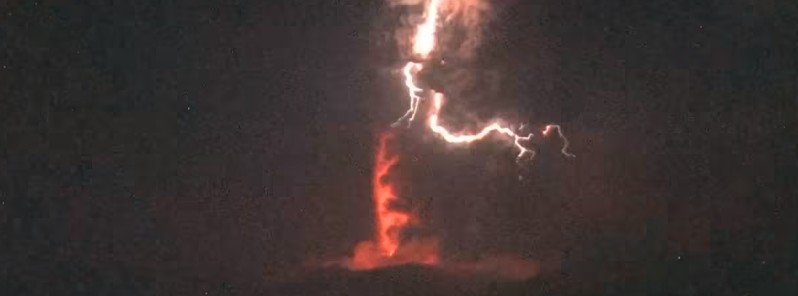
Featured image: Volcanic lightning produced during Shinmoedake eruption on April 5, 2018. Credit: Volcano Time-Lapse
A strong explosive eruption took place at Shinmoedake volcano, Kirishima mountain range in Japan, late April 4, 2018.
The eruption sent ash up to 6.7 km (22 000 feet) above sea level, the highest since a series of eruptions began on March 1, the Japanese Meteorological Agency said.
The eruption also produced minor pyroclastic flows southeast of the crater, in the direction of Takaharu, Miyazaki Prefecture. Some of them reached about 800 meters (2 600 feet) from the crater.
Kagoshima and Mizayaki governments said they had not received any reports of injuries.
The eruption took place two days after a sharp seismicity uptick and mountain 'swelling' observed after a recent contraction due to eruption.
Geological summary
Kirishimayama is a large group of more than 20 Quaternary volcanoes located north of Kagoshima Bay. The late-Pleistocene to Holocene dominantly andesitic group consists of stratovolcanoes, pyroclastic cones, maars, and underlying shield volcanoes located over an area of 20 x 30 km (12.4 – 18.6 miles).
The larger stratovolcanoes are scattered throughout the field, with the centrally located, 1700-m-high (5 577 feet) Karakunidake being the highest.
Onamiike and Miike, the two largest maars, are located SW of Karakunidake and at its far eastern end, respectively.
Holocene eruptions have been concentrated along an E-W line of vents from Miike to Ohachi, and at Shinmoedake to the NE. Frequent small-to-moderate explosive eruptions have been recorded since the 8th century. (GVP)

I'm a dedicated researcher, journalist, and editor at The Watchers. With over 20 years of experience in the media industry, I specialize in hard science news, focusing on extreme weather, seismic and volcanic activity, space weather, and astronomy, including near-Earth objects and planetary defense strategies. You can reach me at teo /at/ watchers.news.

Commenting rules and guidelines
We value the thoughts and opinions of our readers and welcome healthy discussions on our website. In order to maintain a respectful and positive community, we ask that all commenters follow these rules.