
Annular solar eclipse of September 1, 2016
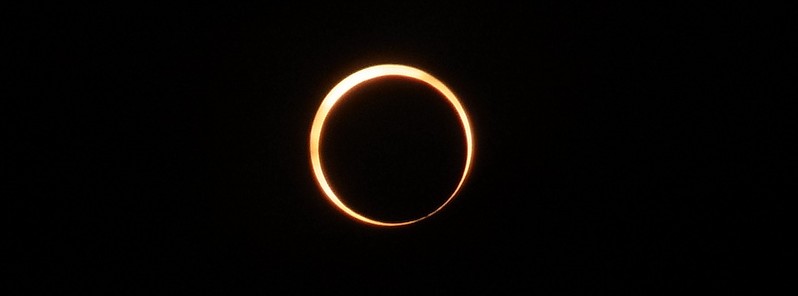
Featured image: Annular Solar Eclipse of May 20, 2012. Credit: Toshiyuki IMAI
A large annular eclipse will cover 97% of the Sun on Thursday, September 1, 2016.
The whole event will last from 06:13 – 12:00 UTC and will be visible across central Africa southwards to Madagascar and into the Indian Ocean. The partial eclipse will be visible across most of Africa and parts of the Middle East.
The instant of greatest eclipse will take place at 09:06 UTC on September 1, 5.4 days before the Moon reaches apogee and 10 days after perigee. During the eclipse, the Sun is in the constellation Leo.
At the point of maximum eclipse, it will last 3 minutes and 6 seconds.

Video courtesy Larry Koehn
This eclipse belongs to Saros 135 and is number 39 of 71 eclipses in the series. All eclipses in this series occur at the Moon’s ascending node. The Moon moves southward with respect to the node with each succeeding eclipse in the series and gamma decreases.
This annular solar eclipse is followed two weeks later by a penumbral lunar eclipse on September 16, 2016.

Image credit: Fred Espenak, NASA/GSFC
An annular solar eclipse occurs when the Moon's apparent diameter is smaller than the Sun's, blocking most of the Sun's light and causing the Sun to look like an annulus (ring). An annular eclipse appears as a partial eclipse over a region of the Earth thousands of kilometers wide.
Links for the Annular Solar Eclipse of September 1, 2016:

The Watchers team and our contributors bring the latest on extreme weather, earthquakes, volcanic eruptions, space weather, and all things science. We're all about making sense of the natural world and keeping you informed on what’s happening. Got a tip or a question? Hit us up using the form at newstips!
Earlier reporting
Nothing on Watchers was published in the last 24 hours. These are older articles.
- On October 22, 2017, a single flash of lightning stretched 515 miles from eastern Texas to near Kansas City, a distance that takes eight hours to drive, and nobody realized how far it had gone until scientists went back through the satellite data years later Epicenter
- CPC posts a slight risk of heavy rain from the Gulf Coast to the Northeast urban corridor November 25-29, and a moderate risk of West Coast wind and Sierra snow on November 25
- Florida's east coast faces a moderate flash flood risk Wednesday through Friday, with 4 to 8 inches of rain forecast and the St. Johns River near Cocoa already in major flood at 17.13 feet
- Cyclone Akvan to make landfall between Nellore and Visakhapatnam around noon on November 20, IMD forecasts 120-130 km/h winds gusting to 145

Unexpected lunar eclipse on September 4,2016. Did anyone else see this happen last night?I’ve looked everywhere and nothing was supposed to occur until 9/16/2016.