
G2 – Moderate geomagnetic storm in progress
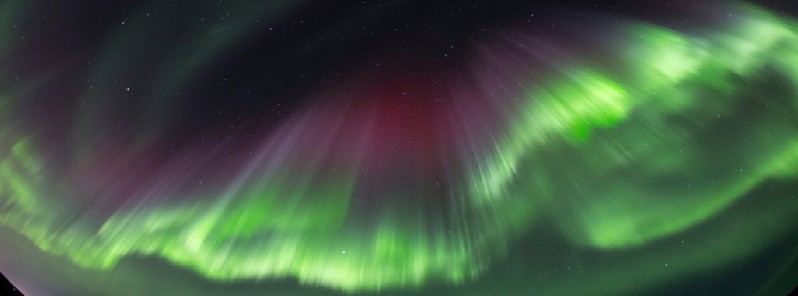
Image credit: Sacha Layos. Captured on March 11, 2016 at Fairbanks, Alaska. Via SpaceWeather.com
After strong G3 geomagnetic storm on March 6 and 7, solar wind parameters increased again around 04:00 UTC on March 11.
The cause is most likely a Coronal Mass Ejection (CME) from March 6. Interplanetary magnetic field (IMF) total field (Bt) valuese steadly increased from 4 to 26 nT after 04:00 UTC.
Geomagnetic K-index of 5 (G1 – Minor geomagnetic storm) threshold was reached at 13:00 UTC. At 14:41 UTC, geomagnetic storming increased to G2 – Moderate levels.

Due to continued CME effects, solar wind parameters are expected to remain enhaced on March 11 and 12 and then followed by the onset of a positive polarity coronal hole high speed stream (CH HSS).

Image credit: NOAA/SWPC
Meanwhile, solar activity is very low and only background flaring is being observed.
SWPC alerts
Space Weather Message Code: ALTK06
Serial Number: 398
Issue Time: 2016 Mar 11 1441 UTC
ALERT: Geomagnetic K-index of 6
Threshold Reached: 2016 Mar 11 1441 UTC
Synoptic Period: 1200-1500 UTC
Active Warning: Yes
NOAA Scale: G2 – Moderate
NOAA Space Weather Scale descriptions can be found at
www.swpc.noaa.gov/noaa-scales-explanation
Potential Impacts: Area of impact primarily poleward of 55 degrees Geomagnetic Latitude.
Induced Currents – Power grid fluctuations can occur. High-latitude power systems may experience voltage alarms.
Spacecraft – Satellite orientation irregularities may occur; increased drag on low Earth-orbit satellites is possible.
Radio – HF (high frequency) radio propagation can fade at higher latitudes.
Aurora – Aurora may be seen as low as New York to Wisconsin to Washington state.
***
Space Weather Message Code: ALTK05
Serial Number: 939
Issue Time: 2016 Mar 11 1301 UTC
ALERT: Geomagnetic K-index of 5
Threshold Reached: 2016 Mar 11 1300 UTC
Synoptic Period: 1200-1500 UTC
Active Warning: Yes
NOAA Scale: G1 – Minor
NOAA Space Weather Scale descriptions can be found at
www.swpc.noaa.gov/noaa-scales-explanation
Potential Impacts: Area of impact primarily poleward of 60 degrees Geomagnetic Latitude.
Induced Currents – Weak power grid fluctuations can occur.
Spacecraft – Minor impact on satellite operations possible.
Aurora – Aurora may be visible at high latitudes, i.e., northern tier of the U.S. such as northern Michigan and Maine.

Teo Blašković founded The Watchers in 2011 and edited it until 2026, covering seismic and volcanic activity, extreme weather, space weather and near-Earth objects. Articles on this page are his archive.
Published in the last 24 hours
- High Risk of excessive rainfall covers Florida’s Space Coast as St. Johns River near Cocoa reaches 5.67 m
- Four small asteroids will pass close to Earth from November 21 to 23
- Cyclone Akvan weakens after landfall near Gopalpur; more than 300 000 evacuated in Odisha, India
- A broad low over southeastern Florida and the northwestern Bahamas has a 30 percent chance of subtropical or tropical development within 48 hours and a 50 percent chance within 7 days, the National Hurricane Center says
