
CME impacts Earth, sparking G2 – Moderate geomagnetic storming
A coronal mass ejection (CME) produced by the August 30, 2025, long-duration M2.7 solar flare impacted Earth at 21:01 UTC on September 1, producing G1 – Minor to G2 – Moderate geomagnetic storm conditions.
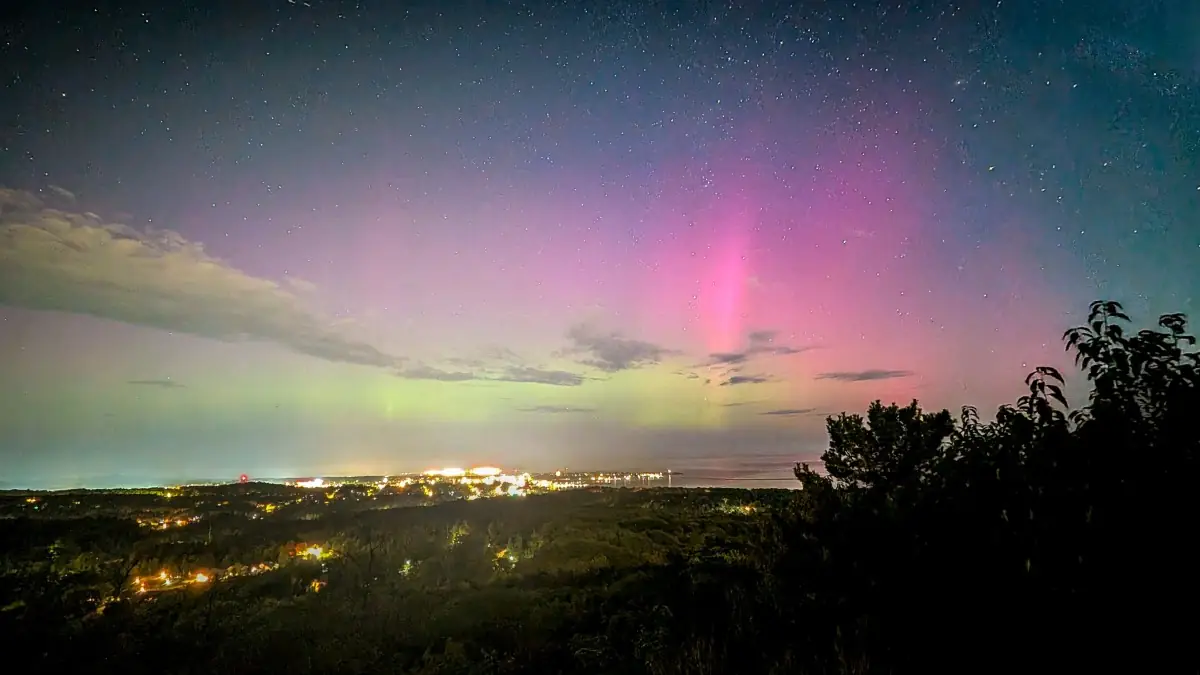
Aurora over Marquette, MI on September 1, 2025. Credit: Scott Anttila/SpaceWeather
A coronal mass ejection (CME) associated with the long-duration M2.7 solar flare on August 30 impacted Earth’s magnetosphere at 21:01 UTC on September 1. The impact caused an abrupt increase in solar wind speed to between 600 and 675 km/s and raised the total interplanetary magnetic field (Bt) to 20–26 nT.
The initial response included a G1 – Minor geomagnetic storm onset at 21:08 UTC, followed by G2 – Moderate geomagnetic storming at 22:41 UTC, according to NOAA’s Space Weather Prediction Center (SWPC).


Despite unfavorable magnetic orientation in the CME’s structure, which limited equatorward auroral penetration, auroras were still reported in mid-latitudes. Purple auroral pillars were seen as far south as Barker, New York, according to space weather physicist Dr. Tamitha Skov.
“Although the poor magnetic orientation of this solar storm has kept most aurora shows at higher latitudes, there have been some nice substorm brightenings,” she said.
WOW pic.twitter.com/xuVWWbjLWF
— James Pettus (@PettusWX) September 2, 2025
The northern lights are out in Grand Bend, Ontario. #Aurora #Auroraborealis #northernlights pic.twitter.com/oQxbkkgvsk
— Jamie (@PhotoChaserJ) September 2, 2025
Forecasts from SWPC indicate continued G1–G2 storming throughout September 2, transitioning to unsettled to active conditions on September 3 as the influence of the CME wanes. By September 4, primarily quiet geomagnetic conditions are expected, with only isolated unsettled periods.
SWPC forecasters estimate a 60% chance of M-class solar flares and a 20% chance of X-class flares on September 2 and 3, decreasing to 55% and 15%, respectively, on September 4.

Teo Blašković founded The Watchers in 2011 and edited it until 2026, covering seismic and volcanic activity, extreme weather, space weather and near-Earth objects. Articles on this page are his archive.
Earlier reporting
Nothing on Watchers was published in the last 24 hours. These are older articles.
- On October 22, 2017, a single flash of lightning stretched 515 miles from eastern Texas to near Kansas City, a distance that takes eight hours to drive, and nobody realized how far it had gone until scientists went back through the satellite data years later Epicenter
- CPC posts a slight risk of heavy rain from the Gulf Coast to the Northeast urban corridor November 25-29, and a moderate risk of West Coast wind and Sierra snow on November 25
- Florida's east coast faces a moderate flash flood risk Wednesday through Friday, with 4 to 8 inches of rain forecast and the St. Johns River near Cocoa already in major flood at 17.13 feet
- Cyclone Akvan to make landfall between Nellore and Visakhapatnam around noon on November 20, IMD forecasts 120-130 km/h winds gusting to 145
